National Pension Fund Approves Candidates for KT&G Leadership

Business by 2FIRSTS.ai
Mar.25.2024
National Pension Fund Approves Candidates for KT&G Leadership
Korean National Pension Fund approves Fang Qingwan as KT&G CEO candidate, supports Sun Donghwan as external director candidate.

According to South Korean media Naver, on March 22, the South Korean National Pension Fund, one of the three major shareholders of the tobacco manufacturer KT&G, has approved the appointment of Fang Qingwan as a candidate for the president of KT&G. The Trust Responsibility Professional Committee of the National Pension Fund decided to approve the nomination of Mr. Fang as the president candidate at a meeting on the 21st.


The National Pension Fund holds approximately 6.2% of KT&G's shares, further increasing the likelihood of Chang Won as the new CEO of KT&G. Simultaneously, the National Pension Fund has also decided to support the election of Professor Sun Dong-hwan as an external director candidate.


In the recent KT&G shareholders meeting, a new "cumulative voting system" was introduced, allowing each shareholder to freely cast 2 votes per share. The National Pension Fund plans to cast one vote for candidate Bang Gwang-wan and one vote for candidate Son Dong-hwan.


Professor Sun Donghuan has been nominated as an external director candidate by corporate bank and activist fund Flashlight Capital Partners (FCP), in an effort to counter the CEO nomination of Fang Qingwan. He is currently competing against Lin Minki, an external director candidate recommended by the KT&G board.


We welcome news tips, article submissions, interview requests, or comments on this piece.

Please contact us at info@2firsts.com, or reach out to Alan Zhao, CEO of 2Firsts, on LinkedIn


Notice

1.  This article is intended solely for professional research purposes related to industry, technology, and policy. Any references to brands or products are made purely for objective description and do not constitute any form of endorsement, recommendation, or promotion by 2Firsts.

2.  The use of nicotine-containing products — including, but not limited to, cigarettes, e-cigarettes, nicotine pouchand heated tobacco products — carries significant health risks. Users are responsible for complying with all applicable laws and regulations in their respective jurisdictions.

3.  This article is not intended to serve as the basis for any investment decisions or financial advice. 2Firsts assumes no direct or indirect liability for any inaccuracies or errors in the content.

4.  Access to this article is strictly prohibited for individuals below the legal age in their jurisdiction.


Copyright


This article is either an original work created by 2Firsts or a reproduction from third-party sources with proper attribution. All copyrights and usage rights belong to 2Firsts or the original content provider. Unauthorized reproduction, distribution, or any other form of unauthorized use by any individual or organization is strictly prohibited. Violators will be held legally accountable.

For copyright-related inquiries, please contact: info@2firsts.com


AI Assistance Disclaimer


This article may have been enhanced using AI tools to improve translation and editorial efficiency. However, due to technical limitations, inaccuracies may occur. Readers are encouraged to refer to the cited sources for the most accurate information.

We welcome any corrections or feedback. Please contact us at: info@2firsts.com

China Tobacco Hubei explores staged nicotine pouch delivery, using dynamic membranes to slow early release and gradient particles to sustain later delivery
China Tobacco Hubei Industrial Co., Ltd. disclosed several oral nicotine-related patent applications in August 2026, including two that approach staged nicotine release from different directions. One uses a high-viscosity membrane that forms inside the pouch after contact with saliva to slow rapid early release, while the other uses gradient particles with a faster-disintegrating outer layer and a slower core to create a fast-to-sustained release profile. Together, the filings explore how nicotine pouches could balance initial delivery with release later in use.
Sep.03
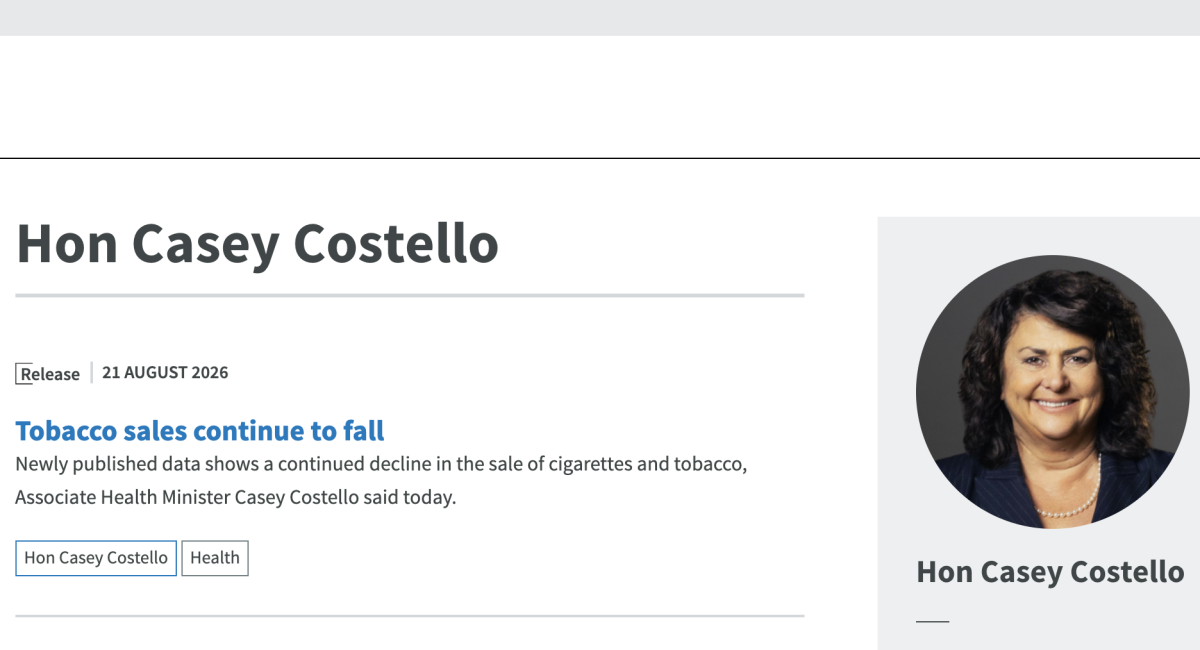
New Zealand Associate Health Minister Casey Costello Warns on Illicit Cigarettes as Legal Tobacco Sales Halve Over Decade
New Zealand Associate Health Minister Casey Costello said legal tobacco sales in the country have fallen by more than half over the past decade, with sales declining more than 20% in 2025 compared with the previous year. She warned that the decline may not fully reflect lower smoking rates, as increased availability of illicit cigarettes could also be contributing. The government said it would continue strengthening tobacco and vape retail enforcement while monitoring the impact of illicit tobacco on public health and tax revenue.
Aug.26
EU Trade Department Faces Scrutiny Over Contacts With Tobacco Industry
European Ombudswoman Teresa Anjinho has opened an inquiry into how the European Commission’s Directorate-General for Trade handles interactions with the tobacco industry. The case follows a complaint from a civil society organisation that alleges regular, unnecessary and non-transparent contacts between DG TRADE and tobacco industry representatives, raising questions over compliance with the EU’s obligations under the WHO Framework Convention on Tobacco Control. The inquiry remains ongoing, and the Ombudswoman has not reached any finding of maladministration.
Aug.24
Australian Coalition Unveils Illicit Tobacco Plan With 80% Excise Cut and Legal, Taxed Vapes and Nicotine Pouches
Australia’s Coalition has unveiled a national illicit-tobacco policy that would cut tobacco excise by 80% and create legal, regulated and taxed adult markets for vaping products and nicotine pouches if it wins government. The plan proposes an excise of A$0.50 per millilitre of e-liquid and A$0.025 per milligram of nicotine in pouches, alongside A$200 million in additional enforcement and a A$60 million three-year public-awareness campaign. The Coalition says the package would narrow the price advantage of illicit products and undermine organised crime, while Labor and public-health groups warn that dramatically cheaper cigarettes could reverse long-term declines in smoking.
Sep.03
UK-Listed Consumer Goods Group Supreme Sees Vape Duty as Potential Consolidation Opportunity, Holds FY27 Outlook
UK-listed consumer goods group Supreme plc says it continues to expect FY27 trading to meet market expectations as the Vaping Products Duty takes effect on October 1, while maintaining a comparatively positive view of the new tax and compliance regime. Supreme has said the framework could increase compliance complexity for smaller operators and contribute to market consolidation, while its manufacturing, compliance and distribution scale may allow it to gain share. Its 88Vape brand will retain its value positioning.
Sep.18
BAT New Categories Revenue Rises 18% in H1 2026 as Broad Portfolio Offers More Ways to Win—and Lose
British American Tobacco’s New Category revenue rose 18% at constant rates in the first half of 2026. Nicotine-pouch brand Velo expanded rapidly, while Vuse recovered as U.S. enforcement against illicit e-vapor products strengthened. Heated-tobacco platform glo remained under pressure, and cigarettes continued to provide most of the group’s profit and cash. Compared with PMI and JT, BAT has more routes to growth—but also greater regulatory, investment and execution risks across its broader portfolio.
BAT
Jul.30