New York Cracks Down on Disposable Flavored E-Cigarette Sales

Nov.08.2024
New York Cracks Down on Disposable Flavored E-Cigarette Sales
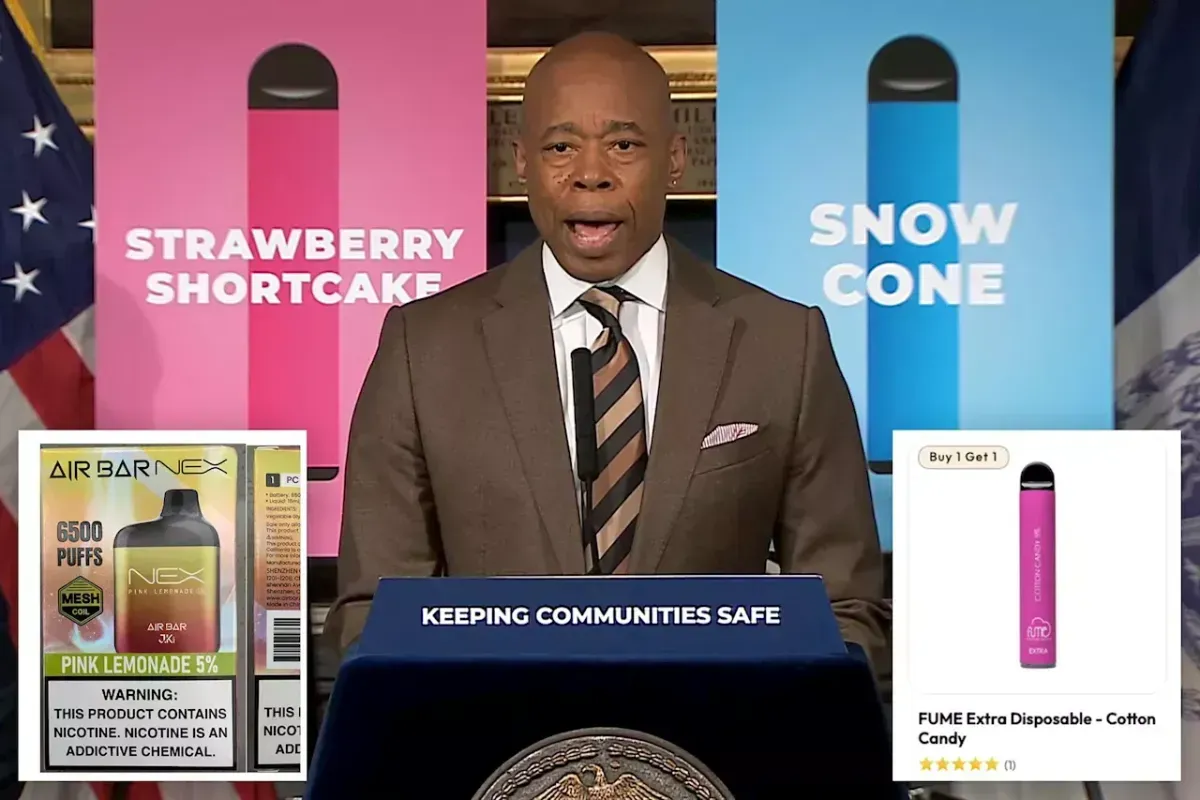
NYC Mayor Eric Adams filed a lawsuit against Price Point Distributors for selling flavored e-cigarettes, aiming to stop sales and seek compensation.

According to a report by the New York Post on November 7th, New York City Mayor Eric Adams announced on Thursday (7th) that the city is suing a distributor of disposable flavored e-cigarettes. The lawsuit is targeting Price Point Distributors, based in Long Island, with the aim of preventing further sales and seeking unspecified economic damages and penalties.


The Adams administration stated that: "Price Point has been pushing nicotine on our children out of greed for too long, and today we will not be doing that anymore."


"When they continue to harm our children, we will not stand idly by. We will not tolerate this level of crime and chaos, including the illegal sale of drugs, e-cigarettes, and other illegal marijuana products."


Previously, New York City Mayor Bill de Blasio signed a law in 2020 banning the sale of flavored e-cigarette products in all five boroughs.


In July 2023, the Adams administration filed a federal lawsuit against four major distributors, and in April 2024 announced a second lawsuit against 11 e-cigarette distributors. Both cases are currently pending.


The National Youth Tobacco Survey reveals that over 2.5 million middle and high school students in the United States have used e-cigarettes in the past 30 days. A follow-up survey conducted by the organization a year later found that flavored e-cigarettes remain the "most popular product" among youth.


We welcome news tips, article submissions, interview requests, or comments on this piece.

Please contact us at info@2firsts.com, or reach out to Alan Zhao, CEO of 2Firsts, on LinkedIn


Notice

1.  This article is intended solely for professional research purposes related to industry, technology, and policy. Any references to brands or products are made purely for objective description and do not constitute any form of endorsement, recommendation, or promotion by 2Firsts.

2.  The use of nicotine-containing products — including, but not limited to, cigarettes, e-cigarettes, nicotine pouchand heated tobacco products — carries significant health risks. Users are responsible for complying with all applicable laws and regulations in their respective jurisdictions.

3.  This article is not intended to serve as the basis for any investment decisions or financial advice. 2Firsts assumes no direct or indirect liability for any inaccuracies or errors in the content.

4.  Access to this article is strictly prohibited for individuals below the legal age in their jurisdiction.


Copyright


This article is either an original work created by 2Firsts or a reproduction from third-party sources with proper attribution. All copyrights and usage rights belong to 2Firsts or the original content provider. Unauthorized reproduction, distribution, or any other form of unauthorized use by any individual or organization is strictly prohibited. Violators will be held legally accountable.

For copyright-related inquiries, please contact: info@2firsts.com


AI Assistance Disclaimer


This article may have been enhanced using AI tools to improve translation and editorial efficiency. However, due to technical limitations, inaccuracies may occur. Readers are encouraged to refer to the cited sources for the most accurate information.

We welcome any corrections or feedback. Please contact us at: info@2firsts.com

BAT Regional Director Fred Monteiro Supports Spain’s Nicotine Rules but Opposes 0.99mg Nicotine Pouch Limit
Spanish newspaper El Confidencial interviewed Fred Monteiro, Regional Director for Americas and Europe at British American Tobacco (BAT). Monteiro said BAT supports setting regulatory limits for nicotine products but opposes Spain’s proposed 0.99mg nicotine-per-pouch limit, arguing that such a restriction could affect adult smokers’ transition to alternatives. He said nicotine regulation should be based on scientific evidence and harm reduction principles. Monteiro also said smoke-free products now account for around 25% of BAT’s Americas and Europe business and nearly 30% of its Europe business
BAT
Jul.30
Reuters Tracks Big Tobacco’s Shift Beyond Cigarettes as Nicotine Pouches Vie for the Next Growth Curve
As cigarette markets face long-term pressure, major tobacco companies are increasingly turning to nicotine pouches in search of growth beyond combustible tobacco. Reuters has examined whether nicotine pouches can become the next strategic growth platform for companies including Philip Morris International, British American Tobacco and Japan Tobacco. PMI strengthened its position through the acquisition of Swedish Match and its ZYN brand, while BAT and JTI continue expanding their own nicotine pouch portfolios. The category has gained attention because of its smoke-free, device-free format, but regulation, youth-use concerns and market scale will determine whether it can become a long-term growth engine.
Regulations
Aug.18 by 2Firsts Perspectives
Australia’s Daily Smoking Rate Falls to Record Low of 5.8% as Nicotine Use Patterns Shift
According to the Australian Institute of Health and Welfare’s National Drug Strategy Household Survey, daily smoking among Australians aged 18 and over fell to a record low of 5.8% in 2025. Health Minister Mark Butler said Australia now has around 500,000 fewer daily smokers than three years ago and credited the government’s vaping reforms as part of broader progress. Among people aged 14 and over, daily smoking declined from 8.3% in 2022-23 to 5.6% in 2025. Daily vaping rates stabilised at 3.6%, while the government also moved to further restrict access to nicotine pouches through unapproved therapeutic import pathways.
Jul.21
U.S. FDA: Youth E-Cigarette Prevention Campaign Prevented About 444,000 Initiations and Reduced Illegal Vape Sales
The U.S. Food and Drug Administration (FDA) said its youth e-cigarette prevention campaign, “The Real Cost,” prevented about 444,000 U.S. youth from starting e-cigarette use between 2023 and 2024 and blocked more than $42 million in unauthorized e-cigarette sales that would have been used by youth.
Market
Jun.25
Science | International Experts Propose a New Smoking Cessation Pathway, Citing Higher Quit Rates With E-Cigarettes Than Nicotine Replacement Therapy
A new expert paper in JAMA urges U.S. clinicians to include nicotine e-cigarettes in smoking-cessation discussions, citing higher quit rates than nicotine replacement therapy. It also stresses that products must deliver enough nicotine to replace cigarettes, dual use should be brief, and complete switching is the goal. 2Firsts argues the recommendations matter beyond clinics: public-health professionals should reassess relative risk, regulators should preserve sufficient product appeal for adult smokers, and manufacturers should focus on helping users quit cigarettes more sustainably.
SCIENCE
Aug.03 by 2Firsts Perspectives
From Nicotine Salts to Cocrystals: China’s Shenzhen Huabao institute explores a more stable form for sustained nicotine release
China-based Shenzhen Huabao Collaborative Innovation Technology Research Institute Co., Ltd. has filed a patent application for a nicotine-ascorbic acid cocrystal, exploring a new solid-state form of nicotine. The patent proposes applications across e-liquids, heated tobacco sticks, oral tobacco, chewing tobacco and snuff. In nicotine pouch tests disclosed in the filing, cocrystal formulations showed less than a 6% decline in nicotine content after three months of accelerated storage and a release profile combining early-stage release with sustained delivery over 60 minutes. The filing reflects exploration of nicotine forms beyond conventional nicotine base and nicotine salts.
Aug.13