New York State Legislature Considers Ban on Flavored Nicotine Pouches

Feb.12.2025
New York State Legislature Considers Ban on Flavored Nicotine Pouches
New York State Legislature is considering a ban on flavored nicotine pouches to curb underage tobacco use.

According to a report by Timesunion on February 11, the New York State Legislature is considering passing a bill to ban the sale of flavored nicotine pouches in the state. The ban is based on the belief that fruit and candy flavored products are a marketing tactic aimed at minors.


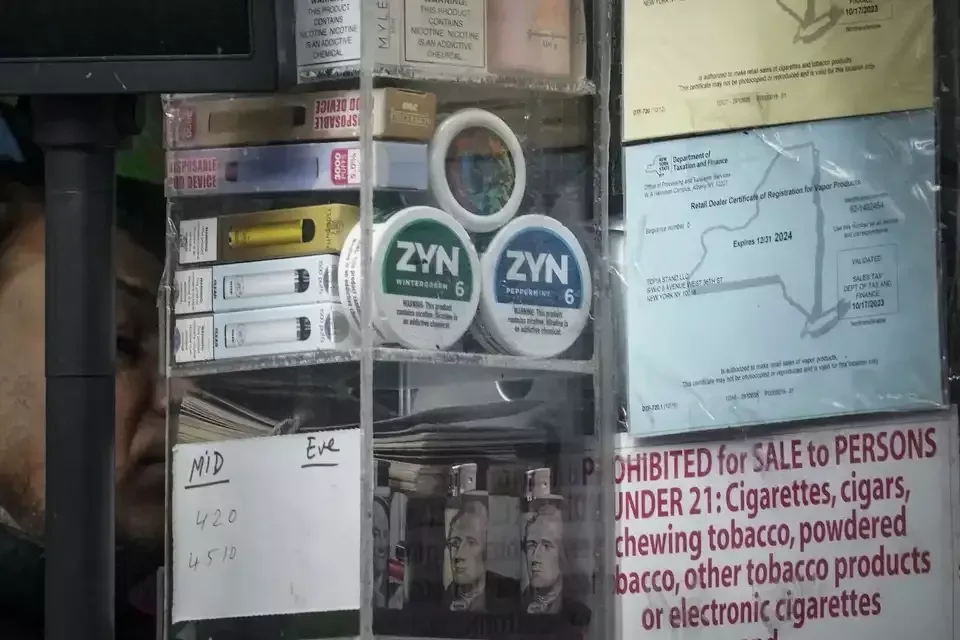
Congresswoman Linda Rosenthal has expressed concerns about the nicotine pouch brand ZYN, which offers flavors such as mint, citrus, and coffee. She pointed out that with flavored e-cigarettes becoming harder to find in New York, minors may turn to nicotine pouches.


Brian Erkkila, the Chief Scientific Officer of Swedish Match, stated that the main customer base of ZYN is not new nicotine users, but rather adults who are transitioning to safer products.


However, some experts believe that a comprehensive ban on the product may backfire. Raymond Niaura, a professor at New York University, stated that data shows the proportion of teenagers using the product is still very low, and he believes a ban is an "overreaction." Alan Mathios, a professor at Cornell University, also warned that a ban on flavored nicotine pouches could lead to the emergence of an illegal market, making it easier for teenagers to access such products.


On January 17, the U.S. FDA approved marketing authorization for 20 ZYN brand nicotine pouch products. This marks a significant milestone for the FDA in regulating novel tobacco products.


We welcome news tips, article submissions, interview requests, or comments on this piece.

Please contact us at info@2firsts.com, or reach out to Alan Zhao, CEO of 2Firsts, on LinkedIn


Notice

1.  This article is intended solely for professional research purposes related to industry, technology, and policy. Any references to brands or products are made purely for objective description and do not constitute any form of endorsement, recommendation, or promotion by 2Firsts.

2.  The use of nicotine-containing products — including, but not limited to, cigarettes, e-cigarettes, nicotine pouchand heated tobacco products — carries significant health risks. Users are responsible for complying with all applicable laws and regulations in their respective jurisdictions.

3.  This article is not intended to serve as the basis for any investment decisions or financial advice. 2Firsts assumes no direct or indirect liability for any inaccuracies or errors in the content.

4.  Access to this article is strictly prohibited for individuals below the legal age in their jurisdiction.


Copyright


This article is either an original work created by 2Firsts or a reproduction from third-party sources with proper attribution. All copyrights and usage rights belong to 2Firsts or the original content provider. Unauthorized reproduction, distribution, or any other form of unauthorized use by any individual or organization is strictly prohibited. Violators will be held legally accountable.

For copyright-related inquiries, please contact: info@2firsts.com


AI Assistance Disclaimer


This article may have been enhanced using AI tools to improve translation and editorial efficiency. However, due to technical limitations, inaccuracies may occur. Readers are encouraged to refer to the cited sources for the most accurate information.

We welcome any corrections or feedback. Please contact us at: info@2firsts.com

The Volume Illusion: Measuring the Future of Nicotine with the Tools of the Past
As next-generation nicotine products become economically central rather than marginal, traditional volume-based metrics are increasingly unable to explain consumption, risk, and value. Units designed for a cigarette-based economy struggle to describe systems defined by delivery speed, pharmacokinetics, and adaptive user behavior. Drawing on financial reporting, regulation, and nicotine science, a fundamental question: can the future of nicotine still be measured using the tools of its past?
Feb.09 by Alan Zhao | 2Firsts Perspectives
Malaysian Sabah GOF seizes e-cigarettes, vapes and e-liquids worth over  USD 156,333 in seven-district operation
Malaysian Sabah GOF seizes e-cigarettes, vapes and e-liquids worth over USD 156,333 in seven-district operation
In Sabah, Malaysia’s General Operations Force (GOF) seized thousands of e-cigarette devices, vapes and e-liquids worth more than RM635,000 and detained 23 people during a simultaneous integrated operation across seven districts.
Jan.19 by 2FIRSTS.ai
Russian consumer group urges Kremlin administration to reject regional vape sales bans
A Russian consumer organization has urged the Presidential Administration to block proposals that would let regions ban ENDS and e-liquid sales, warning it would create fragmented regulation and turbocharge the illicit market. The group cites WHO statistics and overseas experiences to argue for a more targeted regulatory model.
Feb.06 by 2FIRSTS.ai
California federal judge certifies direct purchaser class in Juul–Altria antitrust litigation
A California federal judge has certified a class of direct purchasers of Juul products in antitrust litigation alleging Juul and Altria conspired to have Altria exit the e-cigarette market.
Mar.02 by 2FIRSTS.ai
Puerto Rico House Files P.C. 1070 to Ban Flavored Vaping Product Sales to Under-21s
According to a statement from the Puerto Rico House of Representatives, House Speaker Carlos Méndez and Rep. Pedro Julio Santiago announced the filing of House Bill 1070 (P.C. 1070), which would prohibit sales to people under 21 of vaping devices, liquids, or cartridges featuring a flavor and/or aroma other than nicotine.
Jan.29 by 2FIRSTS.ai
Proposed vaping duty in Jersey: £467,000 forecast for 2026 as it takes effect in the second half of the year
Jersey is proposing a vaping duty. The Treasury Minister said the duty is forecast to raise £467,000 in 2026 because it will take effect in the second half of the year, and £955,000 per year from 2027 to 2029. Implementation is estimated to cost around £400,000 over four years, with an initial cost of £145,000 in 2026. The policy is described as aiming to reduce nicotine consumption and improve public health, while avoiding a shift to smoking.
Feb.26 by 2FIRSTS.ai