Key Takeaways
- A federal judge ruled that Puff Bar and other flavored vape companies cannot escape New York’s lawsuit.
- The court said New York adequately alleged that the companies misrepresented flavored e-cigarettes as generally safe and not harmful to health.
- Core claims remain, including repeated and persistent violations of state and federal law, public nuisance, and gross negligence.
- New York Attorney General Letitia James filed the nearly 200-page complaint in February 2025.
- The complaint says the companies manufactured and distributed flavored disposable vapes that are illegal to sell at retail in New York.
2Firsts, April 7, 2026
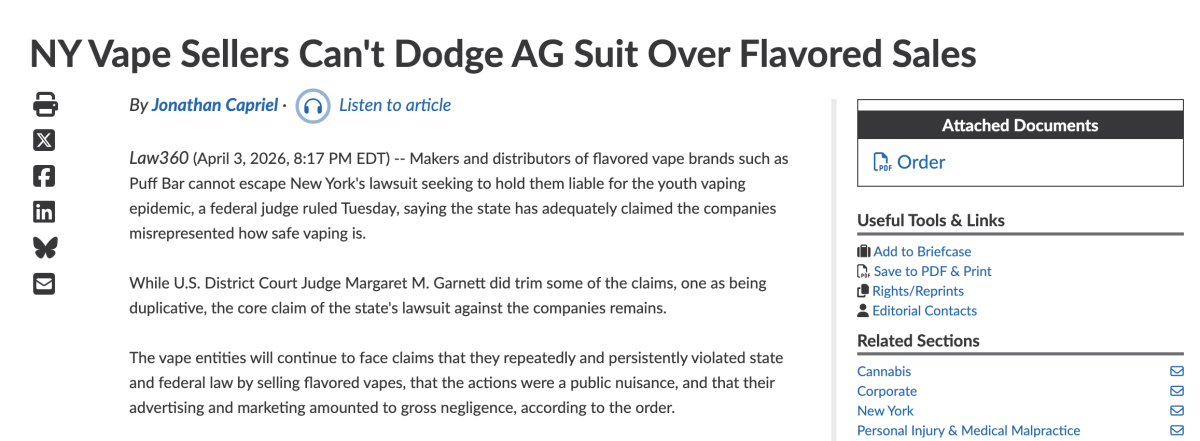
According to Law360, U.S. District Court Judge Margaret M. Garnett ruled that makers and distributors of flavored vape brands such as Puff Bar cannot escape New York’s lawsuit seeking to hold them liable for the youth vaping epidemic.
Court says New York adequately alleged that the companies misled consumers about vape safety
Judge Garnett said that although some claims were trimmed, including one that was dismissed as duplicative, the core of the state’s lawsuit remains intact.
The order said the vape companies will continue to face claims that they repeatedly and persistently violated state and federal law by selling flavored vapes, that their conduct constituted a public nuisance, and that their advertising and marketing amounted to gross negligence.
Margaret M. Garnett said New York alleges that each defendant misrepresented flavored e-cigarettes as “generally safe” and “not harmful to a user’s health.” She said those statements are clearly misleading when compared with the state’s allegations that e-cigarette use increases the risk of respiratory health issues, poor cardiovascular health, development of psychiatric disorders and cognitive impairment later in life, and interference with cognitive development.
New York says the companies sold illegal flavored vapes and violated the federal PACT Act
New York Attorney General Letitia James accused a network of e-cigarette companies of systematically violating state and federal law. The nearly 200-page complaint, filed in February 2025, names Puff Bar, Demand Vape, Mi-One, and Price Point among the defendants.
The complaint says these companies manufactured and distributed flavored disposable vapes that are illegal to sell at retail in New York. It also alleges that the companies not only ignored New York’s flavored vape ban but also shipped products directly to customers in violation of the federal PACT Act.
The state says the companies targeted youth through store placement and social media marketing
Letitia James said her office found that the companies made the products available within walking distance of schools and used social media and celebrity influencers to persuade young people to purchase them.
The complaint also says the companies have long been aware that their products pose health risks, especially to youth, but continued to market and sell them despite New York’s 2020 prohibition on flavored vape products and existing U.S. Food and Drug Administration policies.
New York further alleges that none of the companies received FDA approval to sell the flavored products and that they ignored FDA warning letters telling them to stop selling them.
Image source: Law360
We welcome news tips, article submissions, interview requests, or comments on this piece.
Please contact us at info@2firsts.com, or reach out to Alan Zhao, CEO of 2Firsts, on LinkedIn
Notice
1. This article is intended solely for professional research purposes related to industry, technology, and policy. Any references to brands or products are made purely for objective description and do not constitute any form of endorsement, recommendation, or promotion by 2Firsts.
2. The use of nicotine-containing products — including, but not limited to, cigarettes, e-cigarettes, nicotine pouchand heated tobacco products — carries significant health risks. Users are responsible for complying with all applicable laws and regulations in their respective jurisdictions.
3. This article is not intended to serve as the basis for any investment decisions or financial advice. 2Firsts assumes no direct or indirect liability for any inaccuracies or errors in the content.
4. Access to this article is strictly prohibited for individuals below the legal age in their jurisdiction.
Copyright
This article is either an original work created by 2Firsts or a reproduction from third-party sources with proper attribution. All copyrights and usage rights belong to 2Firsts or the original content provider. Unauthorized reproduction, distribution, or any other form of unauthorized use by any individual or organization is strictly prohibited. Violators will be held legally accountable.
For copyright-related inquiries, please contact: info@2firsts.com
AI Assistance Disclaimer
This article may have been enhanced using AI tools to improve translation and editorial efficiency. However, due to technical limitations, inaccuracies may occur. Readers are encouraged to refer to the cited sources for the most accurate information.
We welcome any corrections or feedback. Please contact us at: info@2firsts.com