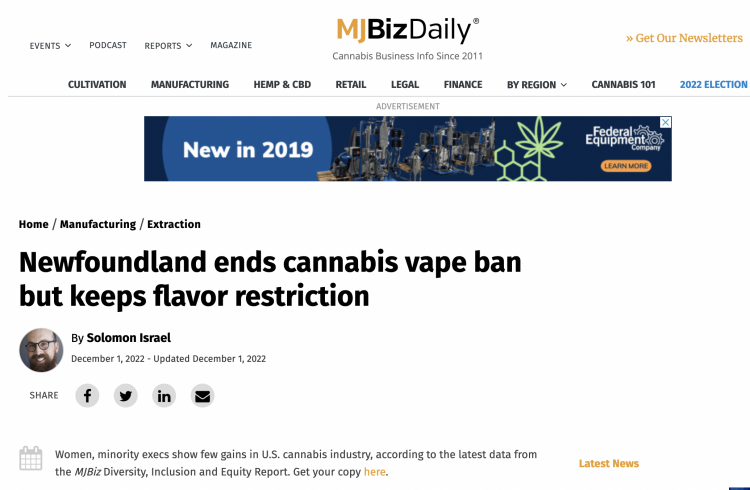
The government of Newfoundland and Labrador in Canada has lifted the ban on the sale of marijuana e-cigarette products at the end of 2019, while still enforcing restrictions on the addition of non-marijuana flavors.
The government of Newfoundland and Labrador, together with the Newfoundland and Labrador Liquor Corporation (NLC), which acts as the province's regulator and wholesaler of adult-use cannabis, has decided to introduce electronic vaping products to the market after reviewing the cannabis industry in Newfoundland, according to the Chief Marketing Officer of NLC, Peter Murphy.
Murphy wrote in a statement to MJBizDaily, "Given that e-cigarettes represent an important part of the illicit market, we believe this is a positive step in continuing to take market share away from illegal operators.
Please note that the use of flavored electronic cigarettes is prohibited, except for natural flavors and terpenes related to cannabis, in order to limit their appeal to young people.
This change has opened up a new but limited market for e-cigarettes: In September, Newfoundland was the second-smallest cannabis market among Canada's 10 provinces, with regulated recreational cannabis sales worth CAD 5.7 million (USD 4.2 million), accounting for approximately 1.5% of Canada's cannabis sales.
Pierre Killeen, Vice President of Legislative and Regulatory Affairs for Canadian Cannabis Council (C3), an industry organization based in Ontario, stated that the Newfoundland government "should be commended for its decision to provide legal, tested, and controlled cannabis e-cigarette products.
This is in line with the public policy objective of legalization, including protecting public health and safety by eliminating illegal markets," he added.
Killeen commented on the restrictions placed by Newfoundland on the addition of marijuana flavored e-cigarettes.
Only time will tell the public policy and market impacts of this decision. Let us have faith and observe how it will play out.
In Canada, following the implementation of new regulations, legal electronic cigarettes and other marijuana-derived products, such as edibles and concentrates, began to hit the market at the end of 2019.
This release comes after a serious public health crisis related to cannabis e-cigarettes, primarily in the United States. This situation has caught the attention of Canadian authorities.
The provinces of Newfoundland and Quebec have banned the sale of electronic cigarettes, while Alberta has slightly delayed the launch of e-cigarettes.
The Quebec government-owned leisure cannabis monopoly, Société québécoise du cannabis (SQDC), still does not sell electronic cigarettes.
Authorities have imposed additional restrictions on the consumption of marijuana and concentrated cannabis in the province, which has a more valuable market than Newfoundland. In September, recreational marijuana sales amounted to $49.7 million.
Killeen from C3 stated that Quebec can learn from experience and lessons on marijuana and e-cigarette products from other provinces and federal partners. By providing access to legalized and regulated marijuana and e-cigarette products, it can achieve the goal of harm reduction.
2FIRSTS will continue to cover this topic, and updates will be available on the "2FIRSTS APP." Scan the QR code below to download the app.
Disclaimer
This article is provided solely for professional research, industry discussion, and informational purposes. Any references to brands, companies, products, technologies, or policies are made for factual reporting and analytical purposes only, and do not constitute endorsement, recommendation, promotion, or advertising by 2Firsts.
Nicotine-containing products, including but not limited to cigarettes, e-cigarettes, heated tobacco products, and nicotine pouches, carry significant health risks. Readers are responsible for complying with all applicable laws and regulations in their respective jurisdictions, including age restrictions and access limitations.
The information contained in this article should not be regarded as investment, legal, medical, regulatory, or commercial advice. While 2Firsts strives to ensure the accuracy and reliability of its content, it does not assume liability for any direct or indirect loss arising from errors, omissions, inaccuracies, or reliance on the information contained herein.
This article is not intended for individuals below the legal age for accessing tobacco or nicotine-related information in their jurisdiction.
Copyright Notice
This article is either original content produced by 2Firsts or content reproduced, translated, summarized, or adapted from third-party sources with attribution where applicable. The intellectual property rights of the original content remain with 2Firsts or the respective original rights holders.
No individual or organization may copy, reproduce, distribute, republish, modify, translate, or otherwise use this content without prior authorization. Any unauthorized use may result in legal action.
For copyright-related inquiries, corrections, or removal requests, please contact: info@2firsts.com.
AI-Assisted Translation and Editing Notice
Portions of this article may have been translated, edited, or reviewed with the assistance of artificial intelligence tools to improve efficiency and readability. Due to the limitations of AI-assisted translation and editing, discrepancies, omissions, or inaccuracies may exist when compared with the original source.
Where applicable, readers are advised to refer to the original source for the most complete and accurate information. If you identify any errors or believe that any content infringes upon your rights, please contact us at info@2firsts.com, and we will review and address the matter promptly.