Tianjin customs cracks down on undeclared tobacco products, seizes over 20,000 heated tobacco pods

Nov.06.2024
Tianjin customs cracks down on undeclared tobacco products, seizes over 20,000 heated tobacco pods
Tianjin customs detects two travelers carrying a large amount of undeclared tobacco products, seizes over 10,000 e-cigarette pods. Customs reminds that there are restrictions on the import of tobacco products, and violations will be dealt with according to the law.

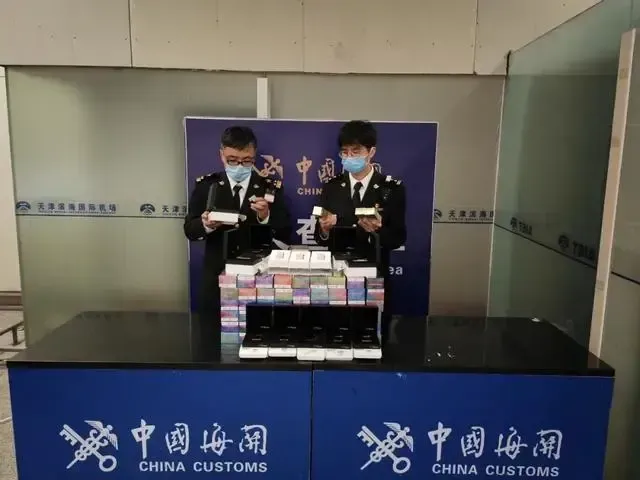
According to a report by Global Times on November 5th, the Tianjin Binhai Airport Customs found abnormal images in the X-ray scans of the luggage of two passengers during a routine inspection. Upon conducting a manual examination, it was discovered that the passengers were carrying a large quantity of undeclared items, including e-cigarette pods and lighters.

 

Tianjin customs cracks down on undeclared tobacco products, seizes over 20,000 heated tobacco pods
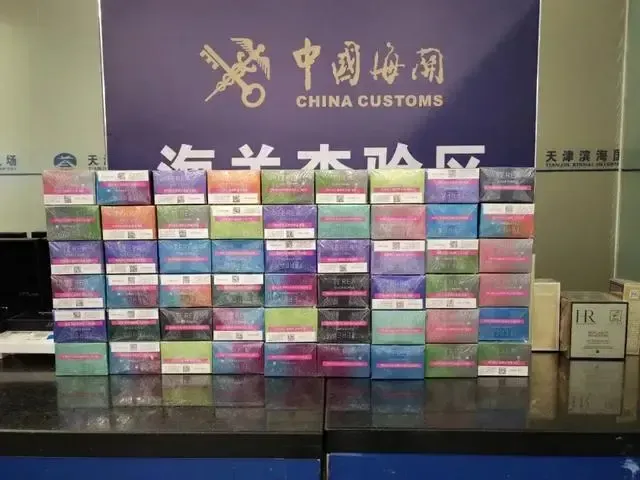
Tianjin Customs seized undeclared items | Image source: Tianjin Customs official website.


After counting, customs officials seized a total of 21,000 e-cigarette pods (heat-not-burn tobacco products) and 17 lighters. The unreported items have been handed over to the customs anti-smuggling department for further processing.
 

Tianjin customs cracks down on undeclared tobacco products, seizes over 20,000 heated tobacco pods
Tianjin Customs seized undeclared e-cigarette pods | Image source: Tianjin Customs official website


Customs reminder: Tobacco products are among the items restricted from entering the country. According to current laws, travelers from or to China's Hong Kong and Macau regions, as well as mainland residents visiting these regions for private purposes, are allowed to bring in tax-free a maximum of 200 cigarettes, 50 cigars, or 250 grams of tobacco. 


For other general travelers, with the exception of short-term frequent visitors to Hong Kong and Macau, regular cross-border commuters, and residents of border areas, the tax-free allowance is up to 400 cigarettes, 100 cigars, or 500 grams of tobacco. Bringing in tobacco products exceeding these limits will result in lawful actions by customs authorities.


We welcome news tips, article submissions, interview requests, or comments on this piece.

Please contact us at info@2firsts.com, or reach out to Alan Zhao, CEO of 2Firsts, on LinkedIn


Notice

1.  This article is intended solely for professional research purposes related to industry, technology, and policy. Any references to brands or products are made purely for objective description and do not constitute any form of endorsement, recommendation, or promotion by 2Firsts.

2.  The use of nicotine-containing products — including, but not limited to, cigarettes, e-cigarettes, nicotine pouchand heated tobacco products — carries significant health risks. Users are responsible for complying with all applicable laws and regulations in their respective jurisdictions.

3.  This article is not intended to serve as the basis for any investment decisions or financial advice. 2Firsts assumes no direct or indirect liability for any inaccuracies or errors in the content.

4.  Access to this article is strictly prohibited for individuals below the legal age in their jurisdiction.


Copyright


This article is either an original work created by 2Firsts or a reproduction from third-party sources with proper attribution. All copyrights and usage rights belong to 2Firsts or the original content provider. Unauthorized reproduction, distribution, or any other form of unauthorized use by any individual or organization is strictly prohibited. Violators will be held legally accountable.

For copyright-related inquiries, please contact: info@2firsts.com


AI Assistance Disclaimer


This article may have been enhanced using AI tools to improve translation and editorial efficiency. However, due to technical limitations, inaccuracies may occur. Readers are encouraged to refer to the cited sources for the most accurate information.

We welcome any corrections or feedback. Please contact us at: info@2firsts.com

BAT’s Product Strategy Reset: A Structural Analysis of Its Post-FY2025 Competitive Architecture
Drawing on BAT’s FY2025 results and earnings call, 2Firsts finds the company shifting from category expansion to competitive entrenchment across Vapour, Modern Oral, Heated Products and Combustibles. The strategy centers on connected devices, geographic customization and portfolio tiering. While structurally coherent, financial returns depend on consistent regulatory enforcement against illicit competitors, making policy execution a key variable for 2026 performance.
Feb.12
Costa Rica’s Constitutional Court Rejects Challenge, New Vape Rules to Take Effect on August 6
Costa Rica’s Constitutional Court has rejected an injunction seeking to stop a new vape regulation from taking effect, ruling that there was no specific harm to constitutional rights. As a result, Technical Regulation RTCR 519-2025, promoted by the Health Ministry, will enter into force on August 6 as originally planned.
Mar.20 by 2FIRSTS.ai
Exclusive|Logistics Operators Warn of Possible New U.S. Border Crackdown on Illicit Vapes
Recent inspections and cargo disruption have led some logistics operators in the China-U.S. vape trade to see early signs of another U.S. border crackdown on illicit e-cigarettes. With late April to early May viewed as a key risk window, the market is watching closely. The bigger question is not only whether enforcement will tighten, but whether it can be sustained.
Special Report
Apr.09
Small ENDS Manufacturers Press FDA on Abuse Liability Standards as Agency Defines Pharmacological Review Framework
At the third session of its PMTA roundtable, the FDA outlined its framework for assessing abuse liability in ENDS products, emphasizing the role of nicotine pharmacokinetics and product-specific data in APPH determinations. Small manufacturers questioned the high cost of clinical PK studies and the absence of defined numeric thresholds, while raising bridging strategies and PBPK modeling as potential alternatives.
Feb.11
Michigan Proposes 57% Vape Tax in $800M Revenue Plan
Michigan Governor Gretchen Whitmer’s FY2027 executive budget proposes a new 57% wholesale tax on vaping products and oral nicotine items as part of a broader $800 million revenue package aimed at stabilizing Medicaid funding.
Regulations
Feb.23
Special Report|Reynolds’ 337 Patent Case Ends, but a Harsher 337 Compliance Battle Now Targets the Entire Vape Supply Chain
The U.S. International Trade Commission (ITC) has terminated Investigation 337-TA-1410 after invalidating key vape patent claims asserted by R.J. Reynolds Vapor Company, removing the immediate risk of import bans for dozens of companies. However, a new case—337-TA-1486—has already opened a more consequential legal front, shifting the focus from patent disputes to regulatory compliance across the vape supply chain, including PACT Act reporting, tax compliance, and FDA marketing authorization.
BAT
Mar.11