PhaseComm and ZERO Sign Business Cooperation Agreement to Create Unmanned Tobacco Shop

Business by 2FIRSTS.ai
Jan.31.2024
PhaseComm and ZERO Sign Business Cooperation Agreement to Create Unmanned Tobacco Shop
PhaseComm and ZERO e-cigarette have signed a collaboration agreement to create unmanned cigarette shops in South Korea.

According to a report by South Korean media news.naver on January 30th, intelligent solutions company PhaseComm and domestic e-cigarette specialist company ZERO e-cigarette have recently signed a business cooperation agreement to jointly create unmanned tobacco shops.


PhaseComm has obtained sales permission for its intelligent automated cigarette vending machine after successfully undergoing sandbox testing by the South Korean Ministry of Trade, Industry, and Energy. This innovative solution enables distributors to conduct face-to-face identity authentication through mobile identification cards or Kakao Pay mobile payment QR codes, thus enabling automated sales of alcohol and tobacco products. Currently, ZERO e-cigarette is aggressively expanding its unmanned retail outlets using this technology.


The representative of PhaseComm stated, "With the signing of this MOU, we will be introducing PhaseComm's proprietary unmanned store solution, which will provide online inventory and sales management services. Additionally, we will enhance user convenience through secure identity verification services (adult authentication) and strive to lead the emerging market of e-liquid unmanned stores."


Cui Jinyong, the representative of ZERO e-cigarette, recently expressed plans to establish unmanned stores aimed at creating a small-scale entrepreneurial model for e-liquid e-cigarette shops. He stated that they intend to significantly reduce the costs of e-cigarette entrepreneurship, enhance convenience, and create new market opportunities.


In addition, PhaseComm has also introduced another service, namely an advertisement service platform that plays ads on the standby screens of tobacco vending machines. Businesses are expected to gain additional revenue through this innovative advertising service platform.


We welcome news tips, article submissions, interview requests, or comments on this piece.

Please contact us at info@2firsts.com, or reach out to Alan Zhao, CEO of 2Firsts, on LinkedIn


Notice

1.  This article is intended solely for professional research purposes related to industry, technology, and policy. Any references to brands or products are made purely for objective description and do not constitute any form of endorsement, recommendation, or promotion by 2Firsts.

2.  The use of nicotine-containing products — including, but not limited to, cigarettes, e-cigarettes, nicotine pouchand heated tobacco products — carries significant health risks. Users are responsible for complying with all applicable laws and regulations in their respective jurisdictions.

3.  This article is not intended to serve as the basis for any investment decisions or financial advice. 2Firsts assumes no direct or indirect liability for any inaccuracies or errors in the content.

4.  Access to this article is strictly prohibited for individuals below the legal age in their jurisdiction.


Copyright


This article is either an original work created by 2Firsts or a reproduction from third-party sources with proper attribution. All copyrights and usage rights belong to 2Firsts or the original content provider. Unauthorized reproduction, distribution, or any other form of unauthorized use by any individual or organization is strictly prohibited. Violators will be held legally accountable.

For copyright-related inquiries, please contact: info@2firsts.com


AI Assistance Disclaimer


This article may have been enhanced using AI tools to improve translation and editorial efficiency. However, due to technical limitations, inaccuracies may occur. Readers are encouraged to refer to the cited sources for the most accurate information.

We welcome any corrections or feedback. Please contact us at: info@2firsts.com

German Tobacco Tax Revenue Falls 10.8% Through August as Tax-Paid Cigarette Volume Drops 12.6%
Germany collected €9.789 billion in total tobacco tax revenue from January through August 2026, down 10.8% from a year earlier, according to the Federal Ministry of Finance. Germany's tobacco tax base covers not only cigarettes and fine-cut tobacco but also heated tobacco and vaping liquids taxed as tobacco substitutes. The German Association of the Tobacco Industry and Novel Products, or BVTE, citing federal statistical data, said tax-paid cigarette volume fell 12.6% to 40.6 billion sticks. BVTE is using the latest figures to argue against further tax increases planned from 2027 through 2030, while Germany's parliament is scheduled to hold a first reading of the bill on September 24.
Sep.23
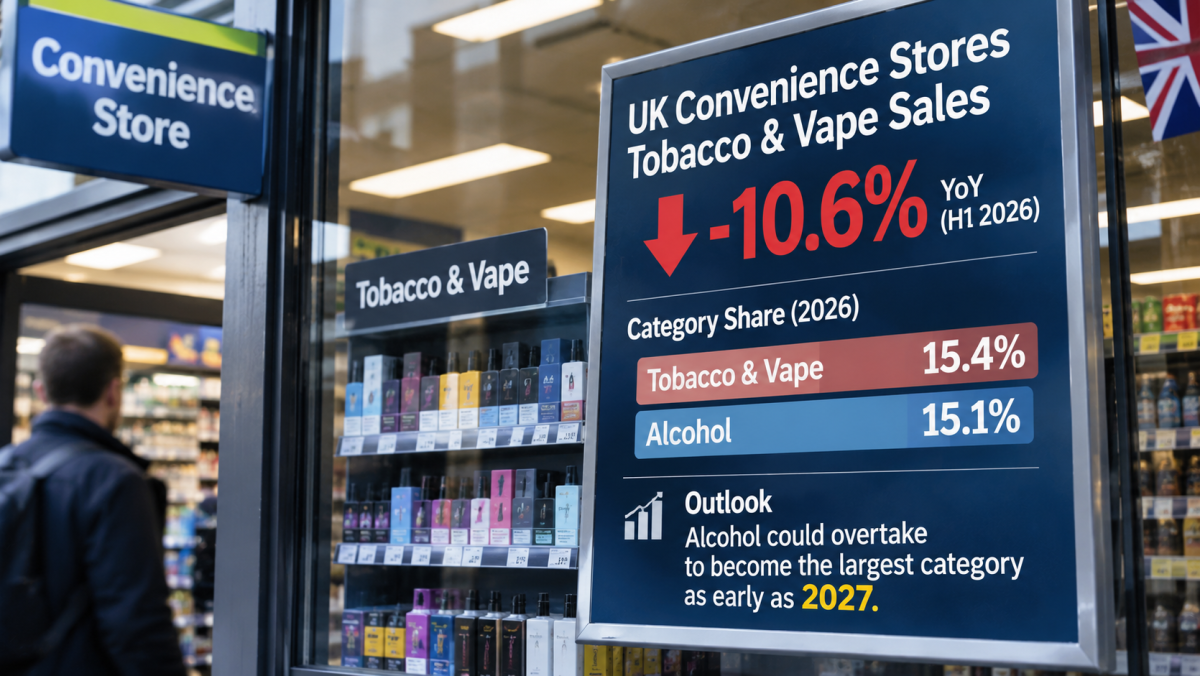
DATA|UK Retail Research Group IGD Says Convenience Tobacco and Vape Sales Fell 10.6%, With 15.4% Market Share Versus Alcohol's 15.1%; Top Rank at Risk in 2027
Combined tobacco and vaping sales in UK convenience stores fell 10.6% year over year in the first half of 2026, making the category a major drag on channel performance, according to retail research organization IGD. Total convenience sales declined 1.2%, while sales excluding tobacco and vaping increased 0.7%. IGD's 2026 category-share figures show tobacco and vaping accounting for 15.4% of convenience sales, compared with 15.1% for alcohol. The organization forecasts alcohol could overtake tobacco and vaping as the largest category by sales value as early as 2027 if current trends continue. IGD expects the convenience market to increase from £48.6 billion in 2026 to £54.9 billion in 2031, a 2.5% compound annual growth rate, or 3.4% excluding tobacco and vaping.
DATA
Nov.11
Special Report | From Oversupply to Supply Gaps: Global Tobacco Leaf Markets Diverge Ahead of 2027
Global tobacco leaf markets diverged sharply in 2026, with India cutting authorised FCV production amid oversupply while Malawi faced a supply shortfall. U.S. demand improved in some leaf categories, but growers in Brazil, Colombia, Tanzania and Zimbabwe faced pressure from prices, buyer access, costs and weather. With nicotine consumption patterns also shifting, 2027 will test whether supply, demand and grower profitability can move back toward balance.
Oct.26
Special Report | How Capital Is Reassessing the Global Tobacco and Modern Nicotine Industry: Lessons from a New York Forum
Capital is reassessing the global tobacco and modern nicotine industry as heated tobacco, vaping and nicotine pouches reshape demand, profitability and regulation. At the 2026 New Approaches Summit in New York, investors and analysts examined whether smoke-free growth can sustain earnings, how regulation shapes startup value, and whether shareholder engagement can be more effective than divestment. The debate points to a broader shift: tobacco transition is increasingly becoming a capital-allocation, governance and valuation question.
Capital Markets
Oct.05
South Korea Imports 12,126 Kg of Nicotine Analogues From April to August After Bringing Synthetic Nicotine Under Tobacco Law
South Korea's liquid-vape market is showing changes across raw-material imports, product types and sales channels after synthetic nicotine came under the Tobacco Business Act on April 24. Customs data show nicotine-analogue imports totaled 12,126 kilograms from April through August, while synthetic-nicotine imports over the same five months totaled 231,663 kilograms, just 39.3% of the amount imported in March alone. Physical liquid-vape stores tracked in Seoul and Gyeonggi Province fell 9.9%, unmanned outlets edged higher and online sales listings increased from 27,774 to 42,437. Government testing of 105 liquid inhalation products promoted as nicotine-free separately found nicotine in 13 and 6-methylnicotine in 12.
Sep.22
2Firsts First Look|China to End VAT Export Rebates on Vape Devices and Nicotine in April 2027, Following Earlier Removal for HTP Devices and Nicotine Vapes
China's Ministry of Finance and State Taxation Administration announced on October 12, 2026, that value-added tax (VAT) export rebates for vape devices, nicotine and its salts, and certain non-combustible inhalation products will be eliminated from April 1, 2027. The measure adds four tobacco- and nicotine-related customs codes, including 8543400010, which covers vape devices and qualifying empty pods. China previously eliminated rebates for nicotine-containing vaping products and devices under code 8543400090 in April 2026. According to industry classification information held by 2Firsts, the latter currently corresponds to heated tobacco devices. Export excise tax refund and exemption arrangements will remain unchanged.
Special Report
Oct.12