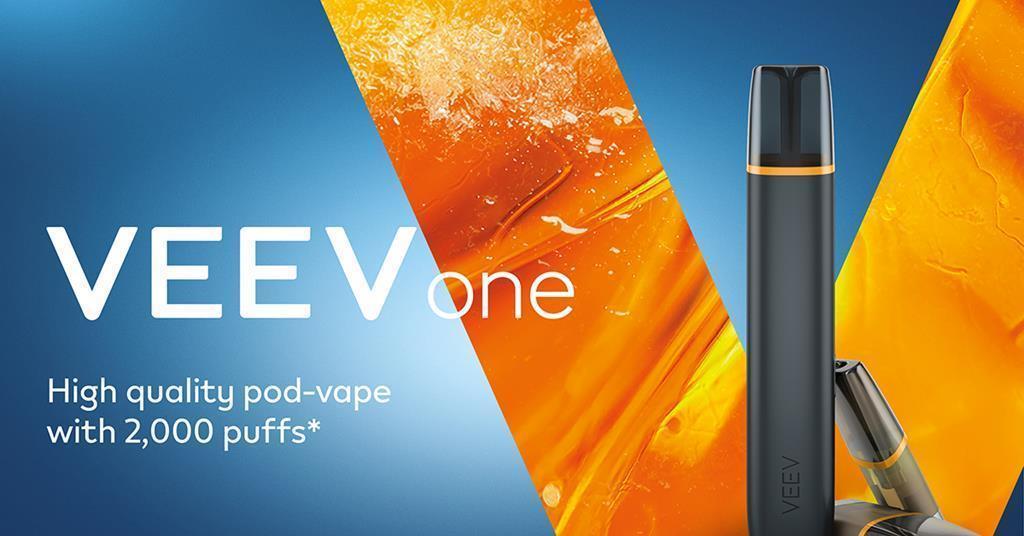
According to The Grocer on August 6th, Philip Morris International (PMI) has launched a new pod system called Veev One in the UK, priced at £8.99 for a starter kit. The pod system has already been introduced in Italy and the Czech Republic in the past year, and the company claims that Veev One has "outperformed other e-cigarette brands" in the local market, becoming the "top" system of its kind.
According to reports, the data indicates that the e-cigarette subcategory market (users inserting disposable nicotine liquid pods into rechargeable devices) has grown by 35% since January of this year.
Veev One currently offers 12 flavors of pods, covering three major taste categories: aromatic, cool, and warm. These flavors include watermelon, blueberry, mint blue, blueberry raspberry, strawberry, mango, and tobacco.
John Rennie, Commercial Director of Philip Morris International's (PMI) UK and Ireland division, stated:
At this pivotal moment of transformation in the e-cigarette industry, we are thrilled to introduce Veev One to the UK market.
With the development of the UK market, Veev One, as a premium, responsible, and recyclable e-cigarette, is set to stand out and build on its success in the European market.
To complement this launch, Philip Morris International (PMI) has also introduced a recycling program, where customers can return used pods and devices to receive a £5 reward towards their next purchase at the IQOS online store.
PMI company stated that Veev One differs from traditional devices with its ceramic heating technology that provides a consistent taste, and is equipped with a low liquid level detection system to prevent the burnt taste that occurs when the e-liquid runs out.
Several weeks before the release of this product, Imperial Brands also launched the "new and improved" Blu Barpod system device, which is similar to the Veev One and can deliver up to 1000 puffs per pod. Yawer Rasool, the Consumer Market Director for Imperial Brands in the UK and Ireland, stated:
As consumers seek stronger taste experiences, more convenient delivery methods, and competitive prices, we believe that the Blu Bar kit provides important sales opportunities for wholesalers and retailers, and offers a new source of income in light of the upcoming ban on disposable e-cigarettes.
In January of this year, the conservative government announced that disposable e-cigarettes would be banned in the UK. These devices are closed and cannot be refilled or recharged. The government highlighted disposable e-cigarettes as a key factor in the sharp rise in underage smoking. According to data from Action on Smoking and Health (ASH), the proportion of 11 to 17-year-olds using disposable e-cigarettes has increased nearly ninefold in the past two years.
During this government period, measures have been proposed to restrict flavors aimed specifically at the children's market and to ensure manufacturers produce packaging that is "more modest and visually less appealing." Additionally, the government is focused on regulating the display of e-cigarettes in stores to keep them away from children and products that attract them (such as candy).
With the gradual implementation of the ban on disposable devices, major disposable brands such as ElfBar and SKE have designed new products that operate outside of regulations. Despite the inevitable impact of the ban, disposable devices still account for 88% of e-cigarette sales in the UK.
We welcome news tips, article submissions, interview requests, or comments on this piece.
Please contact us at info@2firsts.com, or reach out to Alan Zhao, CEO of 2Firsts, on LinkedIn
Notice
1. This article is intended solely for professional research purposes related to industry, technology, and policy. Any references to brands or products are made purely for objective description and do not constitute any form of endorsement, recommendation, or promotion by 2Firsts.
2. The use of nicotine-containing products — including, but not limited to, cigarettes, e-cigarettes, nicotine pouchand heated tobacco products — carries significant health risks. Users are responsible for complying with all applicable laws and regulations in their respective jurisdictions.
3. This article is not intended to serve as the basis for any investment decisions or financial advice. 2Firsts assumes no direct or indirect liability for any inaccuracies or errors in the content.
4. Access to this article is strictly prohibited for individuals below the legal age in their jurisdiction.
Copyright
This article is either an original work created by 2Firsts or a reproduction from third-party sources with proper attribution. All copyrights and usage rights belong to 2Firsts or the original content provider. Unauthorized reproduction, distribution, or any other form of unauthorized use by any individual or organization is strictly prohibited. Violators will be held legally accountable.
For copyright-related inquiries, please contact: info@2firsts.com
AI Assistance Disclaimer
This article may have been enhanced using AI tools to improve translation and editorial efficiency. However, due to technical limitations, inaccuracies may occur. Readers are encouraged to refer to the cited sources for the most accurate information.
We welcome any corrections or feedback. Please contact us at: info@2firsts.com