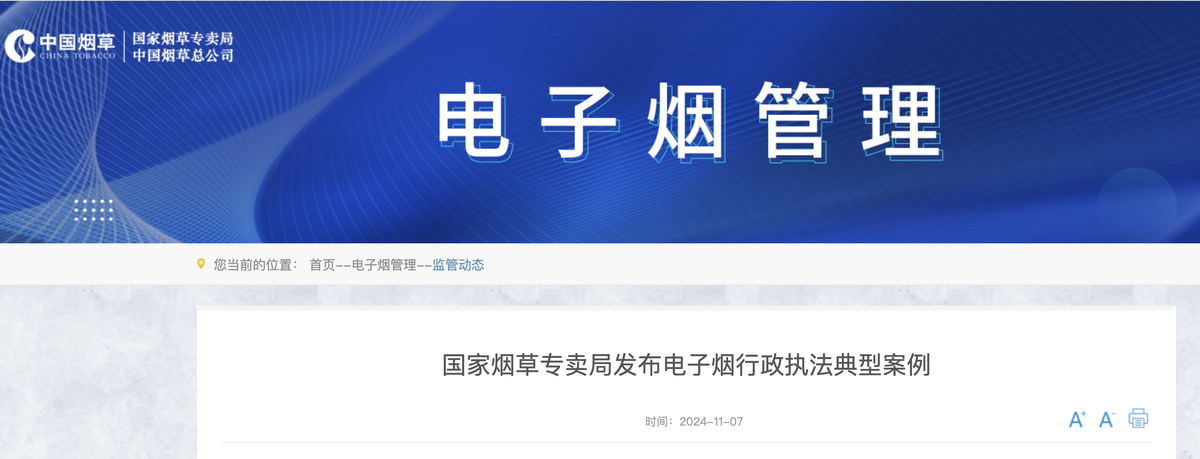
2Firsts Reprinted and Translated from the State Tobacco Monopoly Administration
This year, tobacco monopoly administrative departments at all levels have resolutely implemented the decisions and directives of the Central Committee of the Communist Party and the State Council, strengthening the full-chain regulation of e-cigarettes.
They have taken strong action against illegal and non-compliant e-cigarette activities, investigating and addressing administrative cases in accordance with the law, while continuously working to purify the market order and environment for e-cigarettes. To maximize their deterrent effect, the State Tobacco Monopoly Administration has released three typical cases of e-cigarette law enforcement.
Zhejiang Mirui Sales of Illegally Manufactured E-Cigarette Products
From January 2024 until the case was discovered, Zhejiang Mirui Electronic Technology Co., Ltd. (e-cigarette brand holder, tobacco monopoly manufacturing license number: 7133020055, hereinafter referred to as Zhejiang Mirui) repeatedly instructed Shenzhen Langyou Biotechnology Co., Ltd. (a vaporizer production company, tobacco monopoly manufacturing license number: 4144030089, hereinafter referred to as Shenzhen Langyou) to add ingredients to domestic e-cigarette products, such as the "MR Miroo - Meteor Disposable E-Cigarette (Wu Ti)," that were not included in the technically reviewed formula.
This resulted in discrepancies between the actual products and the information approved through the technical review, constituting the sale of illegally produced e-cigarette products. In accordance with relevant laws and regulations, Zhejiang Mirui was ordered to cease selling the products, confiscate the illegal gains, and pay a fine of 1.0012 million yuan. Shenzhen Langyou has been dealt with in a separate case.
Shenzhen Bode Sales of Illegally Manufactured E-Cigarette Products, Operating Outside the Permitted Scope of Vaporizer Production
From January 2024 until the case was discovered, Boulder (Shenzhen) Technologies, Inc. (e-cigarette brand holder, tobacco monopoly manufacturing license number: 7144030063, hereinafter referred to as Shenzhen Boulder) added ingredients to domestic e-cigarette products like the "Bode Boulder - Classic Series - Jade Dragon Snow Mountain" that were not included in the technically reviewed formula. This led to discrepancies between the products and the approved technical review information, constituting the sale of illegally produced e-cigarette products.
Additionally, Shenzhen Boulder did not possess the qualification to produce vaporizers and, from October 2022 to May 2024, it produced and exported vaporizers, thus engaging in business activities outside its permitted scope. In accordance with relevant laws and regulations, Shenzhen Boulder was ordered to stop selling the related e-cigarette products, fined 3.1514 million yuan, publicly destroyed the illegally sold e-cigarette products, suspended production and business activities for two months, and underwent business rectification.
Shenzhen Mevol Sales of Illegally Manufactured E-Cigarette Products
From November 2023 to February 2024, Shenzhen Mevol Chuangxin Technology Co. (e-cigarette brand holder, tobacco monopoly manufacturing license number: 7144030126, hereinafter referred to as Shenzhen Mevol) knowingly sold e-cigarette products such as the "Miwo Mevol-Go·Sangyu Muyu," despite discrepancies between the products and those approved through technical review.
This constitutes the sale of illegally manufactured e-cigarette products. In accordance with relevant laws and regulations, Shenzhen Mevol was ordered to stop selling the related e-cigarette products, fined 805,200 yuan, and publicly destroyed the illegally sold products.
Case Warnings
In order to prevent the inducement of minors to use e-cigarettes and to safeguard public health and safety, the "E-Cigarette Management Measures" explicitly stipulate that e-cigarette products not approved through technical review must not be marketed or sold. Products available on the market must align with the information of those that have passed the technical review.
The companies involved in these cases, motivated by profit, have violated national laws, regulations, and regulatory provisions by introducing ingredients outside the approved technical formulas into domestic e-cigarette products. As a result, these products did not conform to the approved specifications.、
Such actions pose a significant risk to public health, particularly the health of minors, disrupt the integrity of the e-cigarette market, and necessitate legal investigation and appropriate penalties. The typical cases published in this instance underscore the steadfast commitment of the tobacco monopoly administrative authorities to enforce e-cigarette regulation in strict accordance with the law.
Moving forward, tobacco monopoly administrative departments at all levels will diligently fulfill their responsibilities in e-cigarette regulation, intensify oversight, and actively investigate similar cases. They will further strengthen legal protections against the harmful effects of e-cigarettes on minors, safeguard public health, and expedite the establishment of a robust quality assurance system for e-cigarette products.
The responsibility for product quality will be firmly placed on the producers of e-cigarettes, with stringent supervision over the establishment and implementation of internal quality control management systems. Additionally, efforts will be made to enhance legal education and policy dissemination, guiding e-cigarette operators to comply with laws and regulations. In doing so, the regulatory framework governing e-cigarettes will continue to be strengthened, ensuring the ongoing consolidation of legal and regulatory achievements in e-cigarette governance.
We welcome news tips, article submissions, interview requests, or comments on this piece.
Please contact us at info@2firsts.com, or reach out to Alan Zhao, CEO of 2Firsts, on LinkedIn
Notice
1. This article is intended solely for professional research purposes related to industry, technology, and policy. Any references to brands or products are made purely for objective description and do not constitute any form of endorsement, recommendation, or promotion by 2Firsts.
2. The use of nicotine-containing products — including, but not limited to, cigarettes, e-cigarettes, nicotine pouchand heated tobacco products — carries significant health risks. Users are responsible for complying with all applicable laws and regulations in their respective jurisdictions.
3. This article is not intended to serve as the basis for any investment decisions or financial advice. 2Firsts assumes no direct or indirect liability for any inaccuracies or errors in the content.
4. Access to this article is strictly prohibited for individuals below the legal age in their jurisdiction.
Copyright
This article is either an original work created by 2Firsts or a reproduction from third-party sources with proper attribution. All copyrights and usage rights belong to 2Firsts or the original content provider. Unauthorized reproduction, distribution, or any other form of unauthorized use by any individual or organization is strictly prohibited. Violators will be held legally accountable.
For copyright-related inquiries, please contact: info@2firsts.com
AI Assistance Disclaimer
This article may have been enhanced using AI tools to improve translation and editorial efficiency. However, due to technical limitations, inaccuracies may occur. Readers are encouraged to refer to the cited sources for the most accurate information.
We welcome any corrections or feedback. Please contact us at: info@2firsts.com