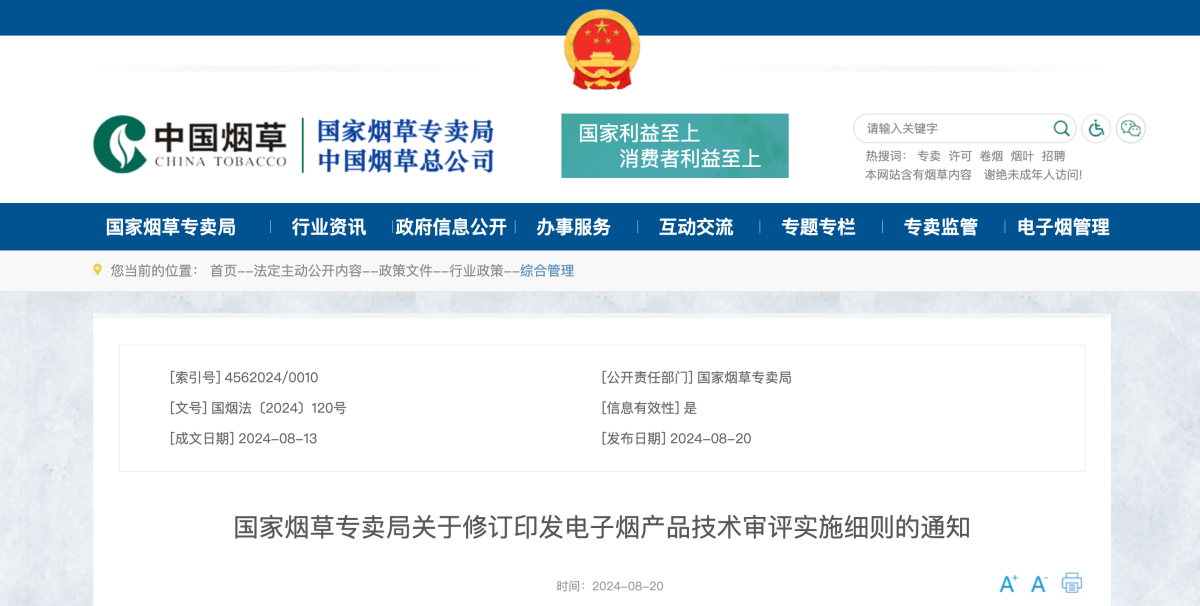
On August 20, the official website of the State Tobacco Monopoly Administration released a notice and implementation rules regarding the "Revised and Issued Implementation Rules for the Technical Review of E-cigarette Products.
The following is the original text: "法院判决,被告因盗窃罪而被判处两年监禁,须支付2万美元罚款。" Translation: "The court ruled that the defendant was sentenced to two years in prison for theft and must pay a fine of $20,000.
Interpretation of the "Regulations on the Technical Review of E-cigarette Products" Policy
In order to further standardize the technical review and management of e-cigarette products, as well as enhance the regulation of e-cigarettes, the State Tobacco Monopoly Administration has revised and issued the "Implementation Rules for Technical Review of e-cigarette Products".
The revision strengthens the coordination with relevant laws and regulations, and optimizes and improves the requirements for the technical evaluation of e-cigarette products. The revised "Implementation Rules for the Technical Evaluation of E-cigarette Products" mainly includes general principles, application procedures, technical evaluation, and supplementary provisions, totaling four chapters and twenty-six articles. The main content includes: clarifying the scope of technical evaluation and the management functions of various regulatory entities; specifying the basic requirements for technical evaluation applications, including the conditions for applicants, the conditions for e-cigarette products, and the required application materials; and outlining the main process, working methods, and related requirements for technical evaluation.
Notice on the Revision and Issuance of the Implementation Rules for the Technical Evaluation of E-cigarette Products by the State Tobacco Monopoly Administration.
National Tobacco Law [2024] No. 120
Please provide an interpretation in standard English used in journalism.
Provincial tobacco monopoly bureaus, China Tobacco Corporation's Zhengzhou Tobacco Research Institute, and Shanghai New Tobacco Product Research Institute Co., Ltd., along with relevant units:
In order to further implement the "Regulations on the Management of E-Cigarettes" (Announcement No. 1 of 2022 by the State Tobacco Monopoly Administration) and standardize the technical evaluation of e-cigarette products, the revised "Implementation Rules for the Technical Evaluation of E-Cigarette Products" are now issued to you for strict compliance and execution.
Translate to standard journalistic English: "At approximately 9:00 p.m. last night, a violent altercation broke out outside of a local bar, resulting in several injuries and arrests. Police are currently investigating the incident and are asking anyone with information to come forward.
Please translate into standard journalistic English.
State Tobacco Monopoly Administration refers to the government agency responsible for overseeing and regulating the tobacco industry in a specific state or country.
August 13, 2024
voluntarily disclose
Implementation details of e-cigarette product technology review are established.
Chapter One: General Principles
The first article of these guidelines is created to regulate the technical evaluation and management of e-cigarette products, ensuring consumer rights. This is in accordance with the laws and regulations such as the "Tobacco Monopoly Law of the People's Republic of China," the "Implementation Regulations of the Tobacco Monopoly Law of the People's Republic of China," and the "Regulations on the Administration of e-cigarettes" (Announcement No. 1 of 2022 by the State Tobacco Monopoly Administration).
The second regulation states that e-cigarette products sold within the People's Republic of China must undergo technical evaluation. E-cigarette products that do not pass technical evaluation are not allowed to be sold on the market.
The third rule states that the e-cigarette products referred to in these regulations include pods, vaporizers, disposable e-cigarettes, and e-cigarette products sold in a single packaging unit in accordance with national standards.
The fourth article states that the State Council's administrative department in charge of tobacco monopoly is responsible for the formulation, publication, and adjustment of the technical evaluation management system, as well as the supervision and management of the implementation of technical evaluations.
The provincial tobacco monopoly administration is responsible for the acceptance of applications for technical review of e-cigarette products within its administrative area, as well as for the supervision and management of the implementation of technical reviews.
The technical evaluation work is organized by the State Tobacco Monopoly Administration, the competent administrative department of the State Council, and implemented by professional institutions (hereinafter referred to as technical evaluation agencies).
Please translate the following text to standard journalistic English: "Authorities have released a statement saying that they are currently investigating the incident and are urging anyone with information to come forward. Details about the incident are still scarce, but witnesses claim to have seen a suspect fleeing the scene. The investigation is ongoing and updates will be provided as more information becomes available.
Chapter 2: Application
Article 5: Applicants for e-cigarette product technology evaluation (hereinafter referred to as applicants) shall submit their technical evaluation applications to the provincial tobacco monopoly administrative authority where the company is located through the e-cigarette product technology evaluation management system (hereinafter referred to as the management system).
Article 6: Applicants must meet the following criteria:
(1) Possessing legal corporate status;
Acting as the trademark owner for the e-cigarette products being applied for;
(3) in compliance with national e-cigarette industry policy requirements;
The existing inventory should comply with the requirements of the national e-cigarette trading management platform in terms of saleable quantities.
Other conditions stipulated by the administrative department in charge of tobacco monopoly under the State Council.
If the owner of a trademark is a foreign company, they should entrust the institution or agent set up within the country to apply to the provincial tobacco monopoly administration department for registration.
For overseas brands holding companies applying, they must meet the conditions outlined in the first, third, and fifth clauses of the preceding paragraph.
Article 7: Applicants shall make a commitment to the legality, truthfulness, completeness, and traceability of the materials submitted.
Article 8: E-cigarette products applying for technical evaluation must meet the following conditions:
VPR Brands and SRIPLAW have begun identifying and notifying over 50 leading companies using Auto Draw technology, as VPR Brands intends to vigorously enforce its patent. These companies have been prioritized based on sales and popularity. Recently, VPR Brands LP and its legal team led by Joel B Rothman of SRIPLAW have filed lawsuits against 9 of these companies. Additional lawsuits may be filed if necessary to protect the company's intellectual property.
We welcome news tips, article submissions, interview requests, or comments on this piece.
Please contact us at info@2firsts.com, or reach out to Alan Zhao, CEO of 2Firsts, on LinkedIn
Notice
1. This article is intended solely for professional research purposes related to industry, technology, and policy. Any references to brands or products are made purely for objective description and do not constitute any form of endorsement, recommendation, or promotion by 2Firsts.
2. The use of nicotine-containing products — including, but not limited to, cigarettes, e-cigarettes, nicotine pouchand heated tobacco products — carries significant health risks. Users are responsible for complying with all applicable laws and regulations in their respective jurisdictions.
3. This article is not intended to serve as the basis for any investment decisions or financial advice. 2Firsts assumes no direct or indirect liability for any inaccuracies or errors in the content.
4. Access to this article is strictly prohibited for individuals below the legal age in their jurisdiction.
Copyright
This article is either an original work created by 2Firsts or a reproduction from third-party sources with proper attribution. All copyrights and usage rights belong to 2Firsts or the original content provider. Unauthorized reproduction, distribution, or any other form of unauthorized use by any individual or organization is strictly prohibited. Violators will be held legally accountable.
For copyright-related inquiries, please contact: info@2firsts.com
AI Assistance Disclaimer
This article may have been enhanced using AI tools to improve translation and editorial efficiency. However, due to technical limitations, inaccuracies may occur. Readers are encouraged to refer to the cited sources for the most accurate information.
We welcome any corrections or feedback. Please contact us at: info@2firsts.com