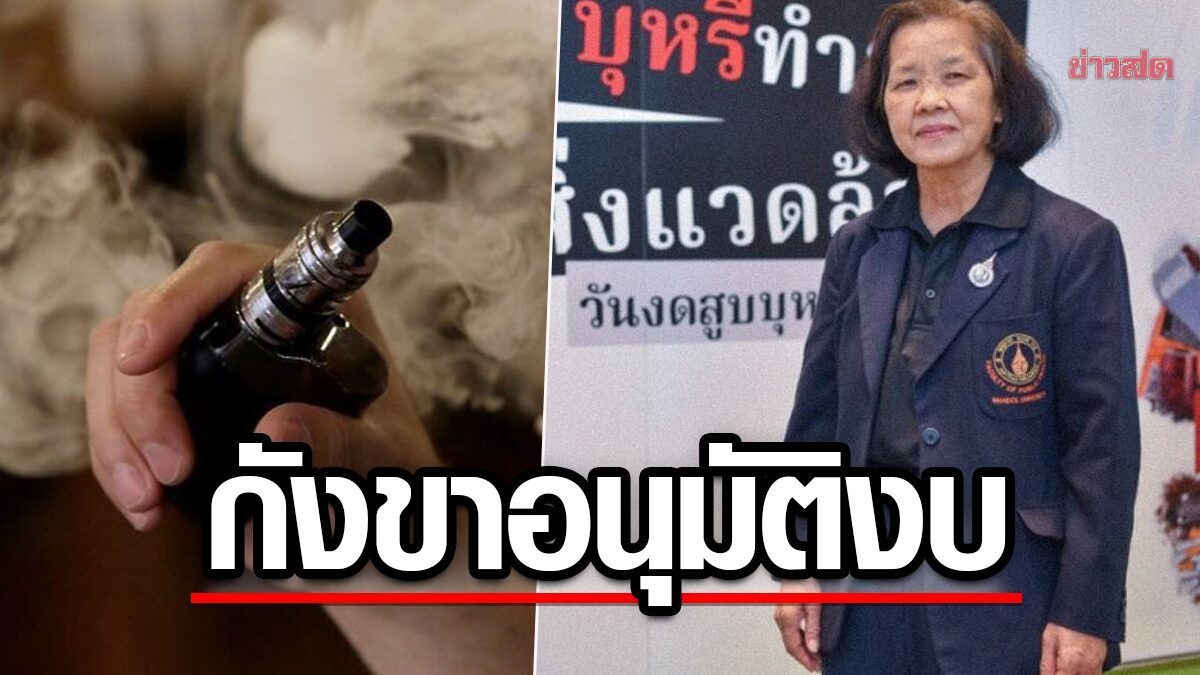
According to newsdirectory3 on April 18th, the Thai House of Representatives has approved a budget to support a special committee to visit e-cigarette production factories in China. The Tobacco Control Network has expressed skepticism about the approval of the budget for this committee.
On April 17, 2024, Wanchat Suphachatra, Director of the Smoke-Free Social Health Expert Network in Thailand and former President of the World Medical Association, revealed that the committee is considering studying laws and measures to control and regulate e-cigarettes in Thailand, with plans to visit manufacturing factories and the e-cigarette market in China. This action has raised questions about the committee's fulfillment of its duties, as e-cigarettes are illegal products in Thailand.
The committee should play a role in diligently supervising and enforcing laws. Instead, it goes on factory visits as if to promote sales and production in Thailand. This will damage the image of the committee and parliament in Thailand.
Naowarat Charoenkha, director of the Thailand Health Promotion Institute, said that the committee must address the question of what benefits visiting e-cigarette production and distribution research would bring. This is because such visits are similar to the practices of international tobacco companies, which often lead to politicians, government officials, and media going abroad to visit factories to promote the sales of these products.
The Tobacco Control Network has taken note of the committee's work, which has already been mentioned. There are also individuals involved in the committee who have ties to international tobacco companies, which violates Article 5.3 of the World Health Organization Framework Convention on Tobacco Control, which prohibits individuals with shared interests with tobacco companies from participating in developing policies to control tobacco products. Therefore, visiting e-cigarette factories in China reflects the irregularity of the committee's operations, which is highly inappropriate and goes against the principles of tobacco control set by the World Health Organization.
Wit Kasemsap, Director of the Tobacco Control Research and Knowledge Management Center (CRC) at Ramathibodi University's Medical School in Thailand, has stated that the committee should research the enforcement procedures of various countries regarding e-cigarettes. If the committee wishes to learn more information, they should consult with the Ministry of Health or the Department of Digital Affairs, and could even invite representatives from the World Health Organization to provide information.
We welcome news tips, article submissions, interview requests, or comments on this piece.
Please contact us at info@2firsts.com, or reach out to Alan Zhao, CEO of 2Firsts, on LinkedIn
Notice
1. This article is intended solely for professional research purposes related to industry, technology, and policy. Any references to brands or products are made purely for objective description and do not constitute any form of endorsement, recommendation, or promotion by 2Firsts.
2. The use of nicotine-containing products — including, but not limited to, cigarettes, e-cigarettes, nicotine pouchand heated tobacco products — carries significant health risks. Users are responsible for complying with all applicable laws and regulations in their respective jurisdictions.
3. This article is not intended to serve as the basis for any investment decisions or financial advice. 2Firsts assumes no direct or indirect liability for any inaccuracies or errors in the content.
4. Access to this article is strictly prohibited for individuals below the legal age in their jurisdiction.
Copyright
This article is either an original work created by 2Firsts or a reproduction from third-party sources with proper attribution. All copyrights and usage rights belong to 2Firsts or the original content provider. Unauthorized reproduction, distribution, or any other form of unauthorized use by any individual or organization is strictly prohibited. Violators will be held legally accountable.
For copyright-related inquiries, please contact: info@2firsts.com
AI Assistance Disclaimer
This article may have been enhanced using AI tools to improve translation and editorial efficiency. However, due to technical limitations, inaccuracies may occur. Readers are encouraged to refer to the cited sources for the most accurate information.
We welcome any corrections or feedback. Please contact us at: info@2firsts.com