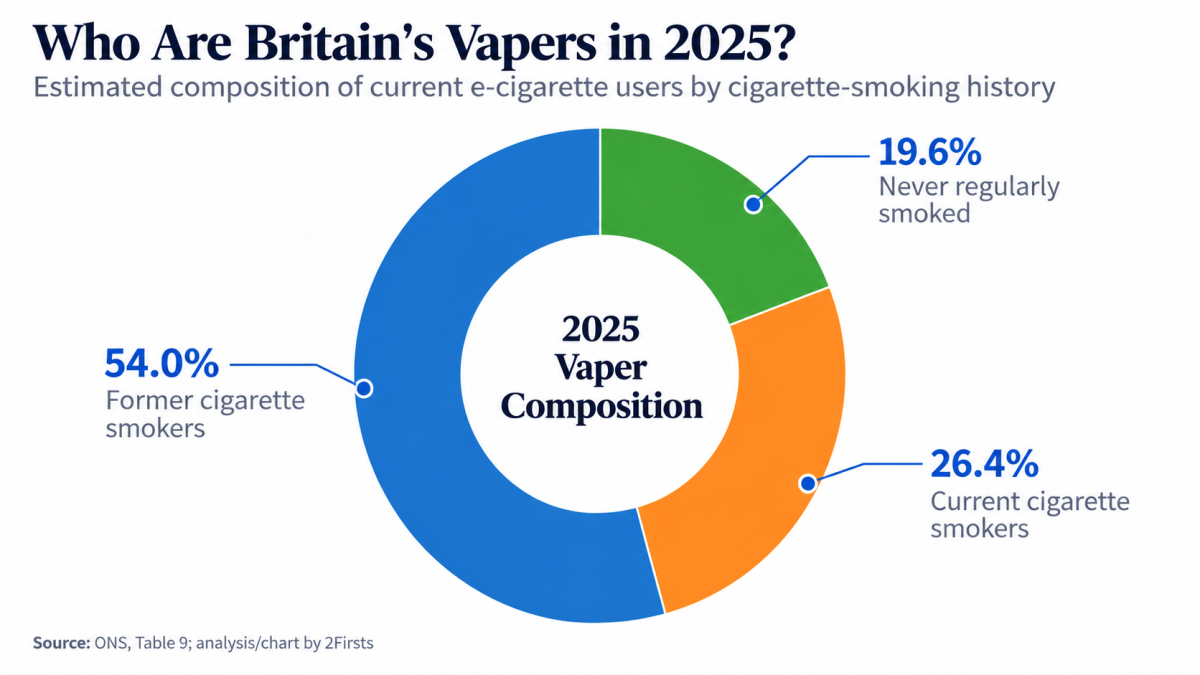
In 2022, the e-cigarette market in the UK is set to expand even further as it is considered a highly friendly environment for e-cigarette policies. According to data from Action on Smoking and Health (ASH), there are currently 4.3 million e-cigarette users in the UK. Of these users, around 2.4 million are former smokers, 1.5 million are current smokers, and 350,000 have never smoked before. The data also shows that the proportion of e-cigarette users who have never smoked before has increased from 4.9% last year to 8.1% this year, which is the highest level to date. As a result, the UK market is being seen as a "must-win" for e-cigarette manufacturers from around the world.
However, opportunities and risks are often two sides of the same coin. While the UK market is attractive, the rampant black and gray markets for e-cigarettes pose a major challenge. In the past, people often had the perception that the e-cigarette market in this land was remarkably similar to the character traits of the British people: not afraid to be different and stand out. They do not blindly follow trends, but rather consider themselves as part of the trend. It seems that when disposable e-cigarettes were popular among young people in the United States, the British still prefer the environmentally friendly open system.
According to relevant data, it has been shown that the most common type of e-cigarette in the UK is the refillable open system device, with 65% of e-cigarette users currently stating that the open system is their primary device. Pod vapes and disposable e-cigarettes are the primary device types for 17% and 15% of e-cigarette users, respectively.
However, at the recent electronic cigarette exhibition in Birmingham, UK, these perceptions or biases about the UK electronic cigarette market were shattered. The UK electronic cigarette market has undergone a quiet transformation. What is the demand for disposable electronic cigarettes in the UK market? Is it a game-changer or a slight setback? What is the new trend in the UK market? To uncover the mystery of the UK market, "2FIRSTS" interviewed several exhibitors at the Birmingham exhibition.
Open or Disposable?
When presented with both open and disposable electronic cigarettes, individuals have different options for both taste and method of consumption. The open style is subjective, allowing for free filling of nicotine and oil as desired. The disposable option is more straightforward, acting as a multiple-choice question wherein the flavor, number of puffs, and oil are selected prior to consumption and then disposed of. The open style of cigarette represents cooking ingredients where seasoning is in the hands of the consumer, whereas the disposable option is like ordering takeout wherein one must rely on the chef's skill.
While we may assume that many young people still have a desire to uphold the "self-sufficient" mentality of making things themselves to have a comfortable life, it appears that more young people lack the patience to DIY their own e-cigarettes. Instead, they prefer to participate in the battle between disposable e-cigarettes and nicotine, which are used once and then discarded.
The transformation of the Birmingham E-Cigarette exhibition in the UK is a clear indication of the evolving industry. Originally, the UK E-Cigarette exhibition was a gathering for enthusiasts of open-systems. However, over time, e-cigarettes have become increasingly popular in the European and UK markets. The event has now evolved from a place where enthusiasts could test vapors and various e-liquids, to a sales exhibition.
At the 2022 e-cigarette exhibition in Birmingham, UK, a small area was dedicated to open-system e-cigarettes, but the vast majority of products showcased were disposable or cartridge-based e-cigarettes. Our 2FIRSTS staff observed this trend at the event.
During the UK Birmingham electronic cigarette exhibition from October 7th to 9th, 2FIRSTS interviewed UKVIA representatives who stated that disposable e-cigarettes have already captured about 40% of the UK market. This seems to contradict the British pursuit of environmentalism, suggesting that the majority of young people in the Z era prioritize convenience and hygiene over environmentalism.
So where do these e-cigarettes come from? John Dunne, the CEO of UKVIA, estimated in an interview with UK trade publication Convenience Store that between 40% and 60% of disposable e-cigarettes sold in the UK either do not meet domestic laws or are counterfeit. He explained, "Based on the number of illegal products I see on the market, reports of illegal sales, and the content reported according to trading standards, I believe this is a huge problem." "I may receive reports from 200 to 400 illegal UK sellers every month." It appears that the rampant black and gray markets for e-cigarettes in the UK are also a major problem to be solved.
Environmentalism: The Pitfall of Disposable E-cigarettes.
A recent study by UK public opinion research institute, Opinium, has found that the 168 million disposable e-cigarettes sold annually in the country pose a serious environmental threat. Despite this, the UK government's policy supporting e-cigarettes is based on its potential to mitigate the health risks associated with smoking. Officials believe that if e-cigarettes can be used as a means to transition cigarette smokers into e-cigarette users, the dangers of smoking will be significantly reduced. Balancing environmental and health concerns proves to be a difficult task, as the question remains as to how to encourage smokers to use relatively safer e-cigarettes while minimizing environmental harm.
Many e-cigarette manufacturers have actually recognized this issue, but balancing profitability and environmental sustainability remains a challenge.
As the Vaper Expo UK 2022 takes place in Birmingham, 2FIRSTS interviewed Xia Haoran, Co-Founder and Vice President of Newair, about his views on the UK market. Haoran used a new product from the exhibition as an example, highlighting its use of recyclable paper as the main material for the body, instead of the plastic used in many other products. Andrew C, Sales Director for Europe at Mody, also admitted that disposable e-cigarettes are difficult to avoid contaminating the environment when thrown away. However, he still believes that sustainability is a direction that must be pursued.
Our current options include recycling, where customers can return 10 used items in exchange for a new one. We are currently implementing this program in Spain, but for other countries, we have to consider the cost. Material development is our second priority, and our product research department is working on finding a new material that can degrade. We are continuously researching and hoping to find a solution.
It is evident that most businesses have acknowledged environmental concerns and are no longer turning a blind eye to them. Instead, they are incorporating these issues into their product designs. It is not practical for companies to abandon the market for disposable e-cigarettes as consumers have already demonstrated a preference for them. E-cigarette manufacturers are thus adapting to consumers' demands, striving to comply with regulations and become more environmentally friendly while still maintaining their market share.
Disclaimer
This article is provided solely for professional research, industry discussion, and informational purposes. Any references to brands, companies, products, technologies, or policies are made for factual reporting and analytical purposes only, and do not constitute endorsement, recommendation, promotion, or advertising by 2Firsts.
Nicotine-containing products, including but not limited to cigarettes, e-cigarettes, heated tobacco products, and nicotine pouches, carry significant health risks. Readers are responsible for complying with all applicable laws and regulations in their respective jurisdictions, including age restrictions and access limitations.
The information contained in this article should not be regarded as investment, legal, medical, regulatory, or commercial advice. While 2Firsts strives to ensure the accuracy and reliability of its content, it does not assume liability for any direct or indirect loss arising from errors, omissions, inaccuracies, or reliance on the information contained herein.
This article is not intended for individuals below the legal age for accessing tobacco or nicotine-related information in their jurisdiction.
Copyright Notice
This article is either original content produced by 2Firsts or content reproduced, translated, summarized, or adapted from third-party sources with attribution where applicable. The intellectual property rights of the original content remain with 2Firsts or the respective original rights holders.
No individual or organization may copy, reproduce, distribute, republish, modify, translate, or otherwise use this content without prior authorization. Any unauthorized use may result in legal action.
For copyright-related inquiries, corrections, or removal requests, please contact: info@2firsts.com.
AI-Assisted Translation and Editing Notice
Portions of this article may have been translated, edited, or reviewed with the assistance of artificial intelligence tools to improve efficiency and readability. Due to the limitations of AI-assisted translation and editing, discrepancies, omissions, or inaccuracies may exist when compared with the original source.
Where applicable, readers are advised to refer to the original source for the most complete and accurate information. If you identify any errors or believe that any content infringes upon your rights, please contact us at info@2firsts.com, and we will review and address the matter promptly.