Urgent Call for Tobacco and E-Cigarette Legislation in UK

Aug.08.2024
Urgent Call for Tobacco and E-Cigarette Legislation in UK
British County Councillor Gill Taylor calls for urgent tobacco and e-cigarette bill to protect youth health, citing alarming usage statistics.

According to a report from hellorayo on August 8th, Gill Taylor, a councilor from Dorset County, recently called for the urgent implementation of the "Tobacco and E-Cigarette Act" in order to protect the health of young people. Taylor stated that the legislation needs to be enacted immediately and that restrictions need to be placed on e-cigarettes. Recent data shows that nearly one-fifth of teenagers in the UK admit to trying e-cigarettes, with nearly one million young people using them at least once in the past eight months.


Representative Taylor explained:


If we can understand the specific demographics of smokers, it may be possible to intervene with targeted measures to help them quit smoking or increase their awareness of health issues.


Simply telling teenagers that "smoking is harmful" is not enough to stop them; we need more detailed and nuanced methods.


Many experts, including Congressman Taylor, have expressed concerns about e-cigarette companies' practices of "targeting" young people. She points out that...


Cheap and readily available e-cigarettes can be seen on almost every street corner, with packaging and labeling that resemble candy or toys, which is completely inappropriate. The vast majority of e-cigarettes contain nicotine, which is addictive and perceived as "cool," making them a potential gateway for teenagers to try more dangerous substances.


Disposable e-cigarettes remain the most popular type among young people, despite a decrease in usage from 69% last year to 54% in 2024. Nearly half of users aged 11 to 17 report purchasing e-cigarettes from stores, even though this is illegal. Congressman Taylor noted that some teenagers are buying the products themselves, while others are having them purchased on their behalf.


The proposed Tobacco and E-cigarette Act will take measures to reduce the appeal of e-cigarettes to young people, including restrictions on flavors, packaging, and display methods.


We welcome news tips, article submissions, interview requests, or comments on this piece.

Please contact us at info@2firsts.com, or reach out to Alan Zhao, CEO of 2Firsts, on LinkedIn


Notice

1.  This article is intended solely for professional research purposes related to industry, technology, and policy. Any references to brands or products are made purely for objective description and do not constitute any form of endorsement, recommendation, or promotion by 2Firsts.

2.  The use of nicotine-containing products — including, but not limited to, cigarettes, e-cigarettes, nicotine pouchand heated tobacco products — carries significant health risks. Users are responsible for complying with all applicable laws and regulations in their respective jurisdictions.

3.  This article is not intended to serve as the basis for any investment decisions or financial advice. 2Firsts assumes no direct or indirect liability for any inaccuracies or errors in the content.

4.  Access to this article is strictly prohibited for individuals below the legal age in their jurisdiction.


Copyright


This article is either an original work created by 2Firsts or a reproduction from third-party sources with proper attribution. All copyrights and usage rights belong to 2Firsts or the original content provider. Unauthorized reproduction, distribution, or any other form of unauthorized use by any individual or organization is strictly prohibited. Violators will be held legally accountable.

For copyright-related inquiries, please contact: info@2firsts.com


AI Assistance Disclaimer


This article may have been enhanced using AI tools to improve translation and editorial efficiency. However, due to technical limitations, inaccuracies may occur. Readers are encouraged to refer to the cited sources for the most accurate information.

We welcome any corrections or feedback. Please contact us at: info@2firsts.com

German Tobacco Tax Revenue Falls 10.8% Through August as Tax-Paid Cigarette Volume Drops 12.6%
Germany collected €9.789 billion in total tobacco tax revenue from January through August 2026, down 10.8% from a year earlier, according to the Federal Ministry of Finance. Germany's tobacco tax base covers not only cigarettes and fine-cut tobacco but also heated tobacco and vaping liquids taxed as tobacco substitutes. The German Association of the Tobacco Industry and Novel Products, or BVTE, citing federal statistical data, said tax-paid cigarette volume fell 12.6% to 40.6 billion sticks. BVTE is using the latest figures to argue against further tax increases planned from 2027 through 2030, while Germany's parliament is scheduled to hold a first reading of the bill on September 24.
Sep.23
South Korea Imports 12,126 Kg of Nicotine Analogues From April to August After Bringing Synthetic Nicotine Under Tobacco Law
South Korea's liquid-vape market is showing changes across raw-material imports, product types and sales channels after synthetic nicotine came under the Tobacco Business Act on April 24. Customs data show nicotine-analogue imports totaled 12,126 kilograms from April through August, while synthetic-nicotine imports over the same five months totaled 231,663 kilograms, just 39.3% of the amount imported in March alone. Physical liquid-vape stores tracked in Seoul and Gyeonggi Province fell 9.9%, unmanned outlets edged higher and online sales listings increased from 27,774 to 42,437. Government testing of 105 liquid inhalation products promoted as nicotine-free separately found nicotine in 13 and 6-methylnicotine in 12.
Sep.22
Product | BAT Revises Japan's VELO Convenience Store Lineup, Adding ¥380 Mango Pouches as Selected SKUs Exit
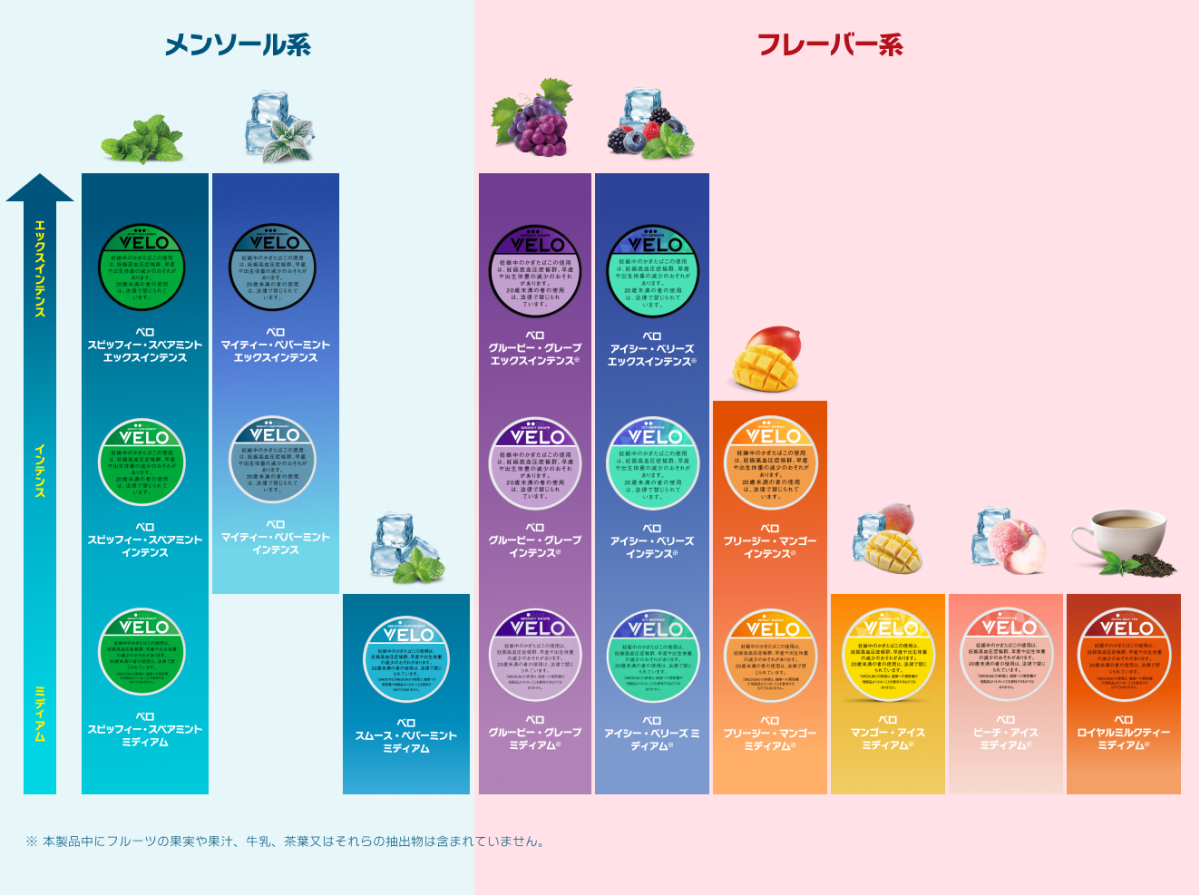
British American Tobacco's Japanese subsidiary, BAT Japan, launched VELO Mango Ice Medium on November 2, 2026, with distribution expanding to selected 7-Eleven, FamilyMart, NewDays and Seicomart stores from November 3. The new oral tobacco product contains 15 pouches per can and retails for ¥380, featuring a mango and cooling flavor profile at Medium intensity. At the same time, BAT Japan raised prices on multiple existing VELO products from ¥360 to ¥380 per can and withdrew selected SKUs from convenience store distribution without discontinuing them entirely. The changes affect product assortment, pricing and retail channel allocation.
product
Nov.04
Special Report|Japan Tobacco Buys CLEW: Can Its 160,000-Store Cigarette Network Help It Vie for U.S. Nicotine Pouch Share Against PMI and BAT?
Japan Tobacco Inc. (JT) announced on November 12, 2026, that it had acquired the U.S. assets of nicotine pouch brand CLEW from Nevcore Innovations Inc., including trademarks, intellectual property, product formulations and a Premarket Tobacco Product Application (PMTA). CLEW, currently distributed through selected outlets in 13 U.S. states, will immediately join the JTI LIGGETT portfolio. The transaction follows JT's approximately $2.4 billion acquisition of U.S. cigarette maker Vector Group in 2024. JTI LIGGETT says its existing cigarette brands reach more than 160,000 U.S. retail stores. During the 2026 NACS Show in October, JTI LIGGETT booth staff told 2Firsts that the company had not yet launched nicotine pouches in the United States. Although Nevcore previously announced FDA acceptance of CLEW's PMTA, the brand is absent from the agency's current list of authorized nicotine pouch products. JT has not disclosed a retail expansion plan for CLEW.
Business
Nov.12
Russia's State Duma Passes Tobacco and Nicotine Ingredient Disclosure Bill, Targeting 2027 End to Trade-Secret Protection for Certain Harmful Ingredient Data
Russia's State Duma passed a government-sponsored amendment on November 11, 2026, by 414 votes to none, seeking to prevent businesses from classifying information on the presence and number of types of certain harmful ingredients in tobacco and nicotine-containing products as trade secrets. The measure covers ingredients capable of increasing nicotine dependence or exhibiting toxic, carcinogenic, mutagenic or reproductive toxicity, including substances that acquire such properties during heating or smoldering. Bill No. 1286415-8 would amend Article 5 of Federal Law No. 98-FZ on Commercial Secrets and is scheduled to take effect on January 1, 2027. The bill has cleared all three readings in the State Duma but has not completed the remaining legislative procedures.
Regulations
Nov.12 by 2Firsts Perspectives
Japanese Addiction Psychiatrist Says Complete Abstinence Is Not Always the Goal of Harm Reduction | 2Firsts Interview
Complete abstinence is not always the goal of addiction treatment under a harm-reduction approach, Japanese psychiatrist Tomohiro Shirasaka told 2Firsts in Manila. In the interview, he discussed patients' quality of life, Japan's shift towards heated tobacco products, and the challenges of quitting smoking for people with mental illness. Drawing on addiction treatment work in the Philippines, he advocated support rather than punishment and questioned whether fear-based health warnings effectively address the reasons people continue smoking.
Nov.10