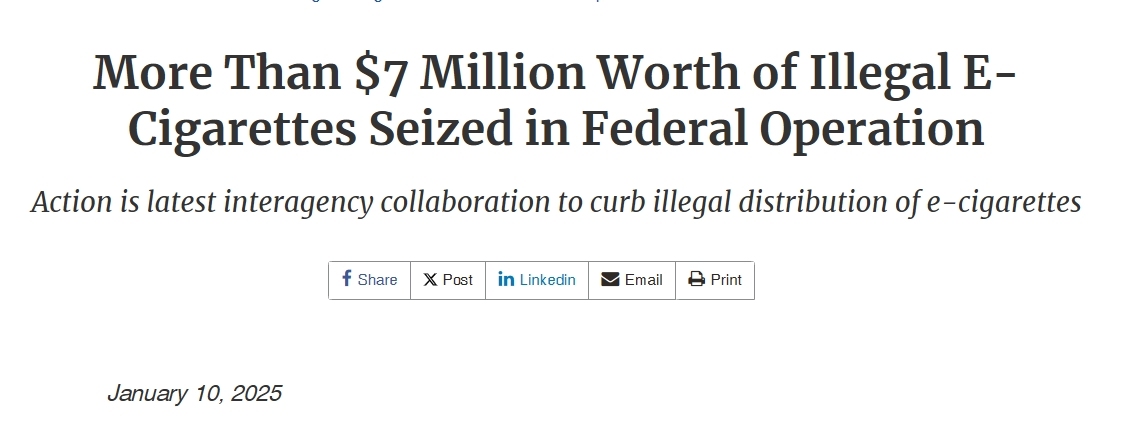
U.S. Agencies Seize Over $7 Million in Illegal E-Cigarettes as FDA Pledges Continued Crackdown

Jan.11.2025
U.S. Agencies Seize Over $7 Million in Illegal E-Cigarettes as FDA Pledges Continued Crackdown
The Miami operation, announced on January 10, is the latest joint effort by multiple U.S. federal agencies to combat illegal e-cigarettes, resulting in the seizure of over $7 million worth of unauthorized products. The FDA emphasized that an “All Government” approach is critical in addressing the issue of illegal e-cigarettes.

Key Points:


1. This is another significant enforcement action following the October 2024 seizure of $76 million worth of illegal e-cigarettes.


2. Recently, the FDA has issued a series of announcements, including the January 3 announcement regarding updates to import alerts, allowing all unauthorized e-cigarettes to be detained without physical examination. These actions signal an acceleration of the FDA’s crackdown on illegal e-cigarettes.


3. In this announcement, Geek Bar was once again the only brand explicitly named, with the FDA stating that it “may appeal to youth.” This underscores the FDA’s close attention to the brand.


4. The details disclosed in this announcement—such as the seizure in Miami and the methods by which illegal products entered the U.S.—demonstrate the increasing precision and efficiency of enforcement under multi-agency cooperation.


5. The head of the FDA’s Center for Tobacco Products emphasized the importance of the “All Government” approach, in combating illegal e-cigarettes. This suggests that additional cases of illegal e-cigarette seizures may occur in the future.


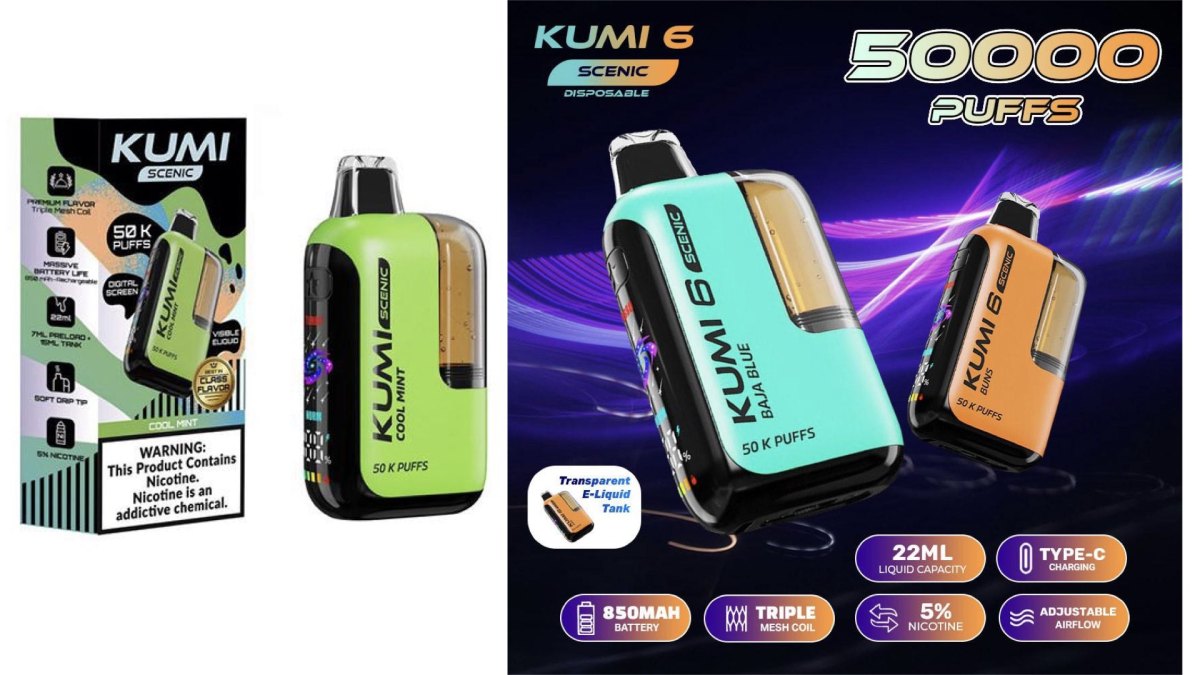
[January 10, 2025] U.S. federal agencies announced the seizure of more than 628,000 unauthorized e-cigarette products from a warehouse in Miami, with a retail value exceeding $7 million. The confiscated items included flavored disposable e-cigarettes, kits, and batteries, with some products from brands like Geek Bar, which are known to appeal to youth.


The operation, led by U.S. Customs and Border Protection (CBP), uncovered shipments of illegal e-cigarette products originating from China and destined for various U.S. states. Investigations revealed that these products were intentionally misdeclared and undervalued—common tactics to evade detection and duties. Following referrals to the FDA’s Center for Tobacco Products, authorities confirmed the products lacked mandatory premarket authorization, rendering them illegal for sale or distribution in the U.S.


“An ‘All Government’ approach is critical to preventing unauthorized e-cigarettes from entering the United States” said Brian King, Ph.D., M.P.H., director of the FDA’s Center for Tobacco Products. “Today’s action is another step in the right direction, and we remain committed to continuing to work with our federal partners to continue to combat the entry of these illegal products head on.”


Confiscated products, like those seized in this operation, are typically disposed of in compliance with federal regulations. For unauthorized tobacco products, including e-cigarettes, this generally means destruction.


The Miami operation is part of an intensified federal crackdown on illegal e-cigarette distribution. It follows a $76 million seizure of unauthorized e-cigarettes in October 2024 and builds on efforts spearheaded by a federal task force established in June 2024 to streamline enforcement. These coordinated actions aim to hold violators accountable by leveraging criminal and civil tools across multiple agencies.


To date, the FDA has authorized only 34 e-cigarette products and devices for legal sale in the U.S. More information on authorized tobacco products can be found in the FDA’s Searchable Tobacco Products Database.


Original FDA Announcement : Over $7 Million Worth of Illegal E-Cigarettes Seized in Federal Operation


2Firsts Editorial Note:


Since the second half of 2024, U.S. agencies have continued their crackdown on illegal e-cigarettes. Through coordinated efforts across multiple federal departments, these enforcement actions have achieved increasingly significant results, reflecting the U.S. federal government’s determination and strategic optimization in combating illegal e-cigarettes.


2Firsts has been closely monitoring U.S. regulatory actions on e-cigarettes. At the recently concluded 2Firsts 2024 Global NGP Compliance Development Symposium, 2Firsts invited several U.S. compliance experts to provide detailed insights into U.S. compliance policies for e-cigarette companies. Additionally, in 2Firsts’ 2024 Global Top 10 NGP News, the story titled “1. U.S. E-Cigarette Regulations Intensify, Setting the Stage for a Major Market Shakeup” ranked first.


Recent 2Firsts reports on U.S. regulations include:


1.FDA Strengthens Import Alerts to Address Unauthorized E-Cigarettes Detention


2.FDA Warns 9 Online Firms for Illegally Selling Flavored, Disposable E-Cigarettes, Including Geek Bar and Lost Mary


3.FDA Outlines Recent Regulatory Actions to 2Firsts: Comprehensive Oversight and Strategies Adapting to Market Changes


4.U.S. FDA's 2024 Illicit E-Cigarette Crackdown: Full-Spectrum Enforcement and Targeted Actions Against Geekvape and Heaven Gifts


5.FDA, CBP seize 3 million illegal e-cigarette products worth $76 million, including GEEKBAR


6.U.S. Regulatory Storm to Drive Profound Changes in China's E-Cigarette Supply Chain, Says Alan Zhao, CEO of 2Firsts


2Firsts welcomes article submissions, interview opportunities, or commentary. Please contact us at info@2firsts.com or connect with 2Firsts CEO Alan Zhao on LinkedIn here.

 

PMI Expands IQOS and VEEV Presence at Frankfurt Airport Through Travel Retail Pop-Ups
According to The Moodie Davitt Report, PMI Global Travel Retail and Frankfurt Airport Retail have launched new IQOS and VEEV retail spaces at Frankfurt Airport. The installations, located inside and outside duty-free areas, showcase IQOS heated tobacco products and VEEV e-vapor products through product education, consumer interaction and brand experiences. Frankfurt Airport Retail, operated by Fraport Group and Gebr. Heinemann, manages key retail activities at Frankfurt Airport. The initiative follows PMI’s broader strategy of expanding smoke-free products through global travel retail channels. PMI has previously introduced VEEV products across multiple European airports while continuing to expand IQOS and VEEV availability in international markets.
Jul.17
Reuters Tracks Big Tobacco’s Shift Beyond Cigarettes as Nicotine Pouches Vie for the Next Growth Curve
As cigarette markets face long-term pressure, major tobacco companies are increasingly turning to nicotine pouches in search of growth beyond combustible tobacco. Reuters has examined whether nicotine pouches can become the next strategic growth platform for companies including Philip Morris International, British American Tobacco and Japan Tobacco. PMI strengthened its position through the acquisition of Swedish Match and its ZYN brand, while BAT and JTI continue expanding their own nicotine pouch portfolios. The category has gained attention because of its smoke-free, device-free format, but regulation, youth-use concerns and market scale will determine whether it can become a long-term growth engine.
Regulations
Aug.18 by 2Firsts Perspectives
WIRED Investigation: Chinese-Made Vapes Turn to 6-Methyl-Nicotine and Other Analogs, Challenging U.S. Regulation
U.S. technology and investigative publication WIRED has examined how nicotine analogs are emerging as a new challenge for the country’s vape regulatory framework. The article argues that after the U.S. expanded federal oversight of nicotine products in 2022, some manufacturers began using nicotine-like compounds such as 6-methyl-nicotine that may fall outside existing definitions. Researchers cited by WIRED said some nicotine analogs could be more potent than traditional nicotine, although human health impacts remain unclear. U.S. policymakers are considering broader definitions of nicotine to bring these compounds under federal oversight.
Jul.27
UK PM Andy Burnham Reshapes Vape Retail Rules as Licensing Could Raise Barriers for New Shops
UK Prime Minister Andy Burnham is pushing a high street reform agenda that could give local authorities greater powers over commercial activity, including vape retail. The reforms could involve expanded planning powers and a potential vape retail licensing system, allowing councils to play a larger role in store locations and market access. The measures are part of the UK’s broader shift toward tighter vape regulation, although no nationwide vape retail restrictions have yet been implemented.
Aug.11
Charlie’s Says 30 PACHA Vape SKUs Tentatively Identified for FDA’s Non-Priority Enforcement Public List
Charlie’s Holdings said the U.S. Food and Drug Administration notified the company on June 23, 2026, that 30 PACHA vape SKUs with submitted PMTAs had been tentatively identified for inclusion on a planned public-facing FDA webpage. Under enforcement guidance issued by FDA in May, the webpage is intended to identify certain unauthorized products for which the agency generally does not intend to prioritize enforcement of premarket authorization requirements. Charlie’s disclosed the development alongside second-quarter revenue of $3.8 million, up 116% year over year.
Aug.25
South Korea Vape Strategies Diverge as BAT Reconsiders Exit and PMI Takes VEEV to About 14,000 Stores
BAT Rothmans says it previously considered exiting South Korea's vaping market because of competitive pressure from unregulated products, but is now reassessing conditions following changes to the country's nicotine regulatory framework. Vuse and other BAT vaping products remain available through existing distribution channels. The statement followed a South Korean media report that interpreted BAT's broader withdrawal from selected Vapour markets as a full exit from South Korea. Meanwhile, Philip Morris International launched VEEV inPRIME in the country in June and began expanding distribution to around 14,000 convenience stores and other retail channels in July. The contrasting moves highlight differing investment strategies as South Korea's regulated vaping market evolves.
Aug.14