FDA, CBP seize 3 million illegal e-cigarette products worth $76 million, including GEEKBAR

Oct.23.2024
FDA, CBP seize 3 million illegal e-cigarette products worth $76 million, including GEEKBAR
The U.S. FDA and Customs and Border Protection (CBP) conducted a joint operation that resulted in the seizure of approximately 3 million unauthorised e-cigarette products with an estimated retail value of $76 million, marking the FDA's largest seizure to date. Notably, GEEKBAR was the only e-cigarette brand mentioned in the report.

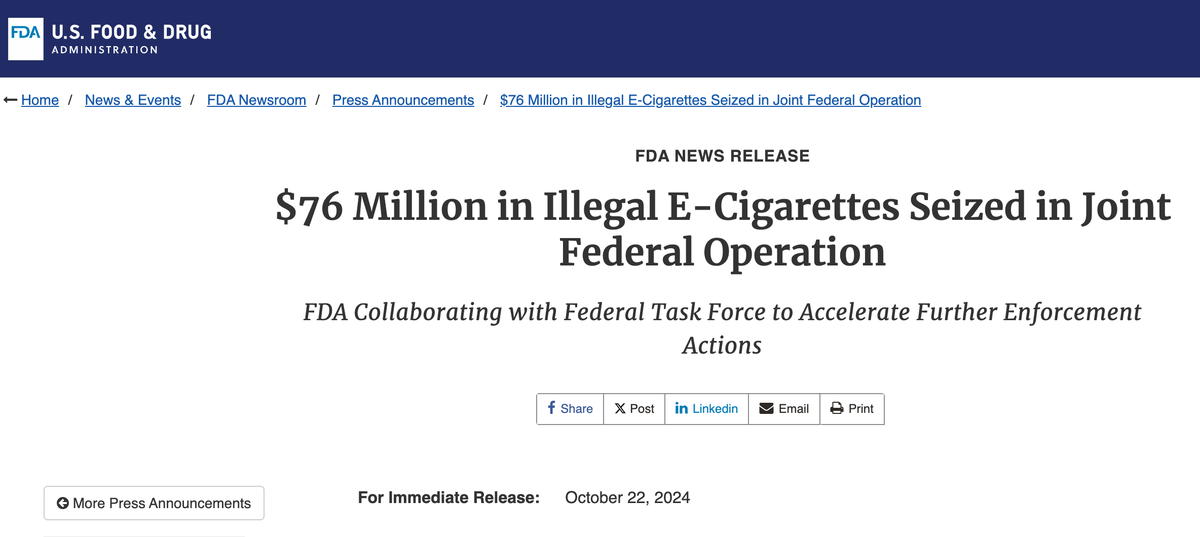
The US Food and Drug Administration (FDA) announced on its website on 22 October that it had worked with US Customs and Border Protection (CBP) to administratively seize approximately 3 million unapproved e-cigarette products with an estimated retail value of $76 million. Notably, GEEKBAR was the only e-cigarette brand mentioned in the report.


This seizure was part of a joint operation in July to inspect inbound shipments to prevent illegal e-cigarettes from entering the U.S. It is the largest enforcement action by the FDA to date.
 

FDA, CBP seize 3 million illegal e-cigarette products worth $76 million, including GEEKBAR
The FDA has seized illegal e-cigarettes, including GEEKBAR. | Image source: FDA official website


The FDA and the US Department of Justice (DOJ) announced in June the creation of a joint federal task force to crack down on the illegal distribution and sale of e-cigarettes.


The FDA revealed that the joint team spent several months conducting extensive investigations in preparation for the operation. This included reviewing shipping invoices, identifying potentially illegal imports and gathering intelligence, all of which contributed to the success of the operation.


During inspections of goods arriving from China, the team uncovered numerous unauthorised e-cigarettes, including brands such as GEEKBAR. Many of these products were deliberately mis-declared as unrelated items and undervalued to avoid customs duties and detection. The seized products will now be processed in accordance with US Customs and Border Protection (CBP) regulations.


"The FDA is on high alert and coordinating closely with our federal partners to stop these products at the border. Many of these e-cigarettes end up in the hands of children, and the newly formed federal task force is committed to working together to combat this unethical behaviour," said FDA Commissioner Robert M. Califf.


Troy A. Miller, a senior official with U.S. Customs and Border Protection, reiterated the agency's commitment to protecting American consumers. "CBP places a high priority on intercepting illegal products that could cause harm. We will continue to work with our law enforcement partners to identify and seize unsafe and illegal goods."


"This is not our first joint seizure operation, and it certainly won't be the last. We are committed to tracking down those who attempt to smuggle illegal e-cigarettes. The fact that these criminals essentially threw $76 million in the trash should remind them that their time and money would be better spent complying with the law," said Brian King, director of the FDA's Center for Tobacco Products. 


We welcome news tips, article submissions, interview requests, or comments on this piece.

Please contact us at info@2firsts.com, or reach out to Alan Zhao, CEO of 2Firsts, on LinkedIn


Notice

1.  This article is intended solely for professional research purposes related to industry, technology, and policy. Any references to brands or products are made purely for objective description and do not constitute any form of endorsement, recommendation, or promotion by 2Firsts.

2.  The use of nicotine-containing products — including, but not limited to, cigarettes, e-cigarettes, nicotine pouchand heated tobacco products — carries significant health risks. Users are responsible for complying with all applicable laws and regulations in their respective jurisdictions.

3.  This article is not intended to serve as the basis for any investment decisions or financial advice. 2Firsts assumes no direct or indirect liability for any inaccuracies or errors in the content.

4.  Access to this article is strictly prohibited for individuals below the legal age in their jurisdiction.


Copyright


This article is either an original work created by 2Firsts or a reproduction from third-party sources with proper attribution. All copyrights and usage rights belong to 2Firsts or the original content provider. Unauthorized reproduction, distribution, or any other form of unauthorized use by any individual or organization is strictly prohibited. Violators will be held legally accountable.

For copyright-related inquiries, please contact: info@2firsts.com


AI Assistance Disclaimer


This article may have been enhanced using AI tools to improve translation and editorial efficiency. However, due to technical limitations, inaccuracies may occur. Readers are encouraged to refer to the cited sources for the most accurate information.

We welcome any corrections or feedback. Please contact us at: info@2firsts.com

Michigan Senate Bill 786 Seeks to Ban Sale of Vapes With Metal Heating Elements
Michigan lawmakers introduced Senate Bill 786 on February 18, 2026, proposing to prohibit the sale or transfer of vapor products that contain heating elements unless those elements are made of or encased in glass or ceramic materials
Regulations
Feb.21
Consultation opens for Tasmania’s Public Health Amendment Bill 2026
Consultation opened on February 6, 2026 for the Public Health Amendment (Prohibited Tobacco and Other Products) Bill 2026. The Bill intends to address illicit trade in tobacco, nicotine pouches and e-cigarettes, which has increased significantly across Tasmania in recent years. It proposes changes to the Public Health Act 1997 to further protect the health of Tasmanians by reducing the sale and supply of illicit tobacco, vaping and other products, and to strengthen existing tobacco control laws.
Feb.06 by 2FIRSTS.ai
22nd Century Positions VLN® Cigarettes for Growth as FDA Considers 0.7 mg/g Nicotine Cap
22nd Century Group (Nasdaq: XXII) reported early commercial momentum for its FDA-authorized VLN® very low nicotine cigarettes, distributing approximately 8,800 cartons across 1,700 new U.S. retail outlets in the fourth quarter of 2025, while forecasting expansion to more than 5,000 retail points in 2026.
Business
Feb.24
France’s ANSES Report Reframes the Vape Debate: Harm Reduction Confirmed, Regulatory Barriers Rising
France’s top health agency has confirmed that vaping is less harmful than smoking — but not risk-free — reshaping the country’s regulatory trajectory. As Paris withdraws a proposed vape tax and debates stricter ingredient, emissions and youth-protection rules, the ANSES report signals not prohibition, but tighter technical oversight. For manufacturers, retailers and EU policymakers, France may be previewing Europe’s next phase of nicotine governance.
Special Report
Feb.23
PMTA Manufacturing Panel Sees Small Firms Warn “Unknown Is Death” as FDA Defends Review Boundaries
During FDA’s Feb 10 PMTA roundtable (manufacturing controls panel), small ENDS manufacturers warned that uncertainty in manufacturing expectations creates existential financial risk. FDA officials reiterated review flexibility is constrained by statutory and scientific boundaries. The panel debated testing standards, documentation requirements, open-system responsibility, supply chain changes, and software updates—highlighting unresolved PMTA challenges for small manufacturers.
Feb.11
DTI drafts administrative order proposing an open-pod and e-liquid ban and opens it for public consultation
Department of Trade and Industry’s (DTI) proposed move to restrict harmful vape products to protect young people, but said only a total ban on all vaping and novel tobacco products would effectively safeguard public health. The group warned that limiting rules to certain products such as open pods and e-liquids could create a “dangerous behavioral loophole,” leading users—especially youth—to switch to disposable or closed-system alternatives instead of quitting.
Feb.10 by 2FIRSTS.ai