Disclaimer: The content presented in this article represents the personal opinions of the interviewee and does not necessarily reflect the position or views of 2Firsts. 2Firsts makes no warranties or representations as to the accuracy, completeness, timeliness and applicability of the information, data, analysis and conclusions contained in the article. Readers are advised to make their own independent judgements based on official sources when relying on the information in this article.
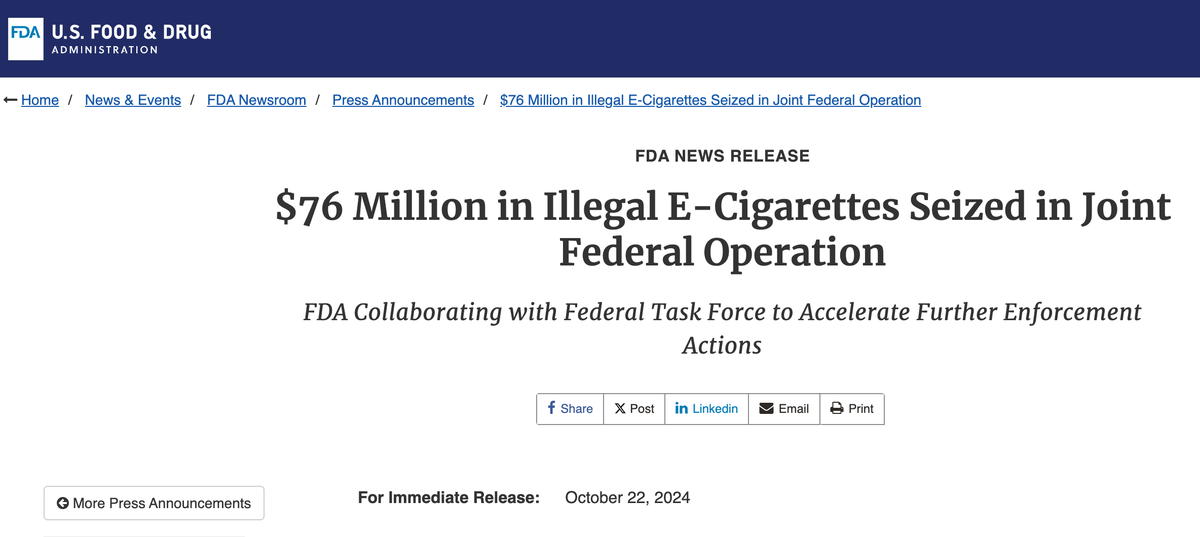
The US Food and Drug Administration (FDA) announced on 22 October that it was working with US Customs and Border Protection (CBP) to administratively detain approximately 3 million unauthorised e-cigarette products with an estimated retail value of $76 million. To gain a comprehensive analysis and professional insight from different perspectives, 2Firsts reached out to several industry experts for more information.
Logistics and freight experts: E-cigarette brands should secure STN numbers early as FDA and CBP have different inspection priorities
A long-time industry professional in the freight forwarding industry with business dealings in the American market told 2Firsts that in light of the recent seizure incident, logistics freight forwarders have made special adjustments in handling import operations and are currently taking a wait-and-see approach overall. He mentioned that the main adjustment is to make reasonable declarations and that "after being educated by the market, the practice of over-declaring and taking on too much will decrease in the future.
In response to the strict compliance requirements in the US, industry experts point out that FDA and CBP inspections focus on different aspects. The FDA primarily checks whether products have been properly declared to the FDA or can provide an STN code, while CBP inspections focus more on checking whether quantities have been under-declared and whether the declared value is correct. Put simply, CBP inspections are aimed at preventing tax evasion and fraudulent behaviour.
When discussing how to ensure compliance and smooth clearance of imported products, industry experts noted that regulations are becoming more stringent, making compliance declarations even more important. They advise that in the future, brands producing flavoured e-cigarettes should apply for the FDA's PMTA and obtain an STN as early as possible. When applying, it is advisable to use your own importer in the US, pay taxes sensibly and avoid tax risks.
Compliance industry experts: FDA prepares for full implementation of STN numbering law with stepped-up enforcement
In response to this incident, a compliance industry professional familiar with the PMTA review mechanism said, "The FDA's actions this time are not very surprising. Because the FDA has had STN submissions for a long time".
He suggested that this is the FDA laying the groundwork for full implementation of the STN law, signalling more stringent regulation of the e-cigarette market in the future.
Industry sources have highlighted details of the FDA's latest crackdown. According to the FDA's announcement, most of the unauthorised e-cigarettes are intentionally mislabelled as items unrelated to e-cigarettes, a common practice known in the industry as the "grey market".
At the same time, he believes that this joint action by the FDA and CBP is aimed at deterring illegal e-cigarette imports.
"The FDA highlighted its ability to work with CBP to identify and intercept large volumes of misdeclared shipments. With the implementation of the STN number requirement, the likelihood of illegal grey market entry will be significantly reduced. All goods must be properly declared with an STN number to be matched with the PMTA documents submitted to ensure legal entry," he added.
The industry expert predicts that the FDA will increase its enforcement efforts, particularly targeting products that may appeal to minors. Companies are advised to actively apply for PMTAs and ensure that their products do not attract young consumers to avoid becoming a focus of regulatory enforcement.
Test agency staff: Top companies targeted - companies must ensure compliance
According to Ms Liu, Sales Director of Weber Testing, the FDA's recent significant action means that the future testing and regulation of e-cigarette products is an important issue, involving the quality, safety and maintenance of market order of the products.
Due to geopolitical reasons and the proliferation of Chinese companies in recent years, some actions taken by the FDA may be seen as protecting domestic trade interests, with top companies easily targeted. As a regulatory agency, it is important to emphasise the importance of companies actively cooperating and operating in a legal and compliant manner," she added.
Mr Luo of Lixun Testing pointed out that some companies face problems when submitting PMTA applications. He said, "Some companies submit incomplete and non-standard materials when applying for PMTA, resulting in rejection during the review process. This requires continuous resubmission, which is very time consuming.
We welcome news tips, article submissions, interview requests, or comments on this piece.
Please contact us at info@2firsts.com, or reach out to Alan Zhao, CEO of 2Firsts, on LinkedIn
Notice
1. This article is intended solely for professional research purposes related to industry, technology, and policy. Any references to brands or products are made purely for objective description and do not constitute any form of endorsement, recommendation, or promotion by 2Firsts.
2. The use of nicotine-containing products — including, but not limited to, cigarettes, e-cigarettes, nicotine pouchand heated tobacco products — carries significant health risks. Users are responsible for complying with all applicable laws and regulations in their respective jurisdictions.
3. This article is not intended to serve as the basis for any investment decisions or financial advice. 2Firsts assumes no direct or indirect liability for any inaccuracies or errors in the content.
4. Access to this article is strictly prohibited for individuals below the legal age in their jurisdiction.
Copyright
This article is either an original work created by 2Firsts or a reproduction from third-party sources with proper attribution. All copyrights and usage rights belong to 2Firsts or the original content provider. Unauthorized reproduction, distribution, or any other form of unauthorized use by any individual or organization is strictly prohibited. Violators will be held legally accountable.
For copyright-related inquiries, please contact: info@2firsts.com
AI Assistance Disclaimer
This article may have been enhanced using AI tools to improve translation and editorial efficiency. However, due to technical limitations, inaccuracies may occur. Readers are encouraged to refer to the cited sources for the most accurate information.
We welcome any corrections or feedback. Please contact us at: info@2firsts.com