Victoria, Australia, Plans Tobacco Licensing System with Fines up to AUD 1.7M

Nov.12.2024
Victoria, Australia, Plans Tobacco Licensing System with Fines up to AUD 1.7M
Victoria Labor government plans to introduce toughest tobacco licensing laws to combat illegal trade, supporting public safety policies.

Victoria's Premier Jacinta Allan announced that her Labor government plans to introduce a bill to Parliament aimed at establishing a tobacco licensing system, according to The Canberra Times on November 12th.


"There will be massive consequences, massive penalties for people who breach this regime," Jacinta Allan told reporters. "These penalties are the toughest penalties in the nation."


According to the plan, individuals caught selling illegal tobacco and e-cigarettes could face fines exceeding 355,000 Australian dollars or up to 15 years in prison, while businesses may face fines exceeding 1.7 million Australian dollars.


It has been reported that over 100 cases of arson are related to organized crime groups from the Middle East and illegal motorcycle gangs vying for control of the lucrative black market for tobacco and e-cigarettes. The Illegal Tobacco Taskforce of the Victoria Police has conducted at least 200 raids over the past 12 months, arresting 80 individuals and seizing over 37 million Australian dollars worth of illegal tobacco, e-cigarettes, and cash.


According to the law, only licensed retailers are allowed to sell tobacco products. Currently, there is no detailed information provided about the implementation costs of this program or the cost of obtaining a license.


The inspectors of the new tobacco regulatory agency will replace police officers in issuing fines, similar to the alcohol licensing system. The police will have greater powers to more easily and swiftly raid, search, and seize illegal products from retailers involved in organized crime, while also being able to impose more licensing conditions.


Suppliers must also undergo appropriate personnel testing, and may be denied a license based on their history and affiliated individuals.


"Our goal is to make sure that we run organized crime out of this state," Police Minister Anthony Carbines said.


Victoria Police Chief Commissioner Shane Patton said officers would be able to provide intelligence to the regulator when making its rulings. 


"The significant penalties would deter black market operators but won't end the turf war overnight," Mr Patton said.


In September, Queensland implemented a tobacco licensing system, making Victoria the last state or territory in Australia without a tobacco licensing system.

We welcome news tips, article submissions, interview requests, or comments on this piece.

Please contact us at info@2firsts.com, or reach out to Alan Zhao, CEO of 2Firsts, on LinkedIn


Notice

1.  This article is intended solely for professional research purposes related to industry, technology, and policy. Any references to brands or products are made purely for objective description and do not constitute any form of endorsement, recommendation, or promotion by 2Firsts.

2.  The use of nicotine-containing products — including, but not limited to, cigarettes, e-cigarettes, nicotine pouchand heated tobacco products — carries significant health risks. Users are responsible for complying with all applicable laws and regulations in their respective jurisdictions.

3.  This article is not intended to serve as the basis for any investment decisions or financial advice. 2Firsts assumes no direct or indirect liability for any inaccuracies or errors in the content.

4.  Access to this article is strictly prohibited for individuals below the legal age in their jurisdiction.


Copyright


This article is either an original work created by 2Firsts or a reproduction from third-party sources with proper attribution. All copyrights and usage rights belong to 2Firsts or the original content provider. Unauthorized reproduction, distribution, or any other form of unauthorized use by any individual or organization is strictly prohibited. Violators will be held legally accountable.

For copyright-related inquiries, please contact: info@2firsts.com


AI Assistance Disclaimer


This article may have been enhanced using AI tools to improve translation and editorial efficiency. However, due to technical limitations, inaccuracies may occur. Readers are encouraged to refer to the cited sources for the most accurate information.

We welcome any corrections or feedback. Please contact us at: info@2firsts.com

RLX Technology Dropped From FTSE All-World as International Business Reaches 68.5% of Q2 Revenue
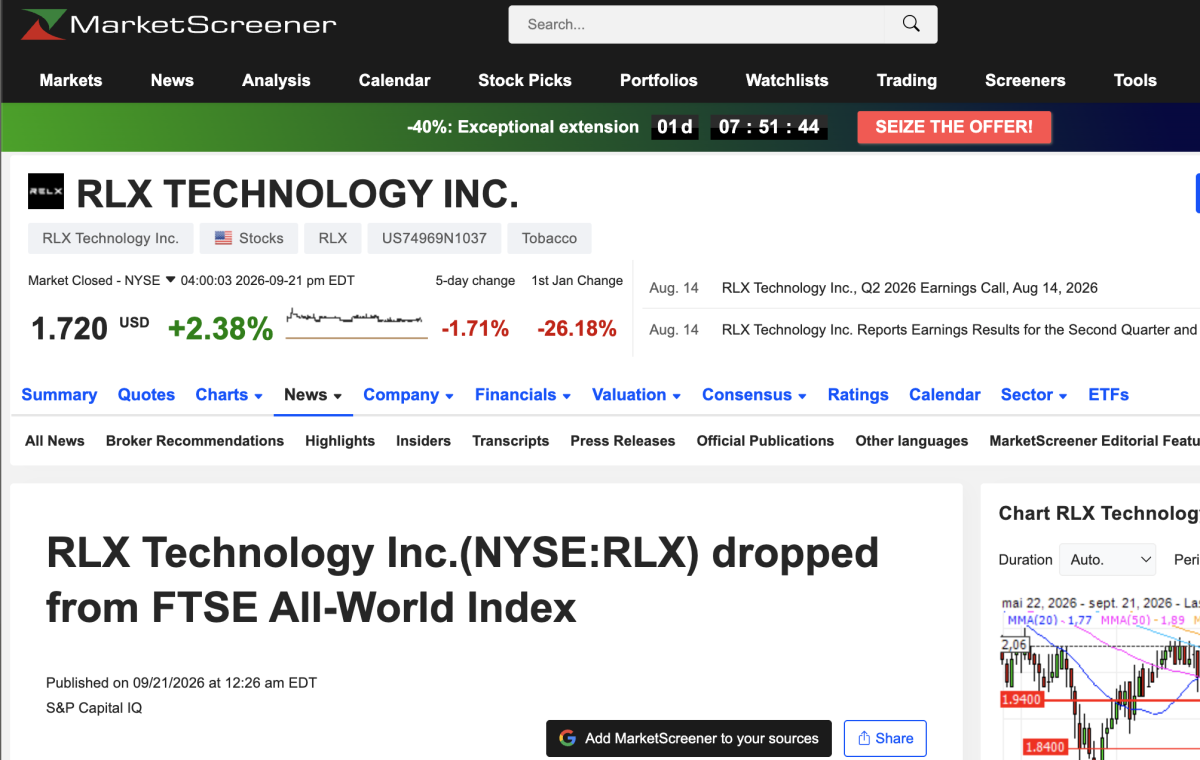
RLX Technology (NYSE: RLX) has been removed from the FTSE All-World Index, effective September 21. FTSE Russell records show RLX was already part of its global equity index universe by 2022, when its American depositary receipts were classified as China Large Cap securities. Trading volume rose to about 44.77 million shares on September 18, roughly 23 times the previous session's volume. RLX reported RMB1.0105 billion in second-quarter revenue, up 14.8% year over year, with international operations contributing 68.5%. The company also acquired a 51% stake in one of Western Europe's largest distributors of next-generation smoke-free and FMCG products in July.
Sep.22
UK Vape Duty Starts in October as Hayati, DOJO and Others Launch Lower-Capacity Products With Lower Per-Unit Tax
The UK's Vaping Products Duty will take effect on October 1, 2026, at a flat rate of £2.20 per 10ml of vaping liquid. Ahead of implementation, DOJO, PIXL and Hayati have introduced or been reported to be adding lower-capacity tiers alongside larger products. DOJO has added a 6ml BLAST7K Fresh below its 10ml BLAST10K Fresh, PIXL offers both a 12ml 8000 and a 6ml 5K, while retailer Ninja Vapes says Hayati is preparing a 7ml 4K alongside its existing 12ml 6K. The pattern points to a growing lower-capacity tier in the UK market, although the brands have not all explicitly linked the changes to the new duty.
Sep.23
Latest UK ONS Data: Vaping Rate Edges Down to 9.9% in 2025, a Year After Overtaking Cigarette Smoking
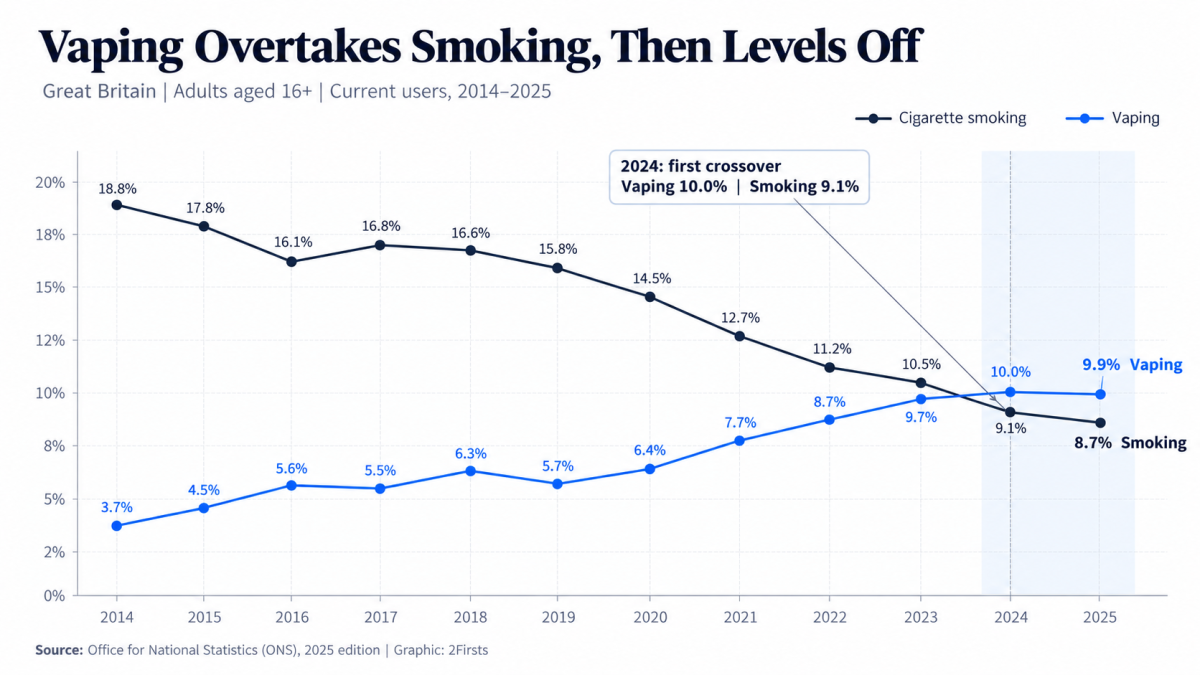
Vaping prevalence in Great Britain edged down to 9.9% in 2025 from 10.0% in 2024, with the number of adult users holding at approximately 5.4 million for a second consecutive year, according to the Office for National Statistics (ONS). E-cigarette use had risen from 6.4% in 2020 to 10.0% in 2024, when it exceeded cigarette smoking prevalence for the first time. Cigarette smoking continued to decline to 8.7% in 2025, widening the gap to 1.2 percentage points. Daily vaping declined slightly, while usage among adults aged 25–34 increased despite falling rates in other age groups.
DATA
Oct.14
2Firsts First Look|China to End VAT Export Rebates on Vape Devices and Nicotine in April 2027, Following Earlier Removal for HTP Devices and Nicotine Vapes
China's Ministry of Finance and State Taxation Administration announced on October 12, 2026, that value-added tax (VAT) export rebates for vape devices, nicotine and its salts, and certain non-combustible inhalation products will be eliminated from April 1, 2027. The measure adds four tobacco- and nicotine-related customs codes, including 8543400010, which covers vape devices and qualifying empty pods. China previously eliminated rebates for nicotine-containing vaping products and devices under code 8543400090 in April 2026. According to industry classification information held by 2Firsts, the latter currently corresponds to heated tobacco devices. Export excise tax refund and exemption arrangements will remain unchanged.
Special Report
Oct.12
Australia Adds 6-Methylnicotine to Schedule 9 Prohibited Substances, Effective October 1
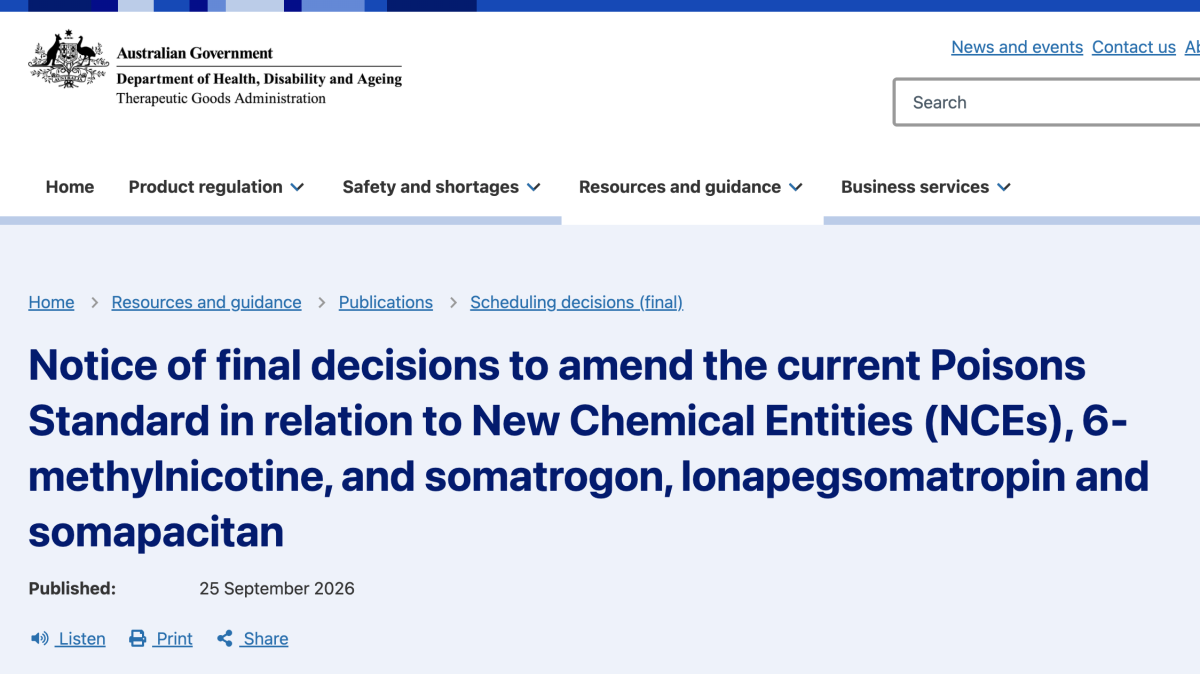
Australia's Therapeutic Goods Administration published a final decision on September 25 to classify 6-methylnicotine as a Schedule 9 prohibited substance under the Poisons Standard, effective October 1, 2026. TGA said the chemical has been reported in e-cigarette liquids sold in Australia and marketed as nicotine-free or nicotine alternatives, while evidence also indicates its use in preparations such as oral pouches. The government originally proposed a Schedule 7 classification but ultimately adopted the stricter Schedule 9 designation, citing acute toxicity, dependence risk, use in unapproved consumer products and misleading marketing.
News
Sep.29 by 2Firsts Perspectives
South Korea's Tobacco Plan Excludes 6-Methyl Nicotine as Customs Tightens Import Controls and Analog Liquid Imports Fall 83%
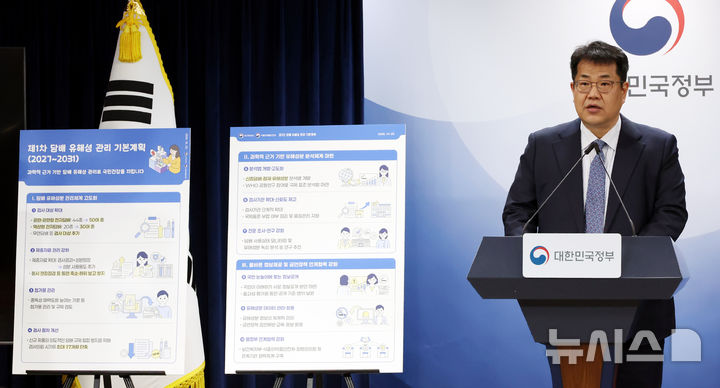
South Korea's government unveiled its first Tobacco Harm Management Basic Plan for 2027–2031 on October 29, 2026, proposing broader testing of vaping and heated tobacco products while excluding nicotine analogs such as 6-methyl nicotine. Synthetic nicotine came under tobacco regulation on April 24, and a June investigation found 6-methyl nicotine in 12 liquid inhalation products marketed as nicotine-free. Customs data released in September showed that imports of nicotine analog solutions fell 83.3%, from 12 metric tons in January–April to 2 metric tons in May–August. By September 20, imports had reached approximately 15 metric tons for the year, with 99.99% originating from China. Customs authorities have tightened pre-clearance testing and supply-chain documentation requirements, while the MFDS expects to complete its assessment of nicotine analog hazards by the end of 2026.
Regulations
Nov.04