Vietnamese Police Carry Out Routine Inspection of E-cigarette Trafficking

Regulations by 2FIRSTS.ai
Jan.09.2024
Vietnamese Police Carry Out Routine Inspection of E-cigarette Trafficking
Vietnamese market authorities, in collaboration with law enforcement agencies, conducted routine inspections to clamp down on illegal e-cigarette sales.

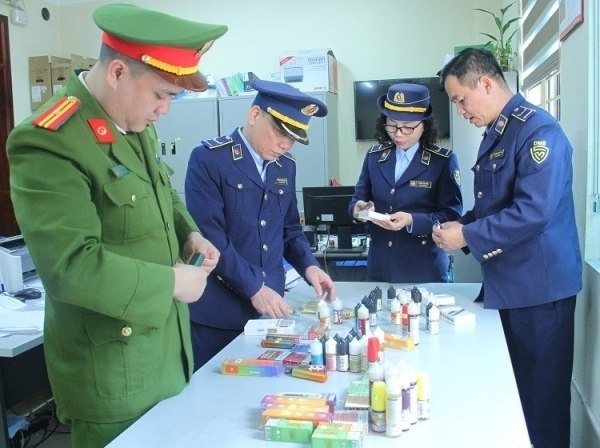
According to Vietnamese media outlet congthuong, on January 9th, the latest update from the law enforcement authorities in Lao Cai Province states that in order to enhance social security and order during the upcoming Lunar New Year, the first and fifth teams of Lao Cai Province Market Management collaborated with the Anti-Corruption, Economic Crime, Smuggling, and Environmental Crime Investigation Department of the local police to conduct a routine inspection.


During the inspection process, the owner of the establishment at the location, Ngo Thi Q. (born in 1991, residing at No. 3 in Kintan District), failed to produce valid documentation or invoices for the goods in question. The inspected items comprised 75 e-cigarettes and e-cigarette oil devices, with a total shipment value of nearly 40 million Vietnamese dong (approximately $1,750).


Subsequently, the market regulatory department of the Old Street province confiscated and destroyed all e-cigarette products of unknown origin, in accordance with the legal provisions. At the same time, the female business owner, Ngo Thi Q., was fined 325,000 Vietnamese dong. This action aims to seek further investigation into the source of the goods and to take strict measures against any violations. This operation demonstrates the determination of the public security agencies to combat illegal business operations and ensure social security.


We welcome news tips, article submissions, interview requests, or comments on this piece.

Please contact us at info@2firsts.com, or reach out to Alan Zhao, CEO of 2Firsts, on LinkedIn


Notice

1.  This article is intended solely for professional research purposes related to industry, technology, and policy. Any references to brands or products are made purely for objective description and do not constitute any form of endorsement, recommendation, or promotion by 2Firsts.

2.  The use of nicotine-containing products — including, but not limited to, cigarettes, e-cigarettes, nicotine pouchand heated tobacco products — carries significant health risks. Users are responsible for complying with all applicable laws and regulations in their respective jurisdictions.

3.  This article is not intended to serve as the basis for any investment decisions or financial advice. 2Firsts assumes no direct or indirect liability for any inaccuracies or errors in the content.

4.  Access to this article is strictly prohibited for individuals below the legal age in their jurisdiction.


Copyright


This article is either an original work created by 2Firsts or a reproduction from third-party sources with proper attribution. All copyrights and usage rights belong to 2Firsts or the original content provider. Unauthorized reproduction, distribution, or any other form of unauthorized use by any individual or organization is strictly prohibited. Violators will be held legally accountable.

For copyright-related inquiries, please contact: info@2firsts.com


AI Assistance Disclaimer


This article may have been enhanced using AI tools to improve translation and editorial efficiency. However, due to technical limitations, inaccuracies may occur. Readers are encouraged to refer to the cited sources for the most accurate information.

We welcome any corrections or feedback. Please contact us at: info@2firsts.com

2Firsts Data | China’s Vape-Related Exports Rise 16.5% in July 2026 as U.S.-Bound Shipments Jump 53.5%
China’s vape-related exports reached $1.047 billion in July 2026, up 16.5% year on year and the highest monthly total of the year. Growth was heavily concentrated in the U.S., where exports jumped 53.5% to $404 million and accounted for 94.9% of the overall increase. Exports to all other markets rose just 1.2%. By category, nicotine-containing non-combustible products—primarily vapes—under HS24041200 rose 24.7% and generated 95.5% of the total increase. Vape-device exports under HS85434000 fell 0.4%, while other nicotine-substitute products under HS24041990 grew 88.9% but remained comparatively small.
DATA
Aug.24
Product | JNR Launches Shisha Hookah 70K E-Hookah With 60ml E-Liquid and 0.6% Nicotine
JNR has introduced the Shisha Hookah 70K, a high-capacity rechargeable disposable vape designed around a hookah-inspired experience. The device comes prefilled with 60ml of e-liquid at 6mg/ml (0.6%) nicotine strength, alongside a 1,000mAh rechargeable battery and a 0.38Ω single mesh coil. It also features adjustable airflow and battery and e-liquid level displays. JNR claims the device can deliver up to 70,000 puffs and offers more than 20 flavors. Retail listings for the product have appeared in markets including Tunisia.
Market
Aug.24 by 2Firsts Perspectives
Kantar Study Finds More Than 93% of Vape Products in Ukraine Fail Regulatory Requirements
According to Interfax-Ukraine, a study conducted by market research firm Kantar Ukraine at the request of major tobacco companies found that more than 93% of vape products in Ukraine did not fully comply with regulatory requirements. The research examined product categories, brand distribution and consumer purchasing channels, showing that pod systems and disposable vapes represent major segments of the market, while offline retail remains the dominant purchasing channel. The findings highlight ongoing compliance challenges in Ukraine’s vape market.
Aug.26
South Korean Lawmaker Jeong Jin-wook Pushes Synthetic Nicotine Vape Probe, Highlighting Supply Chain and Tax Concerns
South Korean lawmaker Jeong Jin-wook has again called for stronger government action against liquid synthetic nicotine vape manufacturers and sellers, alleging that some businesses may have avoided regulation through product labeling changes and corporate restructuring. According to Newsworks, JNILBO and other Korean reports, Jeong has held his third press conference on the issue, calling for a government-wide investigation. The dispute involves whether synthetic nicotine products should fall under tobacco regulations, tax implications and supply-chain transparency. South Korean government agencies have previously said some estimates of potential tax losses cannot be verified due to limited sales data.
Jul.27
Retail Case Study | Wisconsin Vape Market One Year After New Regulations: Johnny Vapes Reports 80% Sales Decline as Consumers Shift Online and Across State Lines
According to WNCY on August 24, 2026, some independent vape retailers in Wisconsin say they have faced significant business pressure one year after new vape regulations took effect. Johnny Vapes, a retailer operating in northeast Wisconsin, said its store count fell from seven locations to four, sales declined by about 80%, and roughly 90% of its inventory was affected. Retailers said some consumers have shifted to online purchases or traveled to neighboring Michigan to buy vape products. The case highlights how local regulations can reshape retail operations, inventory management and consumer purchasing patterns.
Aug.28
WIRED Investigation: Chinese-Made Vapes Turn to 6-Methyl-Nicotine and Other Analogs, Challenging U.S. Regulation
U.S. technology and investigative publication WIRED has examined how nicotine analogs are emerging as a new challenge for the country’s vape regulatory framework. The article argues that after the U.S. expanded federal oversight of nicotine products in 2022, some manufacturers began using nicotine-like compounds such as 6-methyl-nicotine that may fall outside existing definitions. Researchers cited by WIRED said some nicotine analogs could be more potent than traditional nicotine, although human health impacts remain unclear. U.S. policymakers are considering broader definitions of nicotine to bring these compounds under federal oversight.
Jul.27