Recently, Altria has published a research report on its official website titled "Widespread Mislabeling of Nicotine Content in Illegal E-Cigarette Products." The report states that an independent laboratory was commissioned to investigate illegal e-cigarette brands in the US market, and found that 9 out of 12 e-cigarette brands made false statements about the source of nicotine; 10 out of 12 e-cigarette brands falsely reported their nicotine concentration; and 2 out of 14 e-cigarette products claiming to be "nicotine-free" actually contained excessive amounts of nicotine.
The "zero nicotine" e-cigarette product contains nicotine.
The report states that out of 14 "nicotine-free" e-cigarette products, 2 of them contain more than trace amounts of nicotine.
Due to lack of product management and manufacturing controls, illegal manufacturers are circumventing regulations and selling e-cigarette products labeled as "zero nicotine" that actually contain excessive amounts of nicotine, including:
After testing, it was found that Mr Fog Zero Nicotine SW15000 Banana Pancake contains 1.8% nicotine. North FT12000 Zero Nicotine Blue Slurpie was also tested and found to contain 0.1% nicotine by weight.
False claims about the source of nicotine.
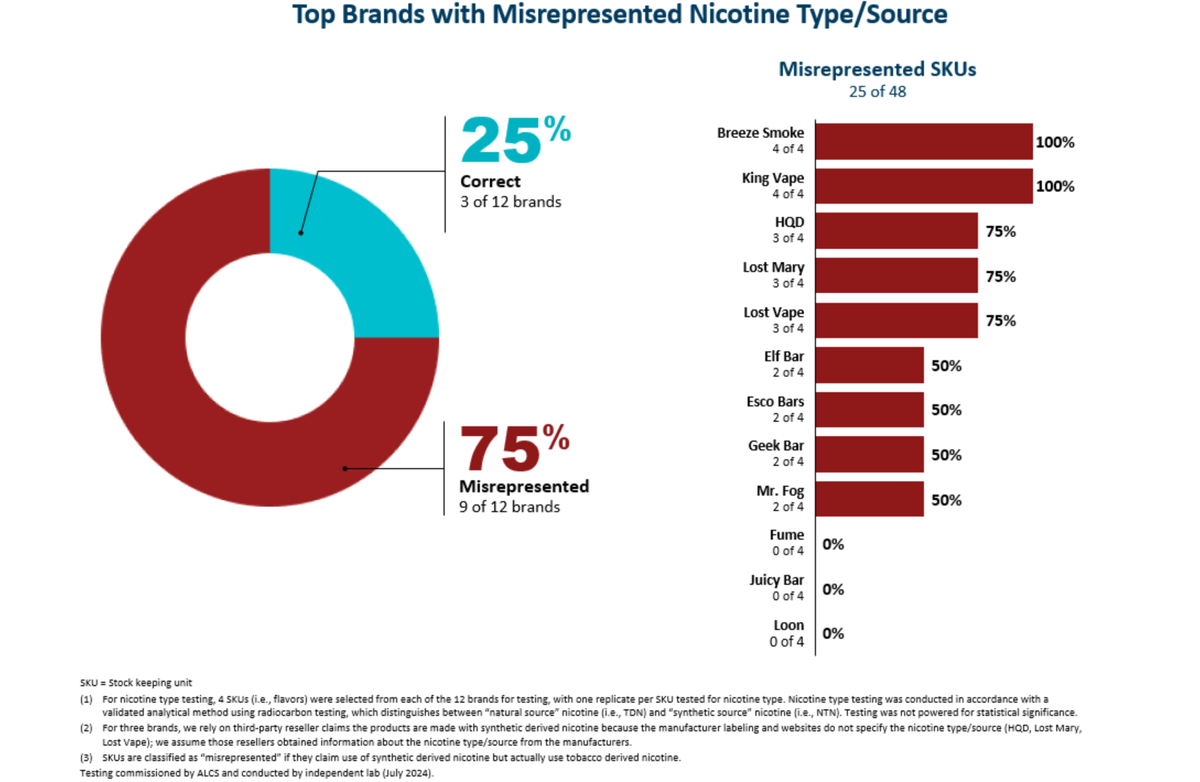
The report stated that out of 12 illegal e-cigarette brands, 9 made false claims about the source of nicotine, with the type of nicotine used not matching their claims.
In 2020, manufacturers began heavily introducing flavored disposable products to the American e-cigarette market, claiming to use synthetic nicotine to circumvent the FDA's 2020 PMTA submission deadline. However, in 2022, the U.S. Congress granted the FDA regulatory authority over synthetic nicotine products. Consequently, any e-cigarette products released to the market after the established deadline (whether they contain synthetic nicotine or tobacco-derived nicotine) are considered illegal until they obtain a Marketing Authorization Order (MGO). This includes products transitioning from synthetic nicotine to tobacco-derived nicotine. Additionally, illegal manufacturers prioritize profit over product integrity and may choose to use tobacco-derived nicotine over synthetic nicotine for cost-saving reasons.
Analysis:
Among the 12 brands, only 3 brands (25%) accurately labeled the type/source of nicotine.
Nine out of twelve brands (75%) were found to have misleading labels.
Specific Brands Misleading Situations:
100% Misleading Labeling: Both Breeze Smoke and King Vape (all 4 SKUs for each) have misleading labeling.
75% of misleading labeling: HQD, Lost Mary, and Lost Vape (3 out of 4 SKUs for each brand have misleading labeling).
50% misleading labeling: Elf Bar, Esco Bars, Geek Bar, and Mr. Fog (2 out of 4 SKUs for each brand have misleading labeling).
0% mislabeling: Fume, Juicy Bar, and Loon (all SKUs correctly labeled).
Incorrect labeling of nicotine concentration
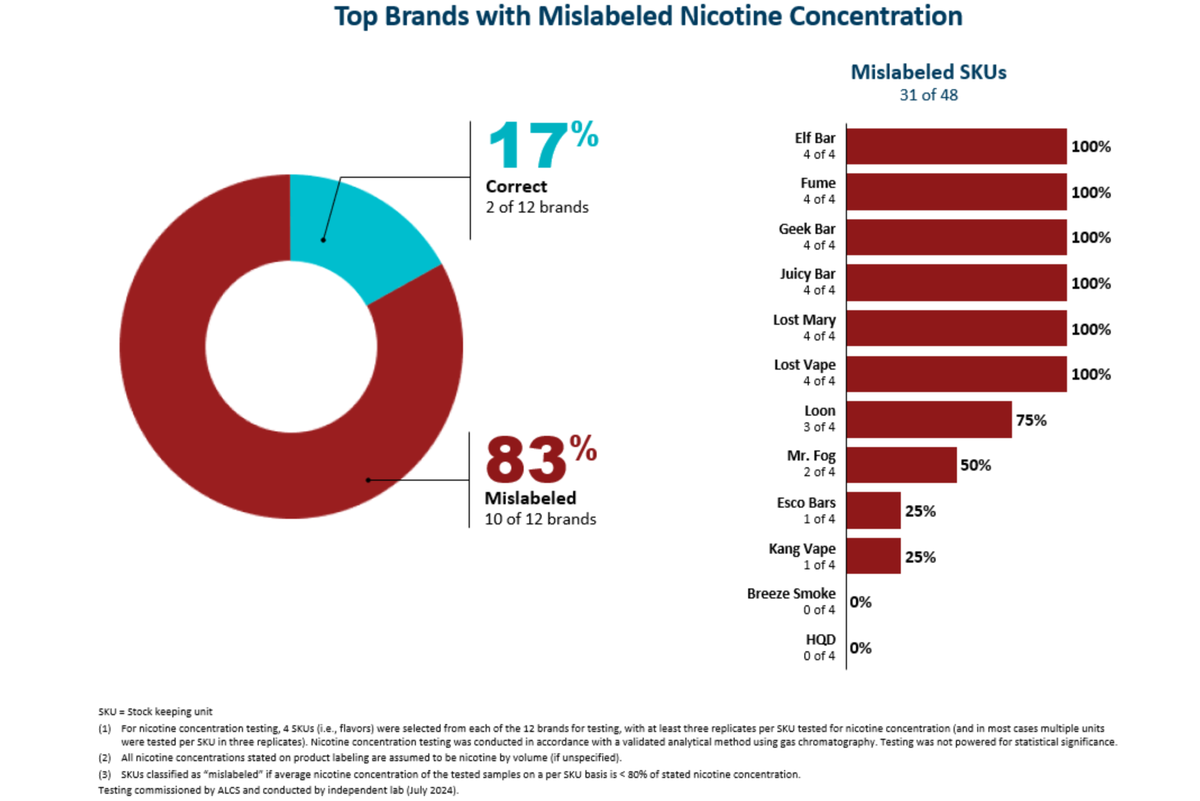
The report states that 10 out of 12 illegal e-cigarette brands inaccurately labeled their nicotine concentrations, with 6 brands mislabeling the nicotine content in all tested SKUs.
The illegal market lacks manufacturing and quality control, leading to serious consumer protection issues, including potential product safety risks. Similar to mislabeling of nicotine sources, profit-driven illegal manufacturers may be incentivized to lower nicotine levels to reduce their product costs. Of particular concern is that lower-than-labeled nicotine concentrations may affect the ability of adult smokers to transition from combustible cigarettes.
Overall situation:
17% of products (2 brands) accurately labeled the nicotine concentration.
83% (10 brands) of products have inaccurate nicotine concentration labeling.
Specific brand performance:
100% of the products from the brands Elf Bar, Fume, Geek Bar, Juicy Bar, Lost Mary, and Lost Vape have labeling errors on all four SKUs.
75% of the tags were inaccurate: Three out of the four SKUs were mislabeled as "Loon.
50% of the items were mislabeled, specifically Mr. Fog (2 out of 4 SKUs).
25% labeling error: Esco Bars and Kang Vape (1 out of 4 SKUs from each brand have labeling errors).
0% error rate (all correct): Breeze Smoke and HQD (all 4 SKUs correctly labeled).
Click to access the original report.
We welcome news tips, article submissions, interview requests, or comments on this piece.
Please contact us at info@2firsts.com, or reach out to Alan Zhao, CEO of 2Firsts, on LinkedIn
Notice
1. This article is intended solely for professional research purposes related to industry, technology, and policy. Any references to brands or products are made purely for objective description and do not constitute any form of endorsement, recommendation, or promotion by 2Firsts.
2. The use of nicotine-containing products — including, but not limited to, cigarettes, e-cigarettes, nicotine pouchand heated tobacco products — carries significant health risks. Users are responsible for complying with all applicable laws and regulations in their respective jurisdictions.
3. This article is not intended to serve as the basis for any investment decisions or financial advice. 2Firsts assumes no direct or indirect liability for any inaccuracies or errors in the content.
4. Access to this article is strictly prohibited for individuals below the legal age in their jurisdiction.
Copyright
This article is either an original work created by 2Firsts or a reproduction from third-party sources with proper attribution. All copyrights and usage rights belong to 2Firsts or the original content provider. Unauthorized reproduction, distribution, or any other form of unauthorized use by any individual or organization is strictly prohibited. Violators will be held legally accountable.
For copyright-related inquiries, please contact: info@2firsts.com
AI Assistance Disclaimer
This article may have been enhanced using AI tools to improve translation and editorial efficiency. However, due to technical limitations, inaccuracies may occur. Readers are encouraged to refer to the cited sources for the most accurate information.
We welcome any corrections or feedback. Please contact us at: info@2firsts.com