Analysis of China's E-cigarette Exports to Czech Republic in February 2024

Industry Insight by 2FIRSTS
Apr.19.2024
Analysis of China's E-cigarette Exports to Czech Republic in February 2024
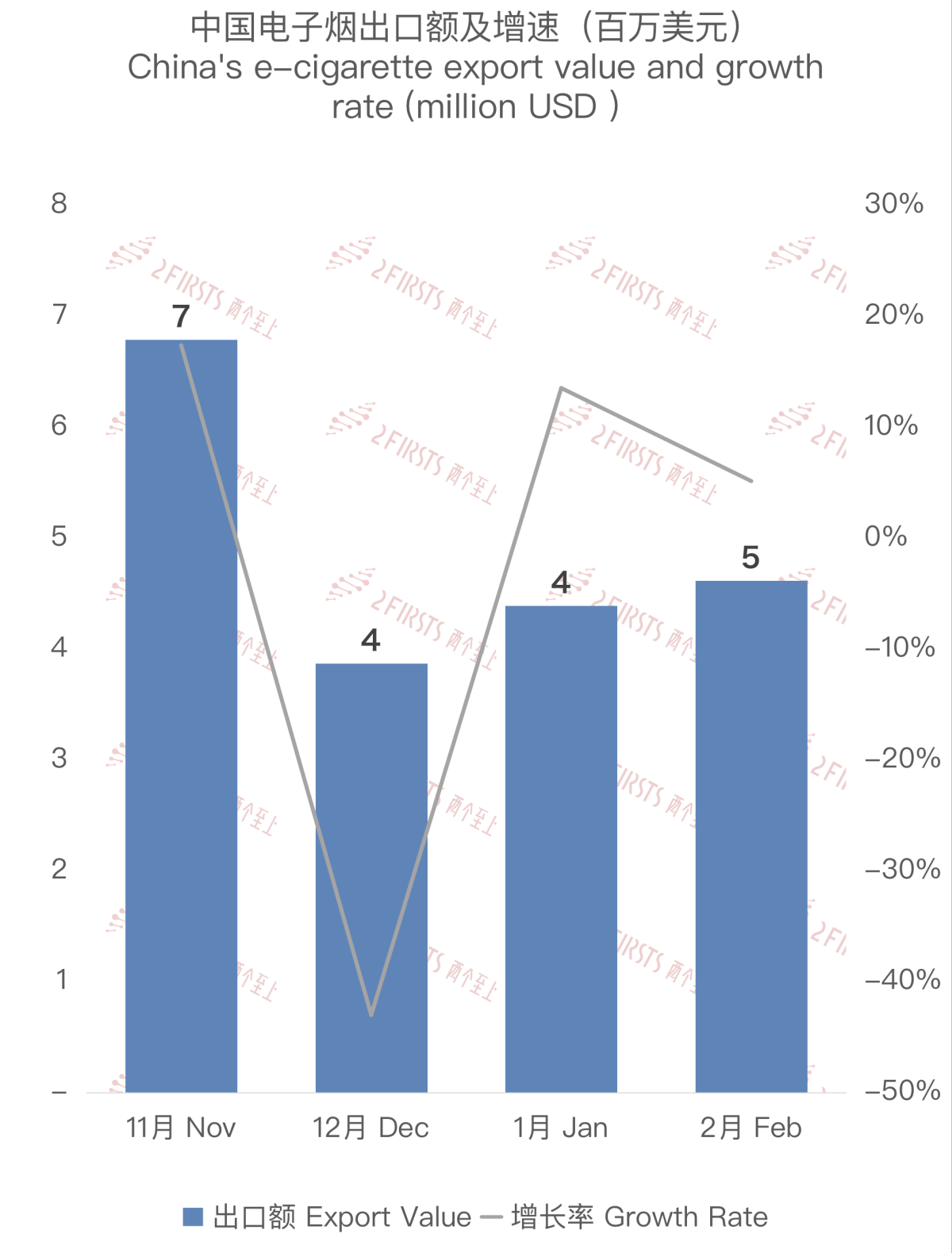
Chinese e-cigarette exports to Czech Republic reached $4.61 million in February 2024, with a 5.13% increase compared to last month.

According to updated trade data from the General Administration of Customs of the People's Republic of China, 2FIRSTS compiled the e-cigarette export data to the Czech Republic for February 2024. Details are as follows:
Analysis of China's E-cigarette Exports to Czech Republic in February 2024
Image source: 2FIRSTS (Mincy diagram)


The export volume was approximately $4.61 million, with a month-on-month increase of 5.13% and a year-on-year increase of 11.62%.
Analysis of China's E-cigarette Exports to Czech Republic in February 2024
Source of the image: 2FIRSTS (Mincy drawing)


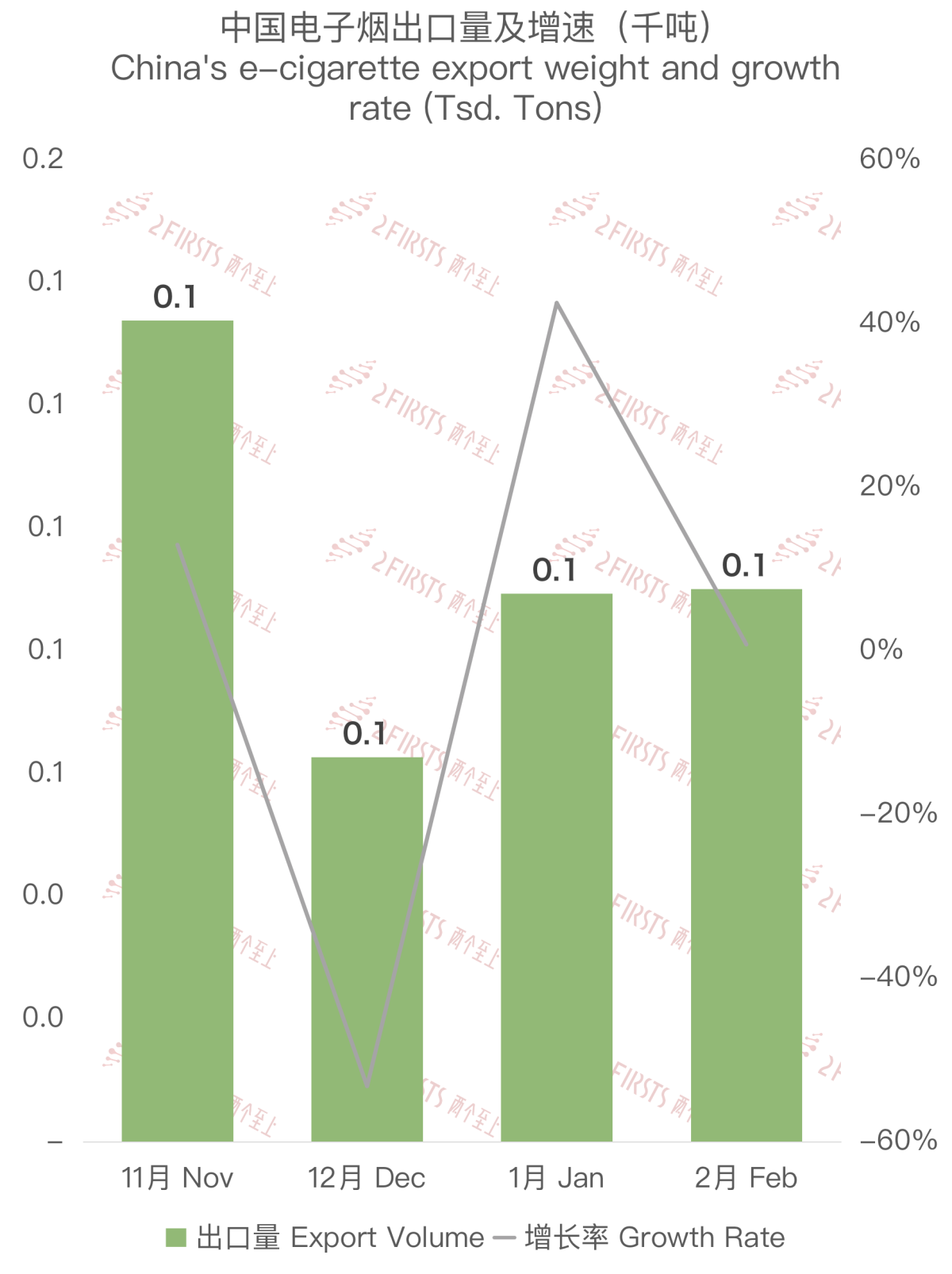
The export volume is about 90 tons, an increase of 0.82% month-on-month and an increase of 82.55% year-on-year.
Analysis of China's E-cigarette Exports to Czech Republic in February 2024
Image source: 2FIRSTS (Drawn by Mincy)


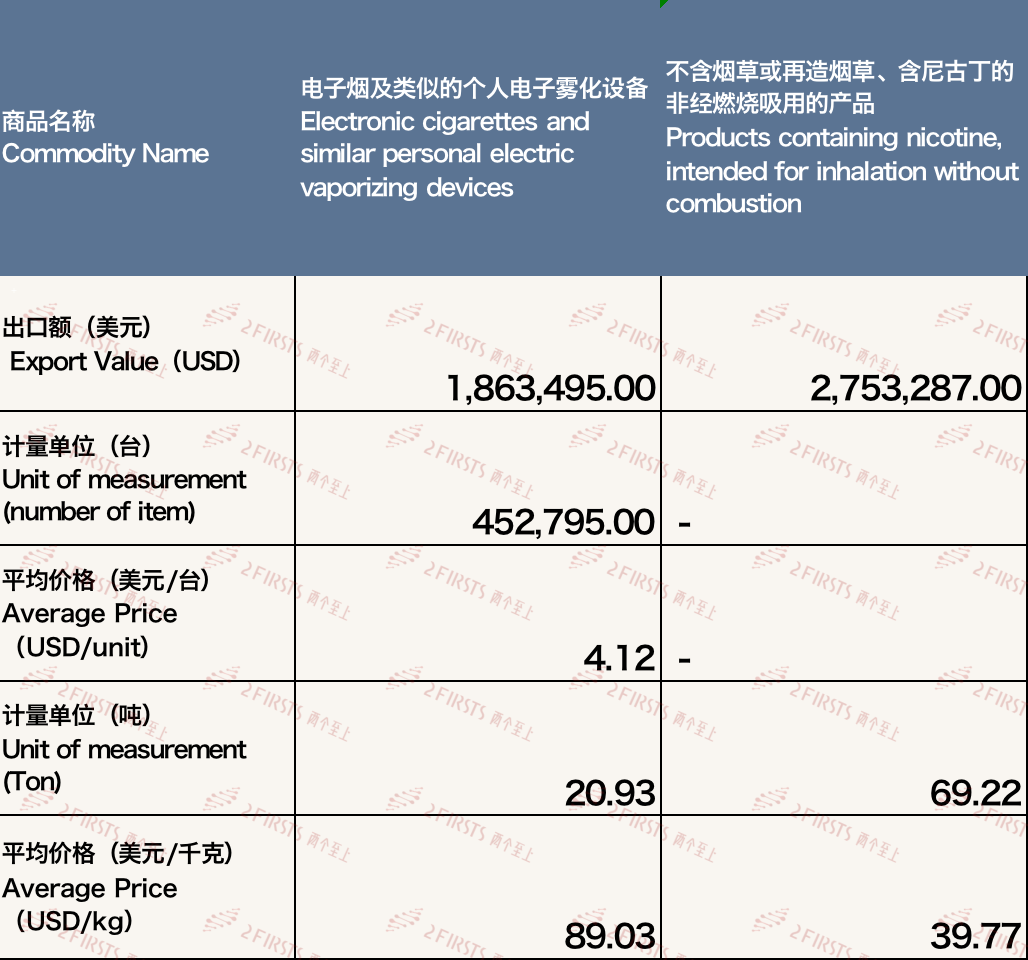
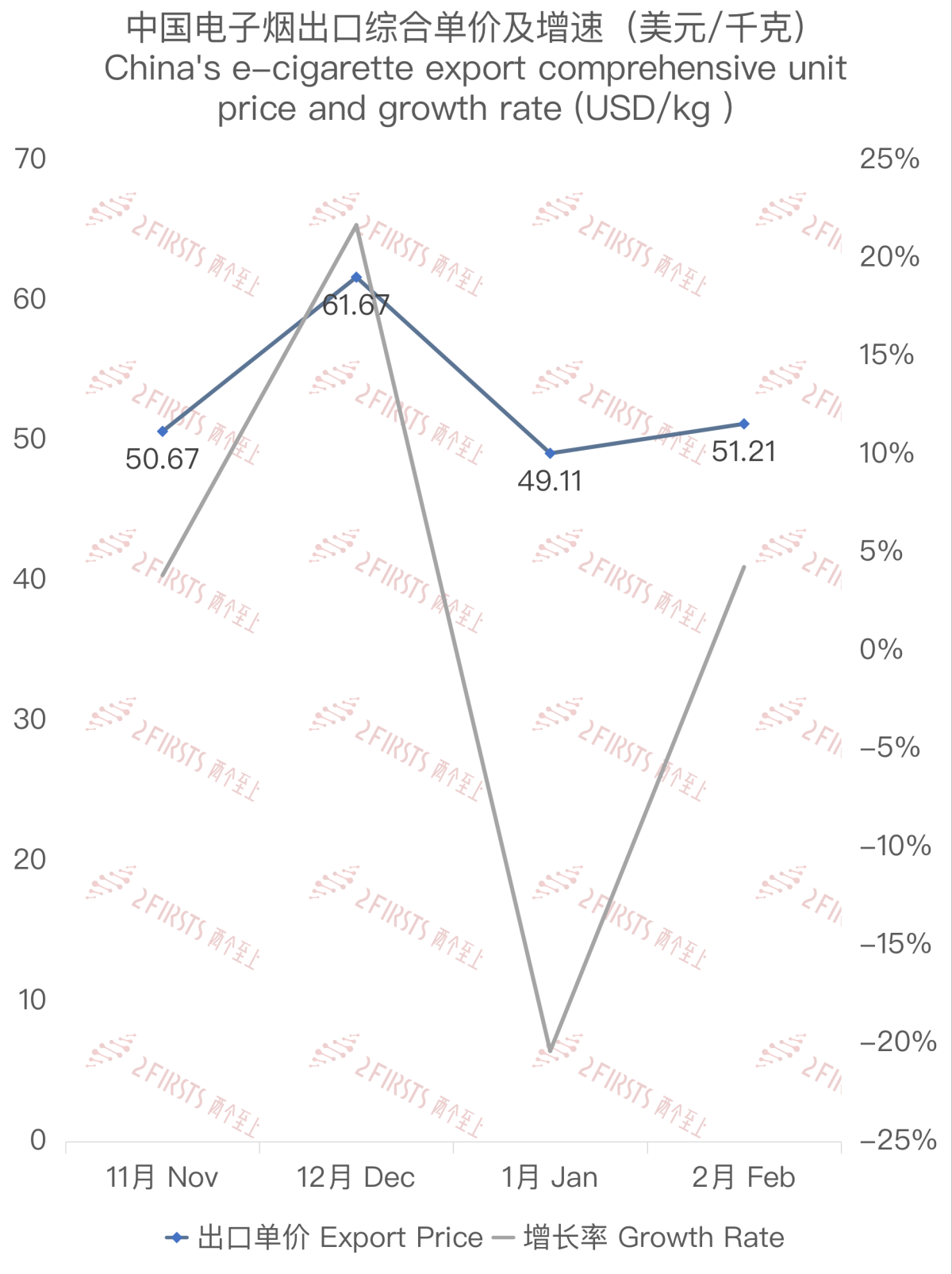
The export unit price is $51.21 per kilogram, an increase of 4.28% month-on-month, and a decrease of 38.86% year-on-year; The average price of "e-cigarettes and similar personal electronic vaporizers" is $4.12 per unit.
Analysis of China's E-cigarette Exports to Czech Republic in February 2024
Image source: 2FIRSTS (Mapped by Mincy)


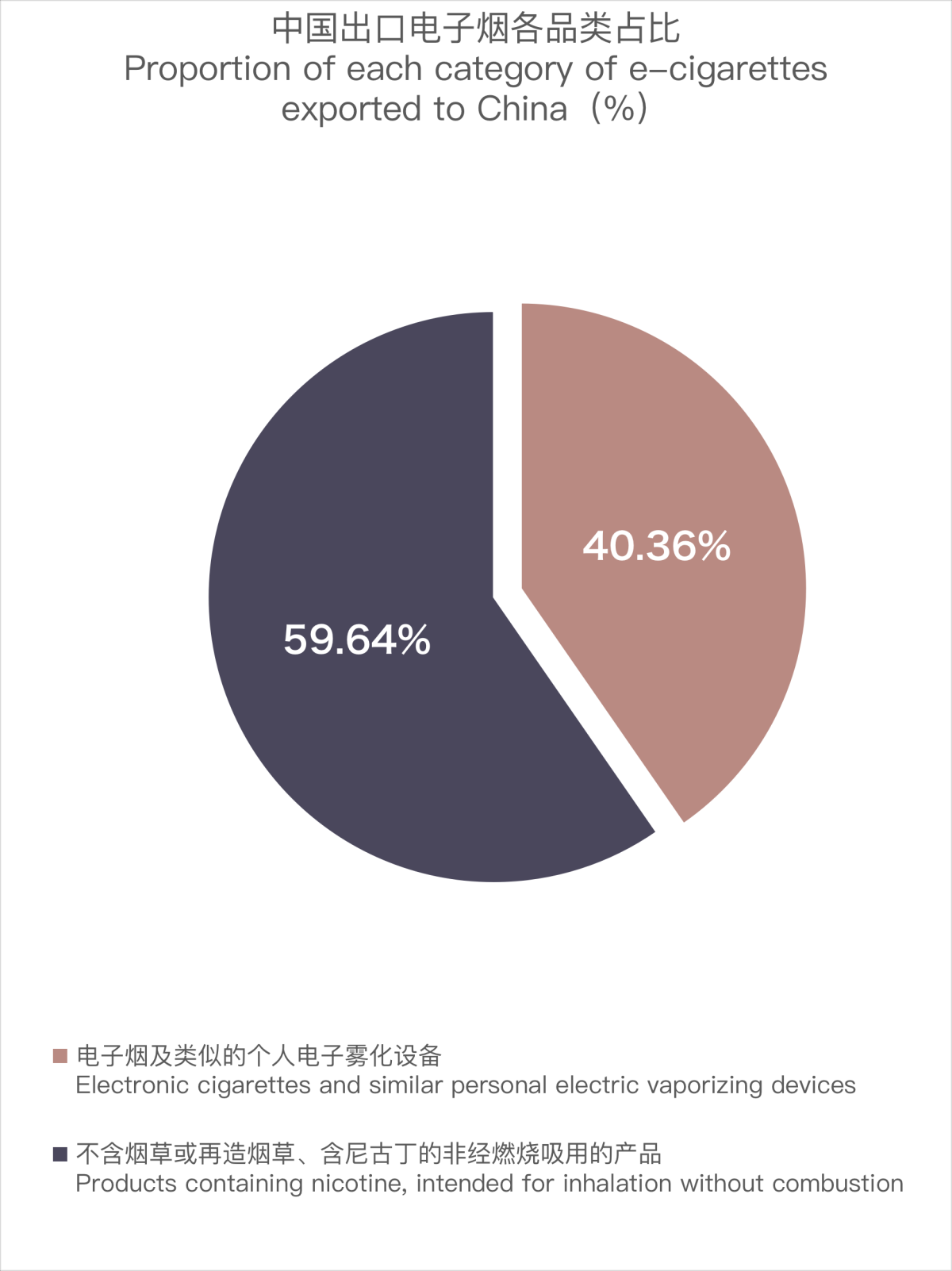
Among them, "e-cigarettes and similar personal electronic vaporizing devices" account for 40.36% of the export category, while "non-tobacco or non-reconstituted tobacco, nicotine-containing non-combustible products for oral use" account for 59.64%.
Analysis of China's E-cigarette Exports to Czech Republic in February 2024
Image source: 2FIRSTS (Mincy mapping)


We welcome news tips, article submissions, interview requests, or comments on this piece.

Please contact us at info@2firsts.com, or reach out to Alan Zhao, CEO of 2Firsts, on LinkedIn


Notice

1.  This article is intended solely for professional research purposes related to industry, technology, and policy. Any references to brands or products are made purely for objective description and do not constitute any form of endorsement, recommendation, or promotion by 2Firsts.

2.  The use of nicotine-containing products — including, but not limited to, cigarettes, e-cigarettes, nicotine pouchand heated tobacco products — carries significant health risks. Users are responsible for complying with all applicable laws and regulations in their respective jurisdictions.

3.  This article is not intended to serve as the basis for any investment decisions or financial advice. 2Firsts assumes no direct or indirect liability for any inaccuracies or errors in the content.

4.  Access to this article is strictly prohibited for individuals below the legal age in their jurisdiction.


Copyright


This article is either an original work created by 2Firsts or a reproduction from third-party sources with proper attribution. All copyrights and usage rights belong to 2Firsts or the original content provider. Unauthorized reproduction, distribution, or any other form of unauthorized use by any individual or organization is strictly prohibited. Violators will be held legally accountable.

For copyright-related inquiries, please contact: info@2firsts.com


AI Assistance Disclaimer


This article may have been enhanced using AI tools to improve translation and editorial efficiency. However, due to technical limitations, inaccuracies may occur. Readers are encouraged to refer to the cited sources for the most accurate information.

We welcome any corrections or feedback. Please contact us at: info@2firsts.com

Research | Swedish Study Finds Oral Lesions in 79% of Examined Nicotine Pouch Users, With Distinct Tissue Responses
A new Swedish study found oral mucosal lesions in 79% of examined nicotine pouch users and 89% of tobacco-derived snus users, with different tissue-response patterns between the two categories. For manufacturers and regulators, the findings shift attention toward product formulation, flavouring, pouch materials and local oral exposure, not only whether a product contains tobacco. The study found no higher prevalence of caries or periodontal disease, but it could not establish causality, long-term outcomes or differences between individual products or designs.
Special Report
Jul.27
Iowa Enforces Vape Registry Law as Retailers Warn Product Limits Could Increase Store Pressure
Iowa has begun enforcing its vape registry law, requiring vape products to be registered before they can be legally sold in the state. The move follows a decision by the U.S. Court of Appeals for the Eighth Circuit to lift an injunction that had blocked enforcement. Retailers have warned that tighter product availability rules could increase pressure on vape shops. One Iowa retailer said that if only a limited number of products remain available, many stores could face significant business challenges.
Aug.06
How Large Is France’s Off-Channel Tobacco Market? Logista Says It Has Become Structural, While the Official Estimate Is 17.7% and Some Industry Studies Put It Above 50%
Logista France says tobacco consumption outside France’s official tobacconist network has become a large and structural market phenomenon, but official and industry estimates differ sharply. France’s TAFE study estimates that 17.7% of tobacco consumption escaped domestic taxation in 2023, with most of that volume attributed to cross-border purchasing rather than street sales. Some industry studies use broader off-channel definitions and put the figure above 50%. Meanwhile, French Customs seized 547.94 tonnes of tobacco in 2025, up 12%, showing continued pressure from illicit trade.
Sep.04
FDA Authorizes JUUL2, Cites Adult Switching Amid Efforts to Speed PMTA Reviews
The FDA authorized the JUUL2 device and tobacco- and menthol-flavored pods on Aug. 28, bringing the number of authorized e-cigarette products to 48. The agency highlighted complete switching among adult smokers, with six-week switching rates reaching 28.4%–49.3% for the menthol pod. The decision comes as FDA works to speed PMTA reviews, reduce application backlogs and expand authorized e-cigarette and nicotine-pouch products while maintaining enforcement priorities for unauthorized products.
Regulations
Aug.29
Product | HQD SiSA 80K Enters the U.S. Market With a Hookah-Inspired Approach to the High-Capacity Disposable Segment
The HQD SiSA 80K Hookah Disposable Vape has appeared across U.S. and cross-border online retail channels. The device comes prefilled with 28ml of e-liquid, uses a 5% nicotine salt configuration and carries a brand claim of up to 80,000 puffs. Beyond puff count, the product differentiates itself through hookah-inspired features including adjustable airflow, a flowing-water sound effect and flavor options associated with traditional hookah consumption.
Aug.18
Product | R.J. Reynolds Launches Four Flavored Vuse Pro Pods for Vuse Alto Devices in U.S.
R.J. Reynolds Vapor Company has introduced Vuse Pro prefilled pods in Peach, Berry, Watermelon and Fresh Mint in selected U.S. states. Vuse’s U.S. website says the pods are intended for use with existing Vuse Alto devices. Each contains 2.0 mL of e-liquid at 5.0% nicotine by weight, uses nicotine salts and is offered in two- and four-pod packs. Reynolds said the rollout includes mandatory ID scanning for every purchase, purchase limits, stronger retailer-accountability requirements and strict age-restricted marketing standards. The four pods have not received marketing authorization from the U.S. Food and Drug Administration.
Sep.10