BAT Japan Launches New Glo Pod with StickSeal Technology

Aug.01.2024
BAT Japan Launches New Glo Pod with StickSeal Technology
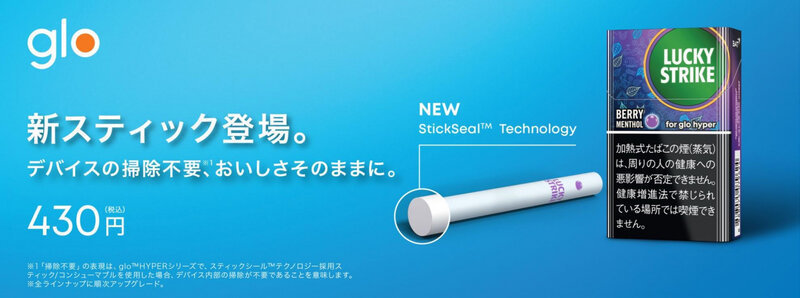
BAT Japan announces new Glo pod product launch on August 6 with StickSeal technology, priced at 430 yen.

According to a report from Biglobe on August 1st, British American Tobacco Japan (BAT Japan) has announced that their new heat-not-burn tobacco brand Glo's new pod product will officially be launched on August 6th, with a retail price of 430 Japanese yen (approximately $2.87 USD). The main focus of this product update is the introduction of a new technology called "StickSeal", and it will be the first time all nine models under the "Lucky Strike" brand will be included in the lineup.


The "StickSeal" technology seals off the front end of the tobacco stick to prevent tobacco residue from remaining inside the heating device, eliminating the need for cleaning. This update will be rolled out in major convenience stores and the official online stores of Glo & VELO in Japan. Supermarkets and national tobacco specialty stores will begin selling the updated products on September 2 and October 8 respectively.


At the same time, BAT Japan announced the gradual launch of a new model of heated tobacco device, "glo HYPER," starting from August 6. The flagship model, "glo HYPER pro," features the latest "HEATBOOST" technology (with a maximum heating temperature of 300°C) and adjustable heating mode "TASTE SELECT." It is also designed to be more compact and portable, catering to the needs of a variety of users.


We welcome news tips, article submissions, interview requests, or comments on this piece.

Please contact us at info@2firsts.com, or reach out to Alan Zhao, CEO of 2Firsts, on LinkedIn


Notice

1.  This article is intended solely for professional research purposes related to industry, technology, and policy. Any references to brands or products are made purely for objective description and do not constitute any form of endorsement, recommendation, or promotion by 2Firsts.

2.  The use of nicotine-containing products — including, but not limited to, cigarettes, e-cigarettes, nicotine pouchand heated tobacco products — carries significant health risks. Users are responsible for complying with all applicable laws and regulations in their respective jurisdictions.

3.  This article is not intended to serve as the basis for any investment decisions or financial advice. 2Firsts assumes no direct or indirect liability for any inaccuracies or errors in the content.

4.  Access to this article is strictly prohibited for individuals below the legal age in their jurisdiction.


Copyright


This article is either an original work created by 2Firsts or a reproduction from third-party sources with proper attribution. All copyrights and usage rights belong to 2Firsts or the original content provider. Unauthorized reproduction, distribution, or any other form of unauthorized use by any individual or organization is strictly prohibited. Violators will be held legally accountable.

For copyright-related inquiries, please contact: info@2firsts.com


AI Assistance Disclaimer


This article may have been enhanced using AI tools to improve translation and editorial efficiency. However, due to technical limitations, inaccuracies may occur. Readers are encouraged to refer to the cited sources for the most accurate information.

We welcome any corrections or feedback. Please contact us at: info@2firsts.com

2Firsts Hosts U.S. Compliance Briefing on Building PMTA Support Capabilities Across the Nicotine Supply Chain
2Firsts held a U.S. compliance briefing in Shenzhen to help vaping, heated tobacco and nicotine pouch supply chain companies strengthen PMTA support capabilities. The event focused on supplier documentation, quality systems, traceability, TPMF/TPMP pathways, age verification and customer audit readiness as U.S. compliance expectations increasingly extend deeper into the nicotine supply chain.
Events
Jun.12
South Korea Rejects 16 Trillion Won Tax-Evasion Claim Over Chinese Synthetic Nicotine
The South Korean government rejected allegations that Chinese synthetic-nicotine e-liquids were linked to about 16 trillion won in tobacco tax evasion, saying China does not ban synthetic nicotine exports and the estimate is difficult to verify, while acknowledging that pre-law synthetic-nicotine inventory is effectively difficult to tax.
Market
Jun.25
Malaysia Nicotine Vape Market Faces Legal Uncertainty Over Tax and Poisons List Ruling
Malaysia’s Finance Minister Anwar Ibrahim said duties and taxes on nicotine-containing vape products will be determined in line with the Court of Appeal’s ruling on whether liquid or gel nicotine can be exempted from the Poisons List under the Poisons Act 1952, a case that could affect the legal basis for vape taxation, retail sales and future ban policy.
Jun.29
Nearly Half of Seoul Vape Vending Machines Bypassed by Fake IDs, Raising Youth Access Concerns
Seoul city authorities inspected 339 tobacco vending machines at e-cigarette retailers and found that 168, or 49.5%, allowed purchases using fake IDs, showing that unmanned retail terminals and adult-verification systems remain a major enforcement gap after e-cigarettes were brought under tobacco regulation.
Market
Jul.03 by 2Firsts Perspectives
Bringing Tax and Insurance Into Nicotine Regulation: Insights From a Tobacco Harm-Reduction Report
A smoke-free nicotine policy report argues that tobacco harm reduction should move beyond product bans and health warnings into tax policy, insurance pricing and risk-based regulation. While some projections remain open to debate, the report highlights a wider challenge: nicotine products, technologies and consumer behavior have changed sharply over the past decade, and regulatory systems may need new tools to better align tobacco control with harm-reduction goals.
Jun.08
How AI Is Rewriting the Talent Playbook for the Nicotine Industry: JTI’s Case
AI is moving from a back-office tool to a core organizational capability in the nicotine industry. Based on JTI’s responses, this 2Firsts feature examines how AI is reshaping talent strategy, internal mobility, decision-making and human accountability as global tobacco companies compete in the shift toward new nicotine categories.
Jun.17