Belfastlive: New Rules to Double Fine for Selling E-Cigarettes to Minors

Regulations by 2FIRSTS.ai
Jan.08.2024
Belfastlive: New Rules to Double Fine for Selling E-Cigarettes to Minors
Shops selling e-cigarettes to minors in Lisburn and Castlereagh may face doubled fines of £500, according to Belfastlive.

According to a report by Belfastlive on January 5th, shops selling e-cigarettes to minors may face a new regulation that could double the fine to £500. This measure will be implemented in the Lisburn and Castlereagh areas.


The Environmental Committee recently reviewed a report on product test purchases, which highlighted that out of the 36 surveyed shops, five were caught selling nicotine inhalation products to a 15-year-old volunteer. This constitutes a serious violation of the legal requirement for a minimum purchasing age of 18.


James Bell, the city councillor for the East District of Daniel County, has raised concerns about current regulations, suggesting that a £250 fine may not be severe enough for selling e-cigarettes to minors. He advocates for increasing the fine to £500 to have a stronger deterrent effect. Pat Carty, the representative of the Social Democrats and Labour Party in North Lisbon, also emphasized a zero-tolerance stance on child protection.


The head of the environmental department has responded by stating that if these fines are not established in next year's tax rates, they will consider making modifications. If they are already included in the regulations, the council's proposal to increase fixed penalties will be reported to the relevant departments. This new regulation aims to strengthen the regulation of e-cigarette sales, especially when it involves minors.


We welcome news tips, article submissions, interview requests, or comments on this piece.

Please contact us at info@2firsts.com, or reach out to Alan Zhao, CEO of 2Firsts, on LinkedIn


Notice

1.  This article is intended solely for professional research purposes related to industry, technology, and policy. Any references to brands or products are made purely for objective description and do not constitute any form of endorsement, recommendation, or promotion by 2Firsts.

2.  The use of nicotine-containing products — including, but not limited to, cigarettes, e-cigarettes, nicotine pouchand heated tobacco products — carries significant health risks. Users are responsible for complying with all applicable laws and regulations in their respective jurisdictions.

3.  This article is not intended to serve as the basis for any investment decisions or financial advice. 2Firsts assumes no direct or indirect liability for any inaccuracies or errors in the content.

4.  Access to this article is strictly prohibited for individuals below the legal age in their jurisdiction.


Copyright


This article is either an original work created by 2Firsts or a reproduction from third-party sources with proper attribution. All copyrights and usage rights belong to 2Firsts or the original content provider. Unauthorized reproduction, distribution, or any other form of unauthorized use by any individual or organization is strictly prohibited. Violators will be held legally accountable.

For copyright-related inquiries, please contact: info@2firsts.com


AI Assistance Disclaimer


This article may have been enhanced using AI tools to improve translation and editorial efficiency. However, due to technical limitations, inaccuracies may occur. Readers are encouraged to refer to the cited sources for the most accurate information.

We welcome any corrections or feedback. Please contact us at: info@2firsts.com

Philippines Mandates Safety Certification for Nicotine Pouches, Gives Industry 12 Months to Comply
The Philippines Department of Trade and Industry has placed nicotine pouches under mandatory product certification through Department Administrative Order No. 26-07, Series of 2026. Nicotine pouches must obtain a Philippine Standard, or PS, license before they can be manufactured, imported, packed, distributed or sold in the country. The regime requires testing for nicotine content, pH and water activity, while packaging must disclose nicotine strength, ingredients, allergens, batch information, the PS certification mark and prescribed health warnings. Existing market participants have a 12-month transition period to comply.
Regulations
Oct.12
IVG Parent Secures HMRC Excise Warehouse and Duty Stamp Approvals Ahead of UK Vape Tax
Acme Vape Ltd, the company behind UK vaping brand IVG, has received HM Revenue & Customs approval to operate an excise warehouse for vaping products and participate in the Vaping Duty Stamps Scheme. The UK's Vaping Products Duty will take effect on October 1, 2026, at a flat rate of £2.20 per 10ml of vaping liquid. Acme Vape Ltd says its approved warehouse in Preston will become operational under the new regime on the same date.
Regulations
Sep.18 by 2Firsts Perspectives
Reynolds Seeks to Join Altria Lawsuit Challenging FDA PMTA Rule and Calculation of 180-Day Deadline
Three R.J. Reynolds companies are seeking to intervene in a lawsuit filed by Altria subsidiaries Helix Innovations and NJOY challenging the FDA's 2021 PMTA final rule. The companies dispute how the agency uses Acceptance and Filing reviews and completeness determinations to establish when the Tobacco Control Act's 180-day decision period begins. Reynolds has also linked prolonged PMTA reviews to competition from unauthorized vaping products. The FDA, meanwhile, has been accelerating reviews and reducing its backlog.
Sep.14
Latest UK ONS Data: Vaping Rate Edges Down to 9.9% in 2025, a Year After Overtaking Cigarette Smoking
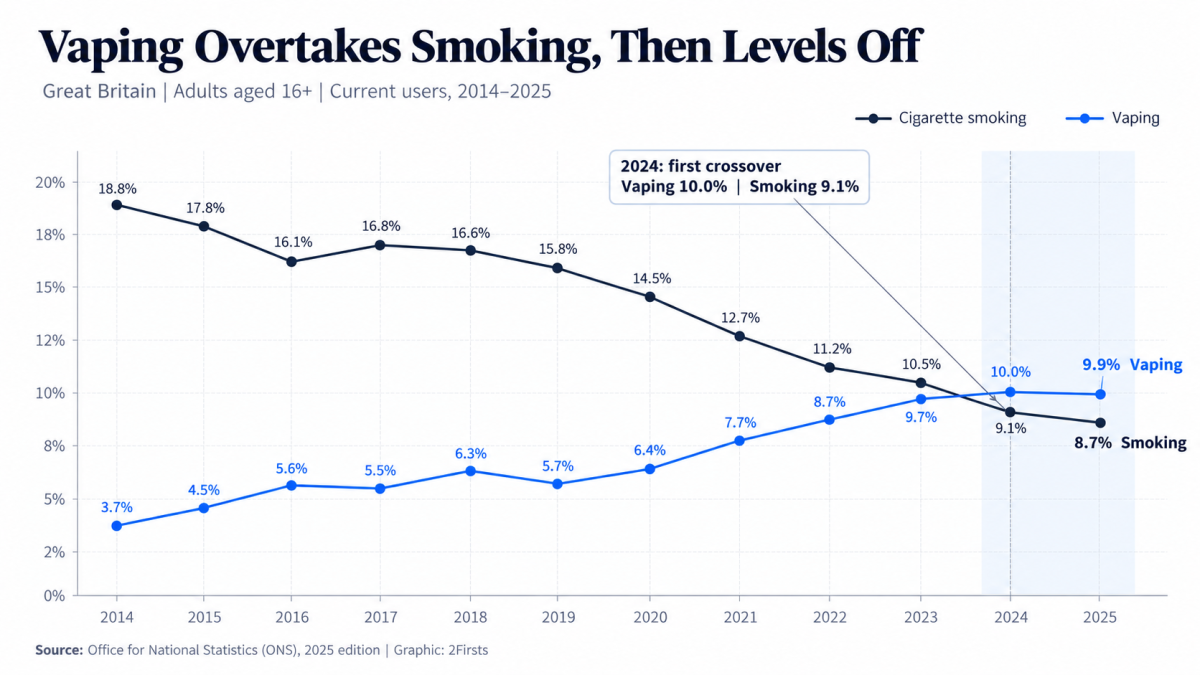
Vaping prevalence in Great Britain edged down to 9.9% in 2025 from 10.0% in 2024, with the number of adult users holding at approximately 5.4 million for a second consecutive year, according to the Office for National Statistics (ONS). E-cigarette use had risen from 6.4% in 2020 to 10.0% in 2024, when it exceeded cigarette smoking prevalence for the first time. Cigarette smoking continued to decline to 8.7% in 2025, widening the gap to 1.2 percentage points. Daily vaping declined slightly, while usage among adults aged 25–34 increased despite falling rates in other age groups.
DATA
Oct.14
F1 Faces Renewed Pressure Over Tobacco and Nicotine Sponsorships as 67 Groups Target ZYN and VELO Ahead of Madrid Race
Ahead of the Formula 1 race in Madrid, 67 Spanish and international public-health, medical and consumer organizations have sent an open letter to F1 President and CEO Stefano Domenicali calling for an end to sponsorships linked to the tobacco and nicotine industry, including nicotine pouches, vaping products and heated tobacco. The letter focuses on Philip Morris International’s ZYN partnership with Ferrari and British American Tobacco’s long-running partnership with McLaren and exposure for VELO. The campaign follows a March letter in which more than 160 organizations worldwide made a similar request to Formula 1.
Sep.10
South Korea Extends Vape Rules to Unmanned Stores After Bringing Synthetic Nicotine Under Tobacco Law
South Korea's Ministry of Gender Equality and Family said on September 14 that it plans to designate unmanned e-cigarette stores as businesses where minors are prohibited from entering or working. Operators would be required to verify customers' ages and display notices restricting access by minors. The proposal is open for public comment through October 6. The move follows an April expansion of South Korea's statutory tobacco definition that brought products made with natural or synthetic nicotine under the Tobacco Business Act. Nicotine-free liquids and products using nicotine analogues such as 6-methylnicotine, however, remain an emerging regulatory issue.
Sep.21