Key Takeaways
- FDA issued guidance on enforcement priorities for unauthorized ENDS and nicotine pouch products on May 8, 2026.
- The guidance applies to certain ENDS and nicotine pouch products marketed without FDA authorization.
- FDA said it will target illegal imports, counterfeit products, misdeclared products and products without required PMTAs.
- FDA does not intend to prioritize enforcement in certain cases where applications have been accepted and filed.
- FDA will create a public list identifying manufacturers and products it does not intend to prioritize for enforcement under the policy.
2Firsts, May 9, 2026
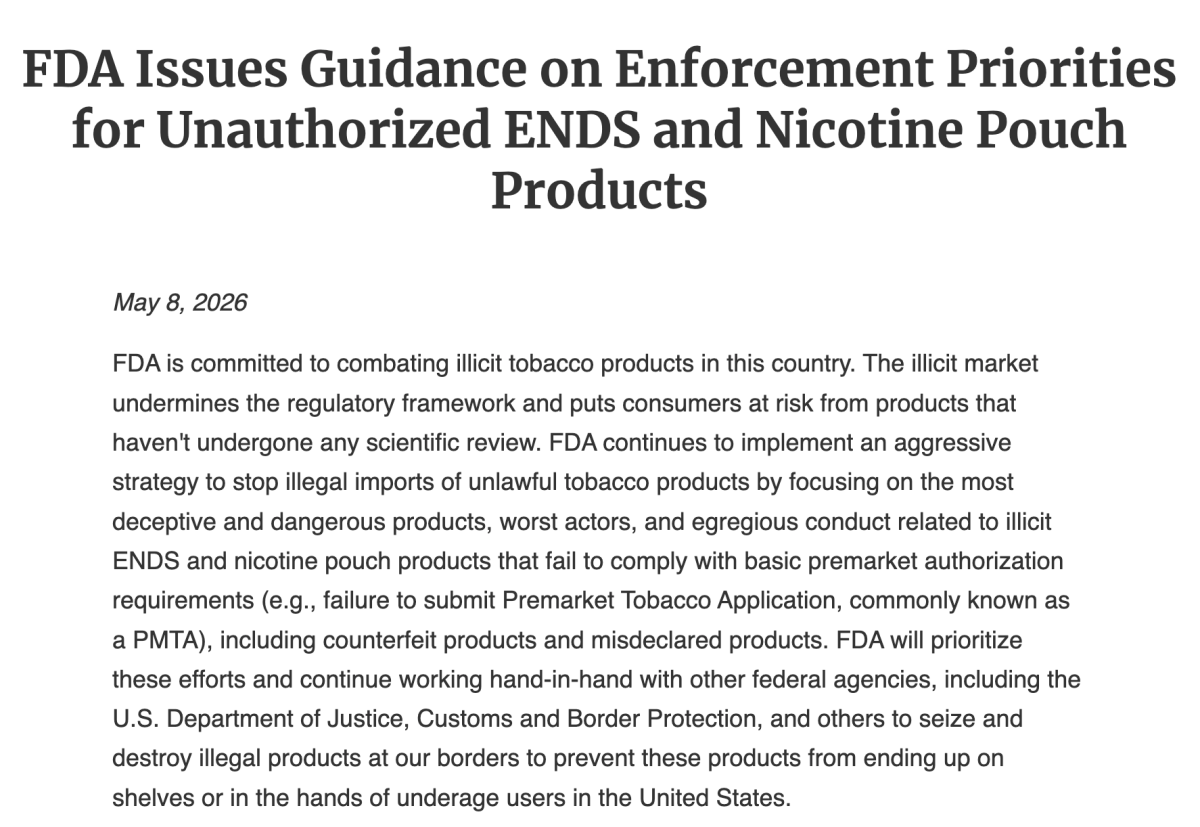
According to the U.S. Food and Drug Administration, the agency issued guidance titled “Enforcement Priorities for Certain New Tobacco Products Marketed Without Premarket Authorization,” describing enforcement policies for certain unauthorized electronic nicotine delivery system products and nicotine pouch products.
FDA said it will continue targeting illicit tobacco products
FDA said it is committed to combating illicit tobacco products in the United States. The agency said the illicit market undermines the regulatory framework and puts consumers at risk from products that have not undergone scientific review.
FDA said it continues to implement an aggressive strategy to stop illegal imports of unlawful tobacco products. The agency said its focus is on the most deceptive and dangerous products, worst actors and egregious conduct related to illicit ENDS and nicotine pouch products.
Enforcement focus includes counterfeit and misdeclared products
FDA said the products at issue include illicit ENDS and nicotine pouch products that fail to comply with basic premarket authorization requirements, such as failure to submit a premarket tobacco product application, commonly known as a PMTA. The agency also identified counterfeit products and misdeclared products.
FDA said it will prioritize these efforts and continue working with federal agencies including the U.S. Department of Justice and Customs and Border Protection to seize and destroy illegal products at U.S. borders, preventing them from reaching shelves or underage users in the United States.
Guidance explains when FDA does not intend to prioritize enforcement
FDA said the guidance describes when it does not intend to prioritize enforcement for ENDS and nicotine pouch products marketed without FDA authorization.
More specifically, FDA said it does not intend to prioritize enforcement if a product has a pending application that has been accepted and filed, or when a manufacturer has a pending and accepted supplemental PMTA.
For non-tobacco flavored ENDS products, FDA said it must also determine that the application includes data necessary to evaluate whether the product is appropriate for the protection of public health.
Products appealing to minors are excluded from the policy
FDA said it does not intend to prioritize enforcement against products falling within those categories unless they have certain elements presumed to appeal to underage users. Examples include depicting a cartoon-like fictional character, disguising the product’s nature as a vaping product, or resembling a children’s toy, phone or gaming platform.
FDA will also consider health and safety concerns
FDA said it would also consider whether a tobacco product presents a significant public health or safety concern beyond that generally presented by e-cigarette, nicotine pouch or other tobacco products.
The agency listed examples including high nicotine content; serious adverse experiences or a larger number of unexpected adverse experiences compared with authorized e-cigarettes or nicotine pouch products; lack of child-resistant packaging under the Child Nicotine Poisoning Prevention Act of 2015; and potential fire hazards.
FDA will create a public list
To promote transparency for consumers and retailers, FDA said it will create and maintain a publicly available list identifying manufacturers and products that the agency does not intend to prioritize for enforcement under the policy.
FDA said manufacturers whose products are marketed under the policy and who want to be listed on the public webpage should contact the regulatory health project manager for their pending application or email CTP_enforcementpriorities@fda.hhs.gov. Manufacturers using the email address will receive an automated reply and can expect more details regarding the webpage soon.
Non-prioritization does not indicate likely authorization
FDA said the fact that an e-cigarette or nicotine pouch product falls within any enforcement policy described in the guidance does not affect whether the product is likely to receive premarket authorization.
Image Source: FDA
We welcome news tips, article submissions, interview requests, or comments on this piece.
Please contact us at info@2firsts.com, or reach out to Alan Zhao, CEO of 2Firsts, on LinkedIn
Notice
1. This article is intended solely for professional research purposes related to industry, technology, and policy. Any references to brands or products are made purely for objective description and do not constitute any form of endorsement, recommendation, or promotion by 2Firsts.
2. The use of nicotine-containing products — including, but not limited to, cigarettes, e-cigarettes, nicotine pouchand heated tobacco products — carries significant health risks. Users are responsible for complying with all applicable laws and regulations in their respective jurisdictions.
3. This article is not intended to serve as the basis for any investment decisions or financial advice. 2Firsts assumes no direct or indirect liability for any inaccuracies or errors in the content.
4. Access to this article is strictly prohibited for individuals below the legal age in their jurisdiction.
Copyright
This article is either an original work created by 2Firsts or a reproduction from third-party sources with proper attribution. All copyrights and usage rights belong to 2Firsts or the original content provider. Unauthorized reproduction, distribution, or any other form of unauthorized use by any individual or organization is strictly prohibited. Violators will be held legally accountable.
For copyright-related inquiries, please contact: info@2firsts.com
AI Assistance Disclaimer
This article may have been enhanced using AI tools to improve translation and editorial efficiency. However, due to technical limitations, inaccuracies may occur. Readers are encouraged to refer to the cited sources for the most accurate information.
We welcome any corrections or feedback. Please contact us at: info@2firsts.com