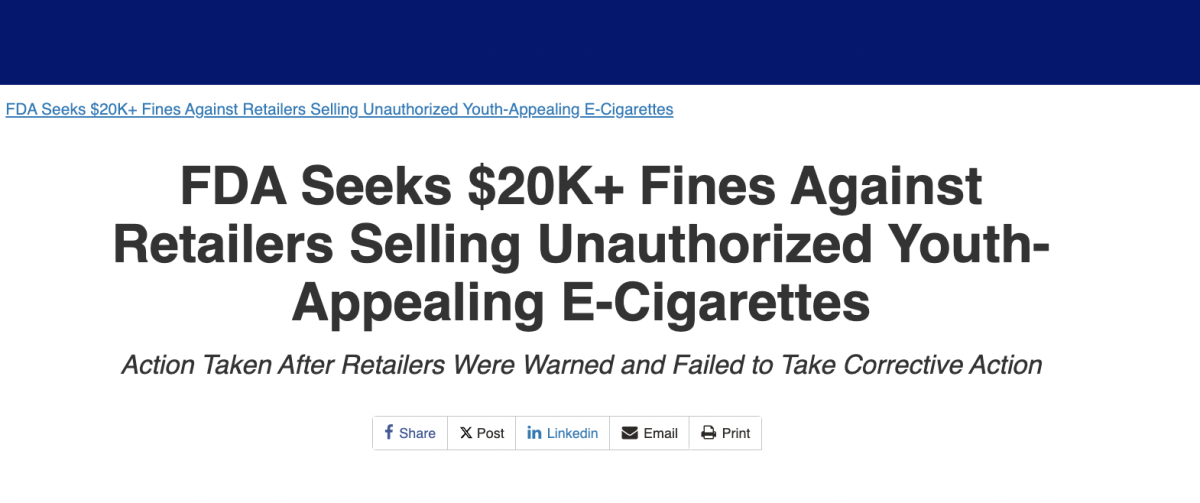
On January 30, in Pacific Standard Time, the Food and Drug Administration (FDA) Tobacco News Center released a statement announcing that civil penalty notices have been issued to 21 physical retailers for selling unauthorized Esco Barse-cigarettes, a popular brand among young people. Earlier, the FDA had sent warning letters to each retailer accusing them of selling unauthorized tobacco products. However, subsequent inspections revealed that these retailers failed to rectify their non-compliant actions, leading the agency to seek penalties of up to $20,678 for each retailer.
Today, the FDA announced its first ever civil penalties against the unauthorized sale of Esco Bars e-cigarettes, following complaints. Data indicates that these products are attractive to American teenagers. According to the 2023 National Youth Tobacco Survey, Esco Bars is the second most popular brand among adolescent e-cigarette users. Approximately one-fifth of middle and high school students who have used e-cigarettes in the past 30 days reported using Esco Bars during that period.
Dr. Brian King, director of the FDA Center for Tobacco Products, has stated that these retailers have been warned about the potential consequences if they continue to sell unauthorized e-cigarettes. They were supposed to responsibly address their violations, but they have chosen not to do so and must now face the repercussions of their decision. The FDA will not stand idly by and tolerate non-compliance with the law.
Currently, $20,678 is the maximum civil penalty amount that the FDA can seek from each retailer for a single violation, which aligns with similar fines sought by the FDA in September, November, and December 2023 for the sale of unauthorized Elf Bar products. Retailers have the option to pay the fine, reach a settlement agreement based on mitigating factors, request an extension for their defense, or present a defense and request a hearing. Retailers who fail to take action within 30 days of receiving a complaint will face default orders, resulting in full penalties being imposed.
Today's civil fines action is just the latest move by the FDA in its efforts to rid the entire supply chain of unauthorized e-cigarettes, especially those popular among young people. As of January 30, 2024, the FDA has issued over 440 warning letters and 88 civil penalty notices to retailers, including brick-and-mortar stores and online retailers, accusing them of selling unauthorized tobacco products. In addition to actions involving retailers, the FDA has also sent warning letters to over 660 companies for illegal manufacturing and/or distribution of unauthorized novel tobacco products, including e-cigarettes. The agency has also filed civil penalty complaints against 48 e-cigarette companies, accusing them of manufacturing unauthorized products, and has sought injunctions against seven unauthorized e-cigarette product manufacturers in coordination with the U.S. Department of Justice.
The FDA will continue its compliance and enforcement actions against the manufacturing, distribution, importation, or sale of unauthorized e-cigarette products, including imposing civil penalties on retailers found in violation of the law. As of now, the FDA has authorized 23 tobacco-flavored e-cigarette products and devices, which are the only legally sold e-cigarette products in the United States. Selling or distributing e-cigarettes without FDA market authorization is a violation of the Federal Food, Drug, and Cosmetic Act.
We welcome news tips, article submissions, interview requests, or comments on this piece.
Please contact us at info@2firsts.com, or reach out to Alan Zhao, CEO of 2Firsts, on LinkedIn
Notice
1. This article is intended solely for professional research purposes related to industry, technology, and policy. Any references to brands or products are made purely for objective description and do not constitute any form of endorsement, recommendation, or promotion by 2Firsts.
2. The use of nicotine-containing products — including, but not limited to, cigarettes, e-cigarettes, nicotine pouchand heated tobacco products — carries significant health risks. Users are responsible for complying with all applicable laws and regulations in their respective jurisdictions.
3. This article is not intended to serve as the basis for any investment decisions or financial advice. 2Firsts assumes no direct or indirect liability for any inaccuracies or errors in the content.
4. Access to this article is strictly prohibited for individuals below the legal age in their jurisdiction.
Copyright
This article is either an original work created by 2Firsts or a reproduction from third-party sources with proper attribution. All copyrights and usage rights belong to 2Firsts or the original content provider. Unauthorized reproduction, distribution, or any other form of unauthorized use by any individual or organization is strictly prohibited. Violators will be held legally accountable.
For copyright-related inquiries, please contact: info@2firsts.com
AI Assistance Disclaimer
This article may have been enhanced using AI tools to improve translation and editorial efficiency. However, due to technical limitations, inaccuracies may occur. Readers are encouraged to refer to the cited sources for the most accurate information.
We welcome any corrections or feedback. Please contact us at: info@2firsts.com