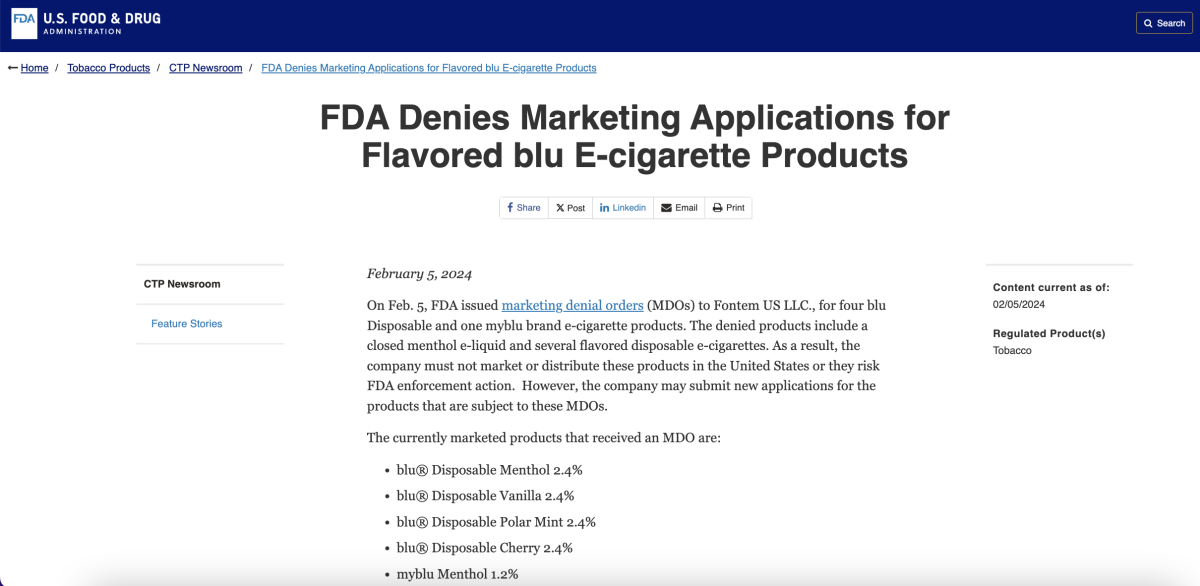
On February 5th, the U.S. Food and Drug Administration (FDA) issued a Marketing Denial Order (MDO) to Fontem US LLC., a subsidiary of Imperial Tobacco. The MDO targeted four blu disposable e-cigarette products and one myblu-cigarette product. These rejected products included closed-system mint-flavored e-cigarette liquid and several flavored disposable e-cigarettes. As a result, the company is prohibited from promoting or selling these products in the U.S. market or else they will face enforcement actions from the FDA. However, the company has the option to submit new applications for these MDO-rejected products.
The current products on the market that have been rejected by the MDO include:
The blu® brand offers a range of disposable electronic cigarettes in various flavors and nicotine levels. These include the blu® disposable menthol flavor with a nicotine strength of 2.4%, blu® disposable vanilla flavor with a nicotine strength of 2.4%, blu® disposable icy menthol flavor with a nicotine strength of 2.4%, and blu® disposable cherry flavor with a nicotine strength of 2.4%. Additionally, the myblu product line offers a mint flavor with a lower nicotine strength of 1.2%.
The FDA evaluates premarket tobacco product applications (PMTAs) based on public health standards, considering the risks and benefits of the products for the entire population. Following a review of the company's PMTAs, the FDA has determined that these applications lack sufficient evidence to demonstrate that allowing these products to be marketed is appropriate for public health protection, as required by the 2009 Family Smoking Prevention and Tobacco Control Act.
Specifically, the application lacks sufficient evidence regarding the harmful and potentially harmful constituents in an aerosol product and the battery safety of multiple products. Furthermore, the applicant has not provided sufficient data to demonstrate the potential benefits of the new product for adult smokers, including the risks of complete smoking cessation or significant reduction in smoking, which would outweigh the risks for adolescents. According to the 2023 National Youth Tobacco Survey, currently, 6% of adolescents who use e-cigarettes report using the blu brand e-cigarette.
According to the rigorous scientific review by the FDA, tobacco products that have received marketing denials are prohibited from being introduced or shipped into interstate commerce and must be withdrawn from the market. Manufacturers, distributors, and retailers that violate the law by selling or distributing these products across state lines may face the risk of enforcement actions. The FDA has provided information on MDO on its tobacco product marketing orders webpage.
Today's action is part of the FDA's ongoing effort to ensure that all new tobacco products cannot legally be marketed without undergoing scientific review and obtaining FDA authorization. Since 2020, the FDA has received over 26 million applications for deemed products and has made decisions on 99% of these applications. To date, the FDA has authorized 23 e-cigarette devices and tobacco flavor e-cigarette products. The FDA provides a publicly available list of authorized e-cigarette products and devices, which retailers, consumers, and others can consult to understand which products can be legally marketed.
We welcome news tips, article submissions, interview requests, or comments on this piece.
Please contact us at info@2firsts.com, or reach out to Alan Zhao, CEO of 2Firsts, on LinkedIn
Notice
1. This article is intended solely for professional research purposes related to industry, technology, and policy. Any references to brands or products are made purely for objective description and do not constitute any form of endorsement, recommendation, or promotion by 2Firsts.
2. The use of nicotine-containing products — including, but not limited to, cigarettes, e-cigarettes, nicotine pouchand heated tobacco products — carries significant health risks. Users are responsible for complying with all applicable laws and regulations in their respective jurisdictions.
3. This article is not intended to serve as the basis for any investment decisions or financial advice. 2Firsts assumes no direct or indirect liability for any inaccuracies or errors in the content.
4. Access to this article is strictly prohibited for individuals below the legal age in their jurisdiction.
Copyright
This article is either an original work created by 2Firsts or a reproduction from third-party sources with proper attribution. All copyrights and usage rights belong to 2Firsts or the original content provider. Unauthorized reproduction, distribution, or any other form of unauthorized use by any individual or organization is strictly prohibited. Violators will be held legally accountable.
For copyright-related inquiries, please contact: info@2firsts.com
AI Assistance Disclaimer
This article may have been enhanced using AI tools to improve translation and editorial efficiency. However, due to technical limitations, inaccuracies may occur. Readers are encouraged to refer to the cited sources for the most accurate information.
We welcome any corrections or feedback. Please contact us at: info@2firsts.com