FDA Warns Five Online Retailers about Unauthorized E-Cigarette Sales

Regulations by 2FIRSTS Leona Zhu
Feb.29.2024
FDA Warns Five Online Retailers about Unauthorized E-Cigarette Sales
FDA warns five online retailers for selling unauthorized e-cigarette products, targeting popular brands favored by youth, violating federal law.

According to the official website of the U.S. Food and Drug Administration (FDA), on February 28th, the FDA announced that it has issued warning letters to five online retailers for selling unauthorized e-cigarette products. These letters point out that the disposable e-cigarette products being sold under well-known brands such as ELFBAR/EB Design/EB Create, Funky Republic, Lost Mary, Hyde, Breeze, and Cali Bars.


The FDA continues to issue warning letters based on ongoing surveillance of multiple monitoring systems to identify products that are popular or appealing to adolescents. According to findings from the 2023 National Youth Tobacco Survey, e-cigarettes have been the most commonly used tobacco product among middle and high school students for the past 10 years.


Among over 2.1 million reported cases of teenagers using e-cigarettes, more than half reported using ELFBAR products. Furthermore, based on the agency's review of retail sales data and survey results targeting teenagers, other brands have also been identified as popular or appealing products for teenagers.


Dr. Brian King, Director of the Center for Tobacco Products, stated: "Protecting our nation's youth from the harms of tobacco products is crucial to the public health mission of our center. We are committed to continuing to use data-driven approaches to identify and prevent the unauthorized sale of tobacco products, and take compliance and enforcement actions when necessary."


Retailers who received these warning letters for selling or distributing unauthorized e-cigarette products in the United States have violated the Federal Food, Drug, and Cosmetic Act. The recipients of the warning letters have 15 working days to respond, detailing the corrective actions they will take and measures to prevent future violations. Failure to promptly correct the violations may result in the FDA taking further action, such as injunctions, seizures, and/or civil monetary penalties (CMPs).


These warning letters are the latest move by the FDA in its ongoing efforts to address the marketing and sale of unauthorized e-cigarettes that are appealing to young people. They supplement the 14 similar warning letters sent earlier this month to online retailers selling unauthorized e-cigarettes. As of February 26th, the FDA has issued warning letters to over 440 retailers and taken 100 civil monetary penalty actions against the sale of unauthorized e-cigarettes.


We welcome news tips, article submissions, interview requests, or comments on this piece.

Please contact us at info@2firsts.com, or reach out to Alan Zhao, CEO of 2Firsts, on LinkedIn


Notice

1.  This article is intended solely for professional research purposes related to industry, technology, and policy. Any references to brands or products are made purely for objective description and do not constitute any form of endorsement, recommendation, or promotion by 2Firsts.

2.  The use of nicotine-containing products — including, but not limited to, cigarettes, e-cigarettes, nicotine pouchand heated tobacco products — carries significant health risks. Users are responsible for complying with all applicable laws and regulations in their respective jurisdictions.

3.  This article is not intended to serve as the basis for any investment decisions or financial advice. 2Firsts assumes no direct or indirect liability for any inaccuracies or errors in the content.

4.  Access to this article is strictly prohibited for individuals below the legal age in their jurisdiction.


Copyright


This article is either an original work created by 2Firsts or a reproduction from third-party sources with proper attribution. All copyrights and usage rights belong to 2Firsts or the original content provider. Unauthorized reproduction, distribution, or any other form of unauthorized use by any individual or organization is strictly prohibited. Violators will be held legally accountable.

For copyright-related inquiries, please contact: info@2firsts.com


AI Assistance Disclaimer


This article may have been enhanced using AI tools to improve translation and editorial efficiency. However, due to technical limitations, inaccuracies may occur. Readers are encouraged to refer to the cited sources for the most accurate information.

We welcome any corrections or feedback. Please contact us at: info@2firsts.com

JUUL Purchasers Ask Ninth Circuit to Preserve Antitrust Classes in Case Over Altria’s $12.8 Billion Investment
Private antitrust litigation stemming from Altria's 2018 $12.8 billion investment for a 35% economic interest in JUUL is advancing before the U.S. Court of Appeals for the Ninth Circuit. Direct purchasers, indirect purchasers and indirect resellers of JUUL products filed answering briefs this week seeking to preserve class certifications granted by a California federal court in February. Altria and JUUL argue that individual consumers and large distributors differ too much in purchasing terms to remain in a single direct-purchaser class, while a separate dispute concerns whether California antitrust law can apply to indirect purchasers across 27 jurisdictions. A September trial has been put on hold during the appeal.
Sep.23
PMI Pushes Smoke-Free Business in Latin America as Argentina Lifts Heated Tobacco Ban, Mexico City Share Tops 7%
Philip Morris International (PMI) showcased IQOS heated tobacco systems and nicotine pouch products at Technovation 2026 in Buenos Aires on October 7–8, presenting research on consumer attitudes, regulatory developments and illicit cigarette trade across Latin America. PMI Chief Global Growth Officer Stefano Volpetti said smoke-free products accounted for more than 7% of the Mexico City market. Argentina repealed its heated tobacco ban in May 2026 and introduced registration requirements for tobacco and nicotine products, while local media reported nicotine pouch sales in Mendoza. A PMI-commissioned survey found that only 8% of respondents across four Latin American countries were familiar with nicotine pouches. A separate KPMG study estimated illicit cigarette consumption at 77 billion sticks across 11 markets in Latin America and Canada in 2025.
PMI
Oct.13
GSTHR Estimates 200 Million People Use Non-Combustible Nicotine Products as 28 Countries Show Rising Use Alongside Falling Smoking Rates
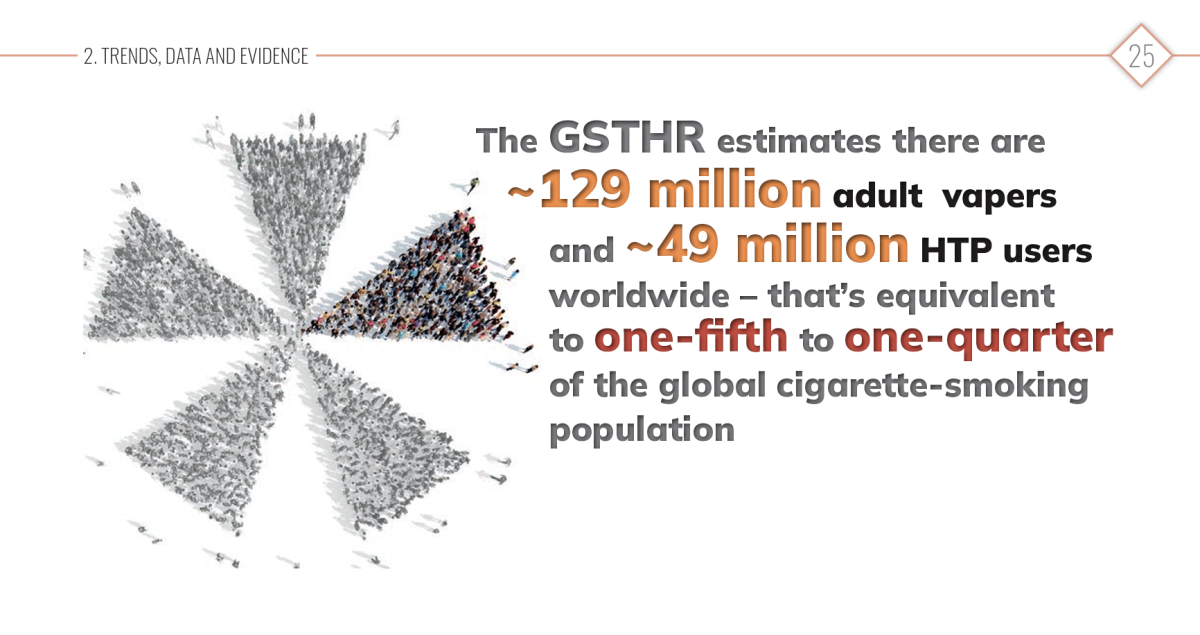
The Global State of Tobacco Harm Reduction, a project operated by Knowledge·Action·Change, estimates that about 200 million people worldwide use non-combustible nicotine products including vapes, heated tobacco, nicotine pouches and snus. Its 2026 report says use of these products rose alongside declining smoking rates in 28 countries it analyzed. The data do not establish that all 200 million users have quit smoking, nor do they prove a direct causal relationship. GSTHR also says regulatory restrictions on the products continue to expand in many markets.
Sep.10
NAS 2026 | FDA CTP Director Says PMTA Pathway Is “Predicated on Tobacco Harm Reduction”
At the 2026 New Approaches Summit in New York, FDA Center for Tobacco Products Director Bret Koplow said the PMTA pathway is “predicated on tobacco harm reduction.” He outlined four CTP priorities: youth prevention, helping adults quit or switch to lower-risk products, improving relative-risk communication, and reducing unauthorized products. Koplow also addressed flavored e-cigarettes, public risk perceptions, industry credibility and efforts to make PMTA reviews more efficient and predictable.
Sep.26
US ITC Judge Finds Glas Infringed Two JUUL Vape Patents, Recommends Restrictions on Related Imports——Glas Received FDA Marketing Authorization for Four Vape Pods in May 2026; Proposed Restrictions Remain Under Commission Review
A U.S. International Trade Commission (USITC) administrative law judge issued an initial determination on October 20, 2026, finding that certain Glas vaping devices, cartridges and components infringed 12 claims across two patents asserted by JUUL, constituting a violation of Section 337 of the Tariff Act of 1930. The judge recommended a limited exclusion order and a cease and desist order against the Glas respondents. Five months earlier, the FDA authorized four Glas e-cigarette pods, including mango, blueberry and two menthol variants. The patent investigation concerns device and cartridge structures and is separate from FDA premarket review. The proposed import restrictions have not become final, and their product-level scope remains unresolved.
company
Nov.05
Product | R.J. Reynolds Launches Four Flavored Vuse Pro Pods for Vuse Alto Devices in U.S.
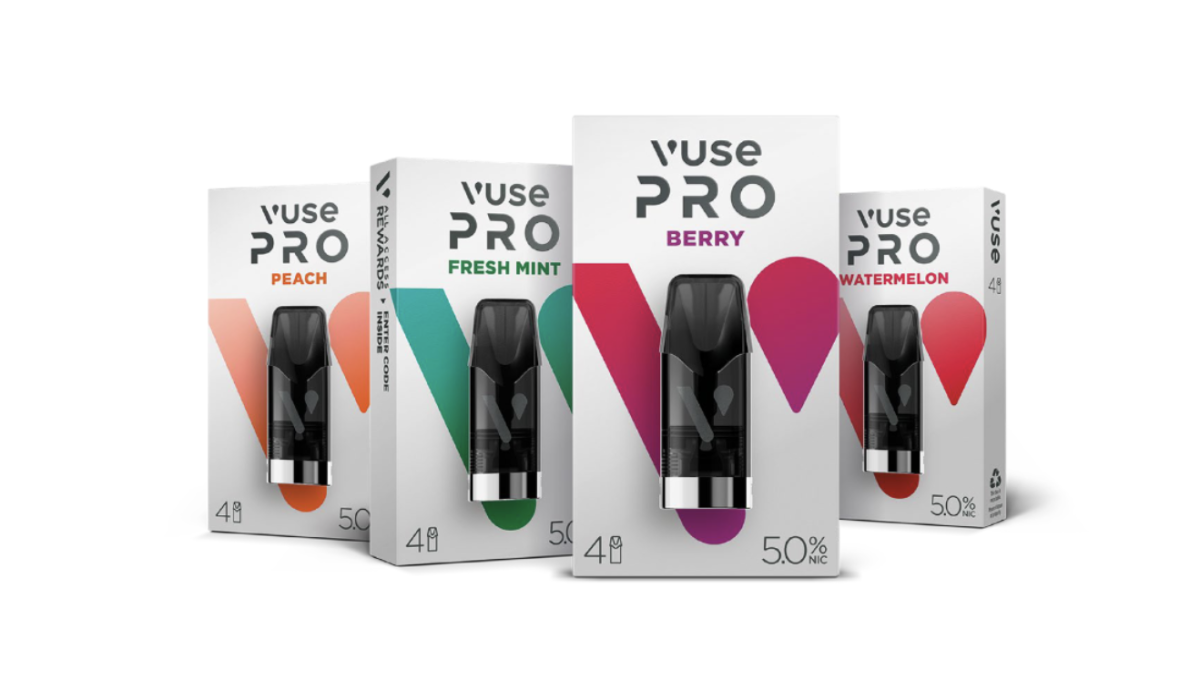
R.J. Reynolds Vapor Company has introduced Vuse Pro prefilled pods in Peach, Berry, Watermelon and Fresh Mint in selected U.S. states. Vuse’s U.S. website says the pods are intended for use with existing Vuse Alto devices. Each contains 2.0 mL of e-liquid at 5.0% nicotine by weight, uses nicotine salts and is offered in two- and four-pod packs. Reynolds said the rollout includes mandatory ID scanning for every purchase, purchase limits, stronger retailer-accountability requirements and strict age-restricted marketing standards. The four pods have not received marketing authorization from the U.S. Food and Drug Administration.
Sep.10