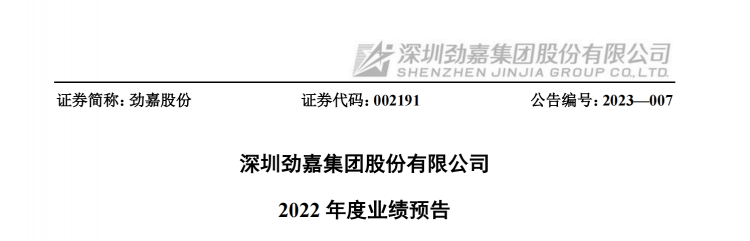
Recently, Jingjia Co., Ltd. released a earnings forecast, stating that the net profit attributable to shareholders of the listed company is expected to be approximately RMB 204 million to 306 million in 2022, representing a year-on-year decrease of 70% to 80%.
Source Image: Jingjia Corporation
The main reason for the change in performance is:
Due to factors such as fluctuations in the global and domestic macroeconomic conditions and increased competition in the market, the sales and prices of the company's primary products have experienced a decline, leading to a decrease in profitability.
According to Regulation No. 8 on Accounting Supervision Risk Warning - Impairment of Goodwill, and taking into account factors such as market competition and actual operational conditions, the company will provision for impairment of goodwill in the asset group of its subsidiary, Jiangsu Shuntai Packaging Printing Technology Co., Ltd., based on the principle of prudence. The estimated amount provisioned is between RMB 300 million and RMB 400 million.
During this reporting period, the estimated amortization of share-based compensation expenses resulting from the implementation of a restricted stock incentive plan amounted to 66.16 million RMB, with an expected amount of 17.73 million RMB for the year 2021.
In 2021, the company changed the classification of its equity holdings in Shenzhen Huada Beidou Technology Co., Ltd. from long-term investments to financial assets held for trading, which were subsequently measured at fair value. This resulted in investment income and fair value changes amounting to RMB 94,521.5 million, which is considered as non-recurring gains and losses. It is expected that the impact of these gains on the current reporting period will be minimal.
In 2021, the company gained investment returns of RMB 58.48 million due to the step-by-step merger of Qingdao Inno Packaging Technology Co., Ltd., and an investment return of RMB 21.12 million from the disposal of equity in Qingdao Jiayi Ze Printing and Packaging Co., Ltd. These incomes were classified as non-recurring gains and losses and were not applicable in this reporting period. The fair value changes of the original equity were included in the investment income amount.
Shenzhen Jinjia Group is a leading modern large-scale comprehensive packaging industry group in China, with top production scale, research and innovation capabilities, and core competitiveness. The company currently has 18 production bases nationwide, producing high-tech and high value-added tobacco labels and products, premium packaging for well-known consumer brands, and new packaging materials such as laser paper/film and tobacco film.
References:
Shenzhen Jingjia Group Co., Ltd. releases 2022 performance forecast.
Disclaimer
This article is provided solely for professional research, industry discussion, and informational purposes. Any references to brands, companies, products, technologies, or policies are made for factual reporting and analytical purposes only, and do not constitute endorsement, recommendation, promotion, or advertising by 2Firsts.
Nicotine-containing products, including but not limited to cigarettes, e-cigarettes, heated tobacco products, and nicotine pouches, carry significant health risks. Readers are responsible for complying with all applicable laws and regulations in their respective jurisdictions, including age restrictions and access limitations.
The information contained in this article should not be regarded as investment, legal, medical, regulatory, or commercial advice. While 2Firsts strives to ensure the accuracy and reliability of its content, it does not assume liability for any direct or indirect loss arising from errors, omissions, inaccuracies, or reliance on the information contained herein.
This article is not intended for individuals below the legal age for accessing tobacco or nicotine-related information in their jurisdiction.
Copyright Notice
This article is either original content produced by 2Firsts or content reproduced, translated, summarized, or adapted from third-party sources with attribution where applicable. The intellectual property rights of the original content remain with 2Firsts or the respective original rights holders.
No individual or organization may copy, reproduce, distribute, republish, modify, translate, or otherwise use this content without prior authorization. Any unauthorized use may result in legal action.
For copyright-related inquiries, corrections, or removal requests, please contact: info@2firsts.com.
AI-Assisted Translation and Editing Notice
Portions of this article may have been translated, edited, or reviewed with the assistance of artificial intelligence tools to improve efficiency and readability. Due to the limitations of AI-assisted translation and editing, discrepancies, omissions, or inaccuracies may exist when compared with the original source.
Where applicable, readers are advised to refer to the original source for the most complete and accurate information. If you identify any errors or believe that any content infringes upon your rights, please contact us at info@2firsts.com, and we will review and address the matter promptly.