KT&G Plans to Launch New Heating Tobacco Products in 2025

Dec.31.2024
KT&G Plans to Launch New Heating Tobacco Products in 2025
KT&G plans to launch new heated tobacco products in 2025, aiming to maintain their lead in the market.

According to a report by N.News on December 30th, KT&G, a South Korean tobacco company, plans to launch a new heated tobacco product (HTP) by 2025.


According to industry sources in the tobacco industry, KT&G is currently preparing to launch a new HTP product by 2025. A spokesperson for KT&G revealed, "Pod products will be released irregularly, but devices are typically updated every one to two years." KT&G had previously announced their plans to launch new products at their third quarter earnings conference in November of last year.


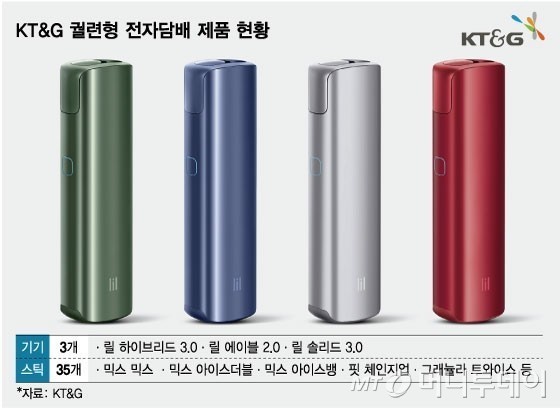
However, KT&G did not clarify whether the new product is a completely new device or an upgrade of one of its existing three devices. The three devices currently sold by KT&G in the Korean market include "Lil Hybrid 3.0", "Lil Able 2.0", and "Lil Solid 3.0". The most recent product launch was in September 2024, when the upgraded version of "Lil Solid 2.0" called "Lil Solid 3.0" was introduced.


In preparation for the launch of new products next year, KT&G is also adjusting the inventory of its existing products. During a conference call in November, KT&G explained that the stagnation in sales growth of pod products in the third quarter was due to the impact of inventory adjustments for the launch of new products next year.


KT&G emphasized that, "Once the new product is launched, sales are expected to return to normal and may even bring additional growth.


An industry expert analysis shows that KT&G is maintaining its leading position in the heated tobacco market through its new product plans. According to convenience store data, KT&G held a 48% market share in heated tobacco sales last year, a slight increase from the previous year's 46%, ranking first. Philip Morris International (PMI) followed closely with 41%, while British American Tobacco (BAT) held 11%. Despite KT&G retaining its top spot, the gap with PMI is narrow, and competition in the market is intensifying with the entry of Japan Tobacco International Korea (JTI Korea).


We welcome news tips, article submissions, interview requests, or comments on this piece.

Please contact us at info@2firsts.com, or reach out to Alan Zhao, CEO of 2Firsts, on LinkedIn


Notice

1.  This article is intended solely for professional research purposes related to industry, technology, and policy. Any references to brands or products are made purely for objective description and do not constitute any form of endorsement, recommendation, or promotion by 2Firsts.

2.  The use of nicotine-containing products — including, but not limited to, cigarettes, e-cigarettes, nicotine pouchand heated tobacco products — carries significant health risks. Users are responsible for complying with all applicable laws and regulations in their respective jurisdictions.

3.  This article is not intended to serve as the basis for any investment decisions or financial advice. 2Firsts assumes no direct or indirect liability for any inaccuracies or errors in the content.

4.  Access to this article is strictly prohibited for individuals below the legal age in their jurisdiction.


Copyright


This article is either an original work created by 2Firsts or a reproduction from third-party sources with proper attribution. All copyrights and usage rights belong to 2Firsts or the original content provider. Unauthorized reproduction, distribution, or any other form of unauthorized use by any individual or organization is strictly prohibited. Violators will be held legally accountable.

For copyright-related inquiries, please contact: info@2firsts.com


AI Assistance Disclaimer


This article may have been enhanced using AI tools to improve translation and editorial efficiency. However, due to technical limitations, inaccuracies may occur. Readers are encouraged to refer to the cited sources for the most accurate information.

We welcome any corrections or feedback. Please contact us at: info@2firsts.com

Altria Smokeable Profit Rises 2.4% as Marlboro Share Falls and U.S. Discounts Gain
Altria’s second-quarter results show a U.S. nicotine market splitting across price, product and regulation. Smokeable profit rose 2.4% as Marlboro pricing offset lower volumes, while discount brand Basic gained share among value-conscious smokers. In oral nicotine, on! PLUS expanded distribution but faced intensifying competition from ZYN and Velo. NJOY remained off the market as patent and regulatory hurdles delayed its return. The broader lesson: U.S. growth increasingly depends on price-tier strategy, retail execution, authorisation and enforcement readiness across the industry.
Special Report
Jul.31
Australia’s TGA Places Nicotine Pouches Under Therapeutic Goods Rules From July 24, Blocking Imports of Unapproved Products
Australia is strengthening controls on nicotine pouches under its existing therapeutic goods regulatory framework. According to the Therapeutic Goods Administration (TGA), nicotine pouch products must meet regulatory requirements, and unapproved products cannot be legally imported. The move follows Australia’s broader approach of maintaining strict oversight of nicotine products, including nicotine-containing vapes. As nicotine pouches expand globally, Australia’s regulatory approach highlights growing differences in how countries manage emerging smoke-free nicotine products.
Regulations
Jul.27
Germany Plans Tobacco Tax Hike, With Cigarette Prices Nearing €12 Per Pack by 2030
Germany plans to raise tobacco taxes over the coming years, potentially pushing the average price of a 20-cigarette pack to about €11.78 by 2030. The proposal also covers fine-cut tobacco, cigars, pipe tobacco and e-cigarette liquids.
Jul.14
From Nicotine Salts to Cocrystals: China’s Shenzhen Huabao institute explores a more stable form for sustained nicotine release
China-based Shenzhen Huabao Collaborative Innovation Technology Research Institute Co., Ltd. has filed a patent application for a nicotine-ascorbic acid cocrystal, exploring a new solid-state form of nicotine. The patent proposes applications across e-liquids, heated tobacco sticks, oral tobacco, chewing tobacco and snuff. In nicotine pouch tests disclosed in the filing, cocrystal formulations showed less than a 6% decline in nicotine content after three months of accelerated storage and a release profile combining early-stage release with sustained delivery over 60 minutes. The filing reflects exploration of nicotine forms beyond conventional nicotine base and nicotine salts.
Aug.13
Nearly Half of Seoul Vape Vending Machines Bypassed by Fake IDs, Raising Youth Access Concerns
Seoul city authorities inspected 339 tobacco vending machines at e-cigarette retailers and found that 168, or 49.5%, allowed purchases using fake IDs, showing that unmanned retail terminals and adult-verification systems remain a major enforcement gap after e-cigarettes were brought under tobacco regulation.
Market
Jul.03 by 2Firsts Perspectives
BAT Regional Director Fred Monteiro Supports Spain’s Nicotine Rules but Opposes 0.99mg Nicotine Pouch Limit
Spanish newspaper El Confidencial interviewed Fred Monteiro, Regional Director for Americas and Europe at British American Tobacco (BAT). Monteiro said BAT supports setting regulatory limits for nicotine products but opposes Spain’s proposed 0.99mg nicotine-per-pouch limit, arguing that such a restriction could affect adult smokers’ transition to alternatives. He said nicotine regulation should be based on scientific evidence and harm reduction principles. Monteiro also said smoke-free products now account for around 25% of BAT’s Americas and Europe business and nearly 30% of its Europe business
BAT
Jul.30