Philip Morris Korea launches 'TEREA Black Ruby' to expand IQOS line to 18 varieties

Oct.25.2024
Philip Morris Korea launches 'TEREA Black Ruby' to expand IQOS line to 18 varieties
PMI Korea introduces new pod "TEREA Black Ruby" for IQOS ILUMA, expanding "TEREA" series to 8 special blend flavors.

Philip Morris International (PMI) Korea has announced the launch of a new pod called "TEREA Black Ruby" for its "IQOS ILUMA" heated tobacco product (HTP) device, according to a report by N.News on 24 October.


The new product can be purchased at IQOS official stores nationwide, as well as convenience stores in some areas, including Seoul, Incheon, Gyeonggi and Busan. The company said that the launch of this new product brings the total number of special blend flavours in the TEREA" range to 8.


The entire "TEREA" line now includes a total of 18 products, including 8 special blends, 6 tobacco blends and 4 fresh blends.

We welcome news tips, article submissions, interview requests, or comments on this piece.

Please contact us at info@2firsts.com, or reach out to Alan Zhao, CEO of 2Firsts, on LinkedIn


Notice

1.  This article is intended solely for professional research purposes related to industry, technology, and policy. Any references to brands or products are made purely for objective description and do not constitute any form of endorsement, recommendation, or promotion by 2Firsts.

2.  The use of nicotine-containing products — including, but not limited to, cigarettes, e-cigarettes, nicotine pouchand heated tobacco products — carries significant health risks. Users are responsible for complying with all applicable laws and regulations in their respective jurisdictions.

3.  This article is not intended to serve as the basis for any investment decisions or financial advice. 2Firsts assumes no direct or indirect liability for any inaccuracies or errors in the content.

4.  Access to this article is strictly prohibited for individuals below the legal age in their jurisdiction.


Copyright


This article is either an original work created by 2Firsts or a reproduction from third-party sources with proper attribution. All copyrights and usage rights belong to 2Firsts or the original content provider. Unauthorized reproduction, distribution, or any other form of unauthorized use by any individual or organization is strictly prohibited. Violators will be held legally accountable.

For copyright-related inquiries, please contact: info@2firsts.com


AI Assistance Disclaimer


This article may have been enhanced using AI tools to improve translation and editorial efficiency. However, due to technical limitations, inaccuracies may occur. Readers are encouraged to refer to the cited sources for the most accurate information.

We welcome any corrections or feedback. Please contact us at: info@2firsts.com

Texas Extends Tobacco Tax Interpretation to a 6-Methylnicotine Product, Citing VELO Ruling
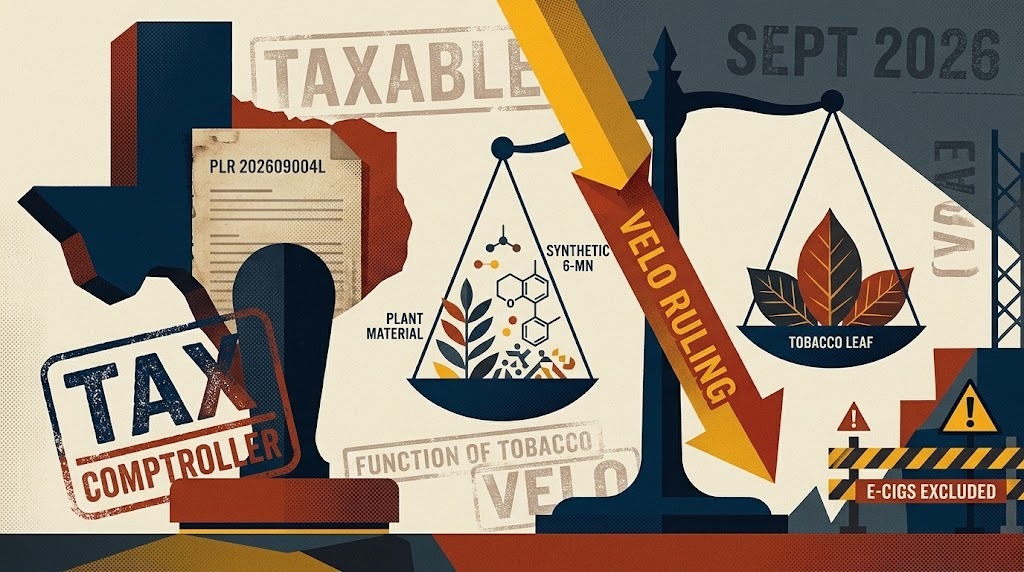
The Texas Comptroller of Public Accounts ruled in September 2026 that a combustible product made with non-tobacco plant material and 6-methylnicotine (6-MN), a synthetic nicotine analog, qualifies as a taxable tobacco product. The applicant said the product contained neither tobacco leaf nor measurable conventional nicotine. The determination applies reasoning from a May Texas Supreme Court decision involving VELO nicotine pouches, finding that the plant material and 6-MN together perform the functions of tobacco in a conventional smoking product. The ruling carries applicable tax, licensing and reporting obligations but is limited to the facts submitted by the taxpayer. It does not establish a blanket tax classification for all 6-MN products or extend the same conclusion to e-cigarettes.
Regulations
Nov.06
EU Vape, Heated Tobacco and Nicotine Pouch Tax Reform Reaches Ministerial Talks: Sweden Opposes Proposed 2032 Minimum of 50% of Retail Price or €50/kg for Nicotine Pouches
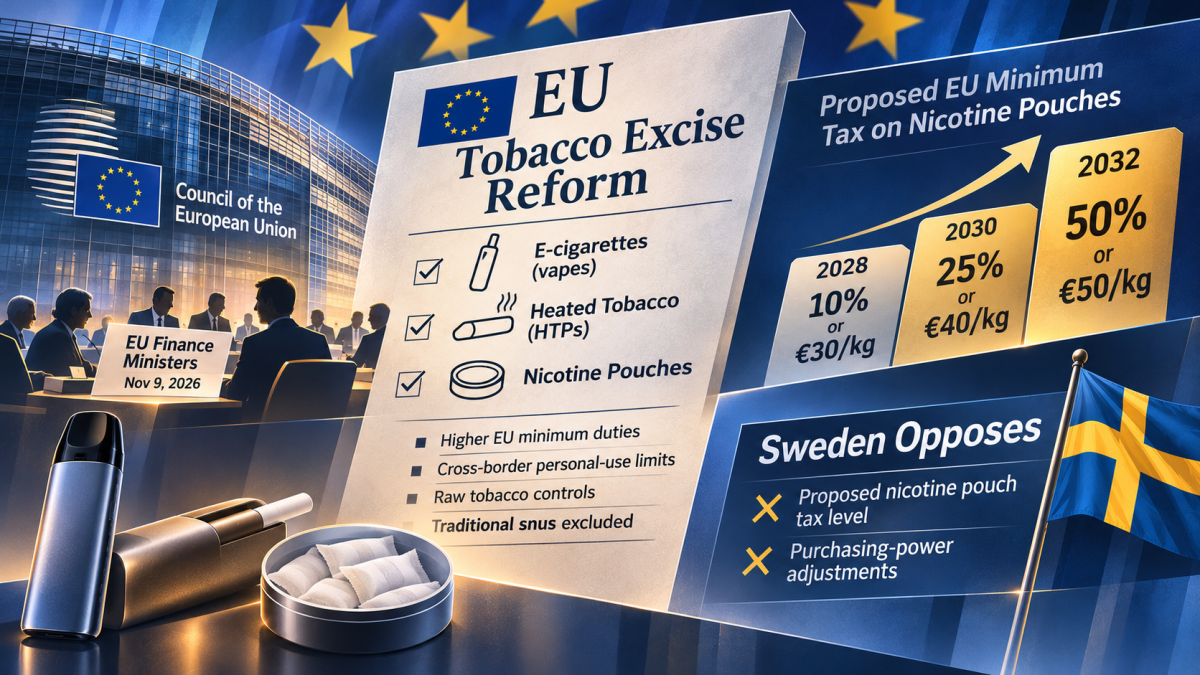
EU finance ministers are scheduled to discuss tobacco excise reform on November 9, 2026, seeking agreement on higher minimum duties for conventional tobacco and a common EU minimum tax framework covering e-cigarettes, heated tobacco and nicotine pouches. A November 5 Council document identifies nicotine pouch taxation as the main outstanding issue. The Irish Council presidency proposes phased increases, reaching 50% of retail selling price or €50 per kilogram in 2032. Sweden has formally said it cannot support the current compromise, objecting to both the proposed nicotine pouch tax burden and the adjustment of minimum rates based on national purchasing power. The package also addresses cross-border personal-use reference quantities, raw tobacco controls and the continued exclusion of traditional tobacco snus.
Regulations
Nov.10
U.S. Health Groups Seek to Overturn FDA Enforcement Discretion for Pending PMTAs as Altria's Helix, NJOY and AVM Move to Intervene
American Vapor Manufacturers (AVM) and Altria subsidiaries Helix Innovations and NJOY filed separate motions on October 7, 2026, seeking to intervene on the FDA's side in a lawsuit challenging its enforcement guidance for certain e-cigarette and nicotine pouch products with pending premarket tobacco product applications (PMTAs). Seven public health and tobacco-control organizations, including the Campaign for Tobacco-Free Kids, sued the agency in July to overturn the policy. AVM argues that vacating the guidance could disrupt orders, inventory, retail distribution and investments in regulatory submissions.
Regulations
Oct.09
JTI Invests ₱2.1 Billion to Upgrade Batangas Manufacturing Hub, Adds First Southeast Asia DIET Facility
JTI Asia Manufacturing Corp. has invested ₱2.1 billion, or about $37 million, in its manufacturing site in Malvar, Batangas, Philippines, to expand tobacco-processing capabilities. About ₱1.9 billion is allocated to JTI's first Dry Ice Expanded Tobacco, or DIET, facility in Southeast Asia, while more than ₱177 million has been spent on expanding its Controlled Atmosphere treatment facility. The Batangas plant supplies the Philippine market and exports to 22 overseas markets, making it one of JTI's key manufacturing hubs in Asia.
Sep.24
STIIIZY Redesign Fails to Escape PAX Labs Patent Import Ban as Section 337 Case Also Involves China ALD
U.S. Customs and Border Protection ruled that STIIIZY had not shown that the redesigned cannabis-vape products covered by its latest request fall outside an ITC limited exclusion order tied to PAX Labs patents. CBP accepted some of STIIIZY’s claim-construction and non-infringement arguments, but the company did not address two additional claims in the same patent. Earlier STIIIZY redesigned cartridges and certain associated components imported with them had received separate CBP clearance.
Sep.16
South Korea Constitutional Court Upholds Volume-Based E-Liquid Tax, With Challenged Rates at KRW 370 and KRW 628 per Milliliter
South Korea's Constitutional Court has upheld fixed taxes on nicotine-containing e-cigarette liquids based on solution volume, ruling that challenged provisions imposing KRW 370 per milliliter in individual consumption tax and KRW 628 per milliliter in tobacco consumption tax do not violate the Constitution. The cases stemmed from historical disputes involving importers that reported nicotine as being extracted from tobacco stems rather than leaves. South Korea has since broadened its tobacco definition to include synthetic nicotine, while current tax laws provide reduced rates for certain products not derived from tobacco.
Sep.18