New Product Launch: Psyper 2500 by LOST MARY

Innovation by 2FIRSTS.ai
Mar.18.2024
New Product Launch: Psyper 2500 by LOST MARY
South Korean media n.news reported that "LOST MARY" introduced a new product, "Psyper 2500," featuring a detachable design.

Special Note: This article is for industry research and communication purposes only, and does not make any brand or product recommendations; minors are prohibited from accessing.


According to South Korean media outlet n.news, "LOST MARY," introduced in Korea for the first time by the Eastern China Commerce Association last year, launched its new product "Psyper 2500" on March 18th.


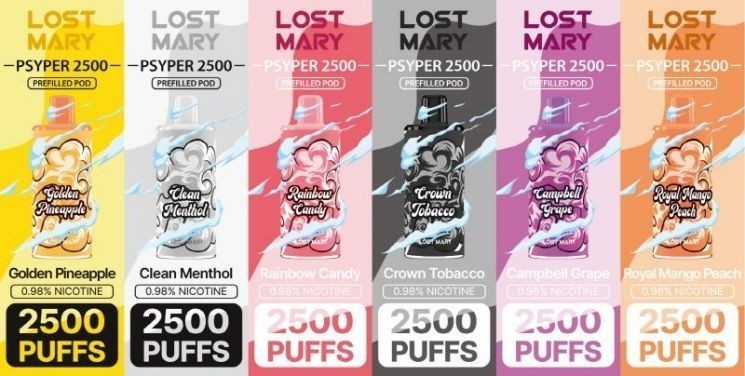
The newly released Psyper 2500 features a detachable design, allowing the disposable pod containing e-liquid to be separated from the device. Users do not need to add additional e-liquid and can easily replace the pod for continued use. The pod has a capacity of 8 milliliters, which, according to the average usage of adult males, can provide up to 2500 puffs. In addition, the device includes a 500mAh battery that can be charged via USB C.


The Psyper 2500 offers six flavors, including globally popular options like "Golden Pineapple," "Royal Mango Peach," "Campbell Grape," and "Rainbow Candy," as well as two flavors specifically designed for the Korean market, "Cool Menthol" and "Crown Tobacco." It also comes in six colors, including pink, sapphire, gold, purple, grey, and black.


The Psyper 2500 will be available for sale through e-cigarette retailers nationwide starting on the 20th, with a retail price of 10,000 Korean won ($7.50).


We welcome news tips, article submissions, interview requests, or comments on this piece.

Please contact us at info@2firsts.com, or reach out to Alan Zhao, CEO of 2Firsts, on LinkedIn


Notice

1.  This article is intended solely for professional research purposes related to industry, technology, and policy. Any references to brands or products are made purely for objective description and do not constitute any form of endorsement, recommendation, or promotion by 2Firsts.

2.  The use of nicotine-containing products — including, but not limited to, cigarettes, e-cigarettes, nicotine pouchand heated tobacco products — carries significant health risks. Users are responsible for complying with all applicable laws and regulations in their respective jurisdictions.

3.  This article is not intended to serve as the basis for any investment decisions or financial advice. 2Firsts assumes no direct or indirect liability for any inaccuracies or errors in the content.

4.  Access to this article is strictly prohibited for individuals below the legal age in their jurisdiction.


Copyright


This article is either an original work created by 2Firsts or a reproduction from third-party sources with proper attribution. All copyrights and usage rights belong to 2Firsts or the original content provider. Unauthorized reproduction, distribution, or any other form of unauthorized use by any individual or organization is strictly prohibited. Violators will be held legally accountable.

For copyright-related inquiries, please contact: info@2firsts.com


AI Assistance Disclaimer


This article may have been enhanced using AI tools to improve translation and editorial efficiency. However, due to technical limitations, inaccuracies may occur. Readers are encouraged to refer to the cited sources for the most accurate information.

We welcome any corrections or feedback. Please contact us at: info@2firsts.com

South Africa health department agrees to exempt smokeless and non-combustible products from tobacco control bill
At a parliamentary committee meeting in South Africa, Health Minister Aaron Motsoaledi said the health department has agreed to exempt non-combustible and smokeless products — including chewing tobacco, snus, nicotine pouches and e-cigarettes — from the Tobacco Products and Electronic Delivery Systems Control Bill. The department is prepared, at this stage, to exempt them from packaging and labelling requirements except for misleading or false claims.
Mar.06 by 2FIRSTS.ai
ACT Health Minister Vows Continued Crackdown on E-Cigarettes and Illicit Tobacco
ACT Health Minister Rachel Stephen-Smith said the government would not ease its action against e-cigarettes and illicit tobacco and would continue strengthening regulation, legislation, and enforcement. Speaking at the launch of a new program to help young people quit vaping, she said reducing tobacco excise would not materially reduce profits in the illicit tobacco market.
Mar.10 by 2FIRSTS.ai
Reynolds Appeals ITC Defeat in Disposable Vape Section 337 Case to U.S. Federal Circuit
On March 13, 2026, R.J. Reynolds and related companies filed an appeal with the U.S. Court of Appeals for the Federal Circuit, seeking review of the U.S. International Trade Commission’s final ruling in the disposable vape Section 337 investigation.
Mar.16 by 2FIRSTS.ai
New York Nicotine Pouch Tax Moves Forward as Critics Question Public Health Impact
New York Governor Kathy Hochul included in her FY 2027 budget proposal a plan to impose the same 75% wholesale tax on nicotine pouches such as Zyn that applies to cigarettes. The measure is expected to raise USD 18 million in FY 2027 and USD 44 million in FY 2028 after full implementation.
Mar.30 by 2FIRSTS.ai
IMF Article Sets Out Three Principles: Cover All Harmful Products, Match Tax Rates to Harm, Improve Cross-Border Coordination
A March 2026 article in Finance & Development, “Taxing Harmful Habits,” argues that taxes on harmful products such as tobacco, alcohol and sugary drinks should better reflect the health harm they cause. The authors propose three principles: capture all harmful products, align tax rates with health harm, and strengthen cross-border coordination to reduce evasion and smuggling.
Mar.24 by 2FIRSTS.ai
Special Report | China’s Two Sessions Revisit Consumption Tax Reform, Tobacco Tax Outlook Draws Attention
China’s 2026 “Two Sessions” again raised the issue of consumption tax reform. As the largest source of consumption tax revenue, the tobacco tax system—its collection stages, tax structure and regional revenue distribution—has re-entered the policy discussion. This article outlines the structure of China’s tobacco consumption tax, past adjustments and key areas of debate, providing international readers with background on one of the country’s most important tax categories.
Special Report
Mar.08