Philippine National Police Warns Over 8000 Minors on E-Cigarettes

Regulations by 2FIRSTS.ai
Mar.18.2024
Philippine National Police Warns Over 8000 Minors on E-Cigarettes
Philippine National Police (PNP) spokesperson Jean Fajardo warns over 8,000 minors for violating e-cigarette laws, arresting nearly 130,000.

According to a report from Philippine media inquirer.net, the spokesperson for the Philippine National Police (PNP), Jean Fajardo, stated that warnings have been issued to over 8,000 underage individuals for violating e-cigarette regulations.


According to Republic Act 11900 of the Philippines or the Nicotine and Non-Nicotine Regulation Act, the legal age to purchase e-cigarette products is 18 years and above. It also specifies that the sale of such products is prohibited within 100 meters of educational institutions, playgrounds, and other places frequented by minors.


The spokesperson stated that approximately 129,878 individuals were arrested in the crackdown, for violating Republic Act No. 11900 and Executive Order No. 26 in the Philippines. Among those arrested, 8,000 were minors, with 6,714 found in violation of Executive Order No. 26 and 1,900 in violation of Republic Act No. 11900. These minors were ultimately issued warnings by the police and handed back to their parents.


It is understood that in this operation, the Philippine police have instructed their operations department to arrest the relevant e-cigarette sellers.


We welcome news tips, article submissions, interview requests, or comments on this piece.

Please contact us at info@2firsts.com, or reach out to Alan Zhao, CEO of 2Firsts, on LinkedIn


Notice

1.  This article is intended solely for professional research purposes related to industry, technology, and policy. Any references to brands or products are made purely for objective description and do not constitute any form of endorsement, recommendation, or promotion by 2Firsts.

2.  The use of nicotine-containing products — including, but not limited to, cigarettes, e-cigarettes, nicotine pouchand heated tobacco products — carries significant health risks. Users are responsible for complying with all applicable laws and regulations in their respective jurisdictions.

3.  This article is not intended to serve as the basis for any investment decisions or financial advice. 2Firsts assumes no direct or indirect liability for any inaccuracies or errors in the content.

4.  Access to this article is strictly prohibited for individuals below the legal age in their jurisdiction.


Copyright


This article is either an original work created by 2Firsts or a reproduction from third-party sources with proper attribution. All copyrights and usage rights belong to 2Firsts or the original content provider. Unauthorized reproduction, distribution, or any other form of unauthorized use by any individual or organization is strictly prohibited. Violators will be held legally accountable.

For copyright-related inquiries, please contact: info@2firsts.com


AI Assistance Disclaimer


This article may have been enhanced using AI tools to improve translation and editorial efficiency. However, due to technical limitations, inaccuracies may occur. Readers are encouraged to refer to the cited sources for the most accurate information.

We welcome any corrections or feedback. Please contact us at: info@2firsts.com

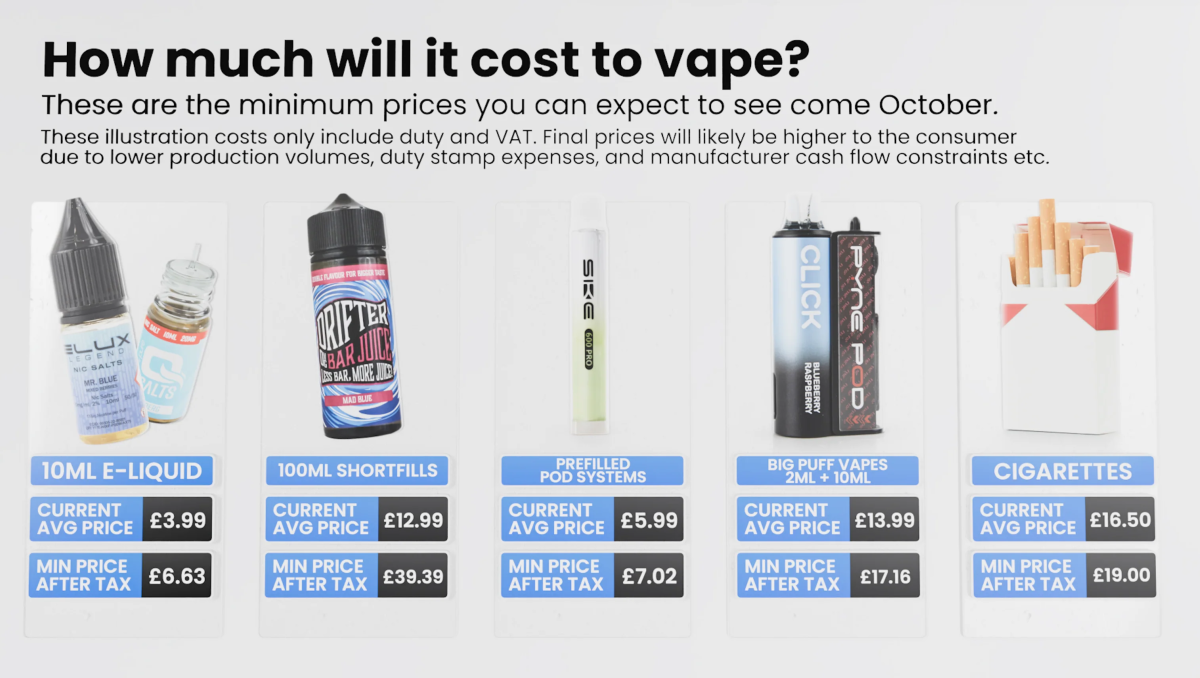
UK Vape Tax Countdown: Retailer Vape HQ Estimates 100ml E-liquid Prices Could Rise From £12.99 to £39.39, While Pod Kits Increase Less Than 10%
The UK’s Vaping Products Duty (VPD), scheduled to take effect in October 2026, is prompting retailers to assess how different vape categories may be affected. UK retailer Vape HQ has estimated potential price changes under the new volume-based tax system, showing that 100ml shortfill e-liquids could see prices rise from around £12.99 to £39.39, a 203% increase, while 2ml prefilled pod vape kits could rise from £5.99 to £6.52, an increase of about 9%. The estimates highlight how a volume-based tax structure creates uneven cost impacts across product categories.
Aug.19
Cochrane 2026 Update Adds Nine Trials, Keeps High-Certainty Finding That Nicotine E-Cigarettes Improve Quit Rates Over NRT
Cochrane’s 2026 update of its living review on electronic cigarettes for smoking cessation included 80 randomized controlled trials involving 29,861 adult smokers, with nine trials added in this update. The review retained its high-certainty conclusion that nicotine e-cigarettes increase smoking cessation rates compared with nicotine replacement therapy. In absolute terms, about 10 in 100 people using nicotine e-cigarettes may quit smoking for at least six months, compared with about 6 in 100 using NRT. The review found no clear difference in serious adverse event rates between the two groups, while longer-term safety and the relative effectiveness of newer device types remain less certain.
Sep.07
Russia’s Vape Device Labeling Regime Enters Force: Registration Starts in September, Mandatory Coding in December
Russia's digital labeling regime for reusable e-cigarettes and similar personal vaping devices entered its first mandatory phase in September 2026. From September 1, manufacturers, importers and other market participants must register with the national Chestny ZNAK tracking system. From December 1, newly manufactured and imported covered devices will be required to carry digital identification codes and be reported as entering circulation. Russia has also issued new operational guidance for imports, marking the transition from a voluntary pilot to phased mandatory implementation.
Sep.15
On-Site Report | CTP Details PMTA Backlog, 180-Day Review Goal and sPMTA Process
FDA’s Center for Tobacco Products detailed new PMTA review data and process changes at the 2026 FDLI conference. Pending PMTAs fell from about 450,000 at the start of 2025 to 135,000 by September 2026. CTP also discussed its 180-day review goal, current sPMTA pilot, alternate-supplier planning, more than 50,300 pending SE reports, and lessons from the nicotine pouch pilot already being applied to ENDS review.
Regulations
Oct.07
2Firsts Data|China’s Vape-Related Exports Rose 3.3% in August 2026 as UK Shipments Jumped 51.4% and U.S. Exports Fell 12.4%
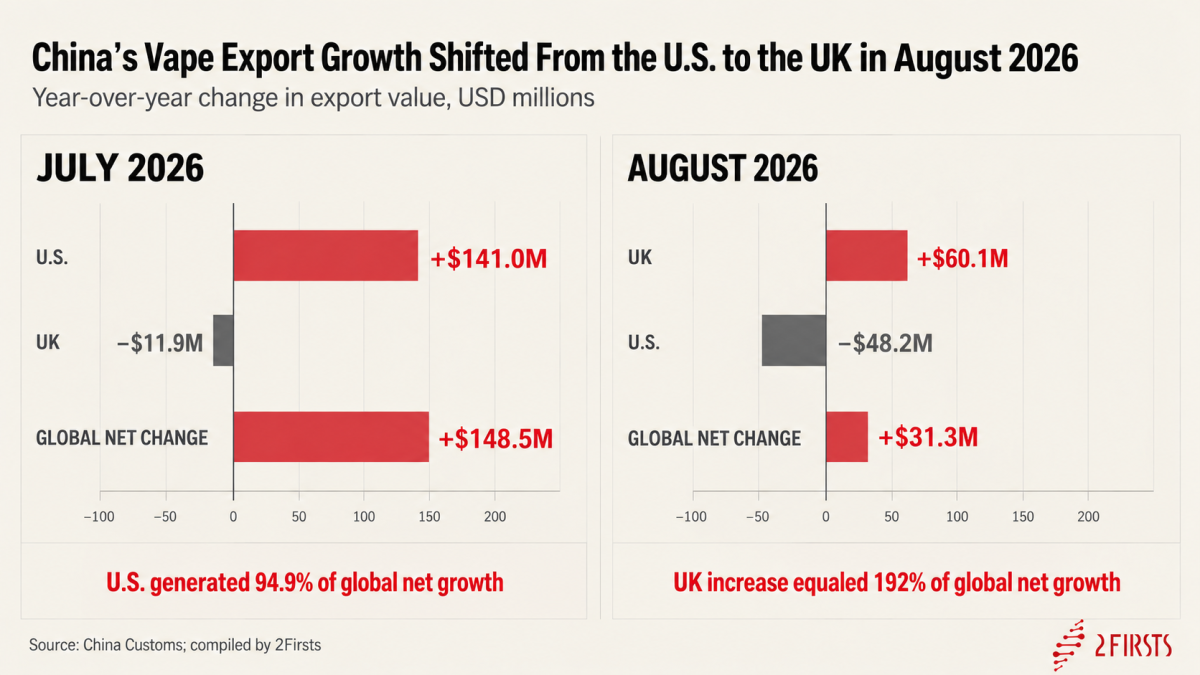
China exported $979 million of vape-related products in August 2026, up 3.3% from a year earlier but down 6.4% from July. The UK replaced the U.S. as the main source of growth: UK-bound shipments jumped 51.4% to a 2026 high of $177 million, while exports to the U.S. fell 12.4% to $339 million. Shipments to markets outside the U.S. increased 14.2%, broadening growth beyond the market that had driven July’s rebound.
News
Sep.23 by 2Firsts Perspectives
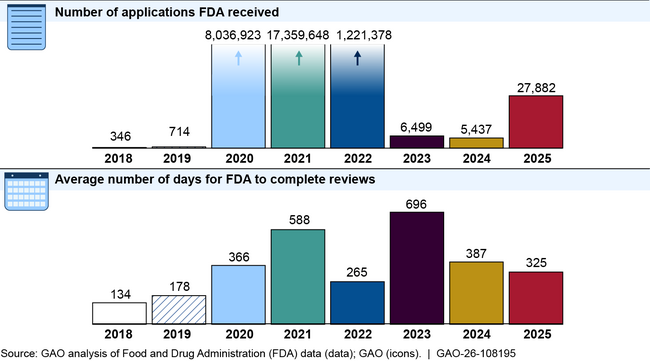
GAO Audit Finds Nearly 132,000 FDA Tobacco Applications Waiting an Average 1,266 Days as Nicotine Pouch Pilot Practices Move Into Vape PMTA Reviews
A U.S. Government Accountability Office audit found that 131,915 tobacco product applications submitted to the FDA since 2018 remained without a final review as of December 31, 2025, with pending applications waiting an average of 1,266 days. GAO also found FDA lacks the data needed to systematically determine whether scientific reviews meet applicable timelines. HHS agreed to upgrade the agency's tracking systems. At the same time, FDA has begun applying lessons from its nicotine pouch PMTA pilot to e-cigarette reviews, while changes to enforcement policy and electronic submissions are making the specific stage of a PMTA increasingly relevant to market access.
FDA
Oct.03