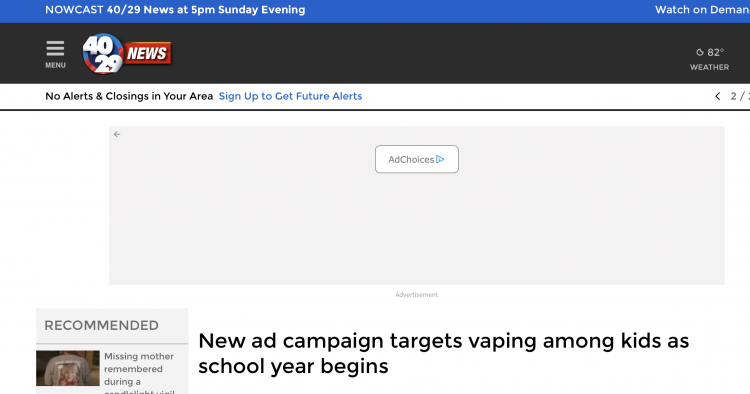
The American Lung Association and Advertising Council have released a series of public service announcements regarding the dangers of electronic cigarettes. According to data from the American Lung Association, there has been a 73% increase in youth electronic cigarette use from 2016 to 2020. Approximately 2 million young people across the country are believed to be using these devices.
Do you know that in the past three to four years, it was the first time in my career that I had to give nicotine gum to teenagers because they were addicted to nicotine and scared? " said Marti Sharkey, a pediatrician in Fayetteville.
To determine whether your child is using an e-cigarette, check their money. "If there are unexplained expenses, start asking questions," says Sharkey. Additionally, if anything looks like a USB but cannot be used as such, it may be an e-cigarette.
Electronic cigarettes are not only a very real problem, but also pose significant health concerns. According to her, this addiction to nicotine is causing children's heart rates to increase and increasing their anxiety, as we have already seen them struggle with anxiety.
Jamie Hunter, a consultant for Falmington, stated that the symptoms of anxiety are similar to those of depression.
The American Lung Association (ALA) has launched a new ad campaign aimed at tackling e-cigarettes, titled #DoTheVapeTalk. To prevent addiction, the ALA advises parents to start talking to their children about it between the ages of 10-14. Sharkey, a representative for the ALA, notes that nicotine addiction is very real, and parents should discuss the risks with their children before they start using e-cigarettes. Parents should also closely monitor any suspicious behavior and continue to have ongoing conversations with their children.
The American Lung Association refers to e-cigarettes as a gateway to smoking, stating that children who use e-cigarettes are more likely to try traditional cigarettes and become addicted to nicotine.
Statement:
This article is compiled from third-party information and is solely intended for industry-related discussion and learning purposes.
This article does not represent the viewpoint of 2FIRSTS and we cannot confirm the authenticity or accuracy of its content. The translation of this article is intended solely for industry exchange and research purposes.
Due to limitations in the translator's abilities, the compiled article may not fully convey the same meaning as the original. It is recommended to refer to the original text for accuracy.
2FIRSTS maintains full alignment with the Chinese government on any domestic, Hong Kong, Macao, Taiwan, and foreign-related statements and positions.
The copyright of the compiled information belongs to the original media and author. If there is any infringement, please contact us for deletion.
Disclaimer
This article is provided solely for professional research, industry discussion, and informational purposes. Any references to brands, companies, products, technologies, or policies are made for factual reporting and analytical purposes only, and do not constitute endorsement, recommendation, promotion, or advertising by 2Firsts.
Nicotine-containing products, including but not limited to cigarettes, e-cigarettes, heated tobacco products, and nicotine pouches, carry significant health risks. Readers are responsible for complying with all applicable laws and regulations in their respective jurisdictions, including age restrictions and access limitations.
The information contained in this article should not be regarded as investment, legal, medical, regulatory, or commercial advice. While 2Firsts strives to ensure the accuracy and reliability of its content, it does not assume liability for any direct or indirect loss arising from errors, omissions, inaccuracies, or reliance on the information contained herein.
This article is not intended for individuals below the legal age for accessing tobacco or nicotine-related information in their jurisdiction.
Copyright Notice
This article is either original content produced by 2Firsts or content reproduced, translated, summarized, or adapted from third-party sources with attribution where applicable. The intellectual property rights of the original content remain with 2Firsts or the respective original rights holders.
No individual or organization may copy, reproduce, distribute, republish, modify, translate, or otherwise use this content without prior authorization. Any unauthorized use may result in legal action.
For copyright-related inquiries, corrections, or removal requests, please contact: info@2firsts.com.
AI-Assisted Translation and Editing Notice
Portions of this article may have been translated, edited, or reviewed with the assistance of artificial intelligence tools to improve efficiency and readability. Due to the limitations of AI-assisted translation and editing, discrepancies, omissions, or inaccuracies may exist when compared with the original source.
Where applicable, readers are advised to refer to the original source for the most complete and accurate information. If you identify any errors or believe that any content infringes upon your rights, please contact us at info@2firsts.com, and we will review and address the matter promptly.