Raising Awareness: The Harmful Effects of E-Cigarettes on Students

Oct.18.2023
Raising Awareness: The Harmful Effects of E-Cigarettes on Students
According to a recent survey by WHO, 2.6% of Vietnamese students aged 15-17 used e-cigarettes in 2019, with the trend becoming younger.

According to a recent investigation by the World Health Organization, it has been found that 2.6% of students aged 15 to 17 in Vietnam were using e-cigarettes in 2019. However, a survey conducted in 2022 on tobacco use among students indicates that the usage of e-cigarettes among those aged 13 to 15 has increased to 3.5%, with a concerning trend towards younger age groups.


One possible reason for this issue may be a lack of understanding among people about the harm caused by e-cigarettes. Many individuals have been misled by advertising campaigns claiming that e-cigarettes are harmless and non-addictive. Additionally, some young people and students perceive e-cigarettes as trendy and appealing to their friends. Therefore, it is necessary to provide accurate scientific information to students in order to enhance their understanding of the risks associated with e-cigarettes.


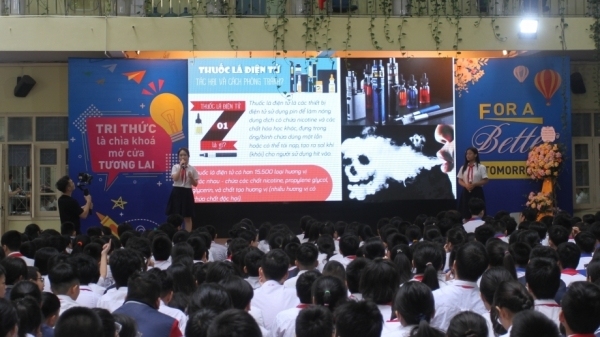
In order to enhance parental and student awareness of the hazards of e-cigarettes, the Campaign for Tobacco-Free Kids organization has been actively disseminating information regarding the risks associated with e-cigarettes among students.


Representatives of the "Smoke-Free Kids Movement" expressed during the event that it provided an opportunity for students to share their thoughts and desires, as well as seek clarification and receive accurate scientific information about e-cigarettes.


A new generation of tobacco products like e-cigarettes, heated tobacco, and hookahs have emerged in Vietnam, posing serious health risks to humans and being associated with diseases and drug addiction. However, so far, there have been few measures taken to address the harm caused by these tobacco products.


Representatives of the "Smoke-Free Children Movement" are urging Vietnam to pay attention to the dangers of tobacco. "We urge an immediate cessation of purchasing, distributing, and using e-cigarettes in Vietnam. E-cigarettes are toxic, and all violations should be subject to criminal penalties," they emphasized.


We welcome news tips, article submissions, interview requests, or comments on this piece.

Please contact us at info@2firsts.com, or reach out to Alan Zhao, CEO of 2Firsts, on LinkedIn


Notice

1.  This article is intended solely for professional research purposes related to industry, technology, and policy. Any references to brands or products are made purely for objective description and do not constitute any form of endorsement, recommendation, or promotion by 2Firsts.

2.  The use of nicotine-containing products — including, but not limited to, cigarettes, e-cigarettes, nicotine pouchand heated tobacco products — carries significant health risks. Users are responsible for complying with all applicable laws and regulations in their respective jurisdictions.

3.  This article is not intended to serve as the basis for any investment decisions or financial advice. 2Firsts assumes no direct or indirect liability for any inaccuracies or errors in the content.

4.  Access to this article is strictly prohibited for individuals below the legal age in their jurisdiction.


Copyright


This article is either an original work created by 2Firsts or a reproduction from third-party sources with proper attribution. All copyrights and usage rights belong to 2Firsts or the original content provider. Unauthorized reproduction, distribution, or any other form of unauthorized use by any individual or organization is strictly prohibited. Violators will be held legally accountable.

For copyright-related inquiries, please contact: info@2firsts.com


AI Assistance Disclaimer


This article may have been enhanced using AI tools to improve translation and editorial efficiency. However, due to technical limitations, inaccuracies may occur. Readers are encouraged to refer to the cited sources for the most accurate information.

We welcome any corrections or feedback. Please contact us at: info@2firsts.com

South Korea Vape Strategies Diverge as BAT Reconsiders Exit and PMI Takes VEEV to About 14,000 Stores
BAT Rothmans says it previously considered exiting South Korea's vaping market because of competitive pressure from unregulated products, but is now reassessing conditions following changes to the country's nicotine regulatory framework. Vuse and other BAT vaping products remain available through existing distribution channels. The statement followed a South Korean media report that interpreted BAT's broader withdrawal from selected Vapour markets as a full exit from South Korea. Meanwhile, Philip Morris International launched VEEV inPRIME in the country in June and began expanding distribution to around 14,000 convenience stores and other retail channels in July. The contrasting moves highlight differing investment strategies as South Korea's regulated vaping market evolves.
Aug.14
Alaska Warns 1,500 Tobacco Retailers Over Unauthorized Vapes and Nicotine Pouches
Alaska Attorney General Stephen J. Cox has sent notices to more than 1,500 tobacco retailers and distributors warning them against selling vape and nicotine pouch products that lack authorization from the U.S. Food and Drug Administration (FDA). According to the Alaska Department of Law, businesses were advised to verify products against FDA authorization databases and avoid selling unauthorized nicotine products. The action highlights how state-level enforcement is increasingly extending federal product authorization requirements to retail channels.
Jul.24
China’s Jiangsu Tobacco Monopoly Bureau and Drug Regulator Target Illegal Vape Sales Disguised as Medical Devices, Define Six Violations
China’s Jiangsu Tobacco Monopoly Bureau and Jiangsu Provincial Medical Products Administration have issued a joint notice targeting illegal production and sales of vape products disguised as medical devices. The notice identifies six categories of violations, including obtaining medical licenses through false materials, misusing medical device credentials, expanding production beyond approved scopes, and using medical device-related online platforms to promote or sell vape products. The action is based on China’s tobacco and medical device regulations and aims to strengthen vape oversight and consumer protection.
Aug.04
JT’s Ploom Volumes Rise 43.5% as Cigarettes Anchor Its Transition
JT’s Ploom heated-tobacco volumes rose 43.5% in the first half of 2026, while combustibles still represented about 97% of its tobacco volume and remained the main earnings base. In Japan, reduced-risk products now account for 48.7% of industry shipments, shifting competition from category adoption towards brand share, pricing and consumer retention. JT’s results offer a revealing case of a traditional tobacco company pursuing a prolonged, dual-track transformation.
JTI
Jul.30
Gallup Tracks Nicotine Pouch Use for the First Time: 11% of U.S. Adults Smoke, 9% Vape and 4% Use Nicotine Pouches
Gallup’s 2026 Consumption Habits survey tracked nicotine pouch use for the first time. The survey found that 11% of U.S. adults reported smoking cigarettes in the past week, 9% reported vaping, and 4% reported using nicotine pouches. Cigarette smoking remained near Gallup’s long-term low, while adult vaping rates stayed relatively stable in recent years.
Market
Aug.25 by 2Firsts Perspectives
Global Tobacco Control Faces Regional Adaptation Test as Nicotine Markets Evolve, Asian Specialist Says
As e-cigarettes, heated tobacco products and nicotine pouches expand across global markets, a central question is gaining urgency: can tobacco control rely on a universal policy model? In an interview with 2Firsts, Asian public health and addiction medicine specialist Dr. Rashidi Mohamed bin Pakri Mohamed says Western experience remains relevant, but policies must be adapted to local culture, healthcare systems, enforcement capacity, illicit markets and clinical evidence.
Jul.08