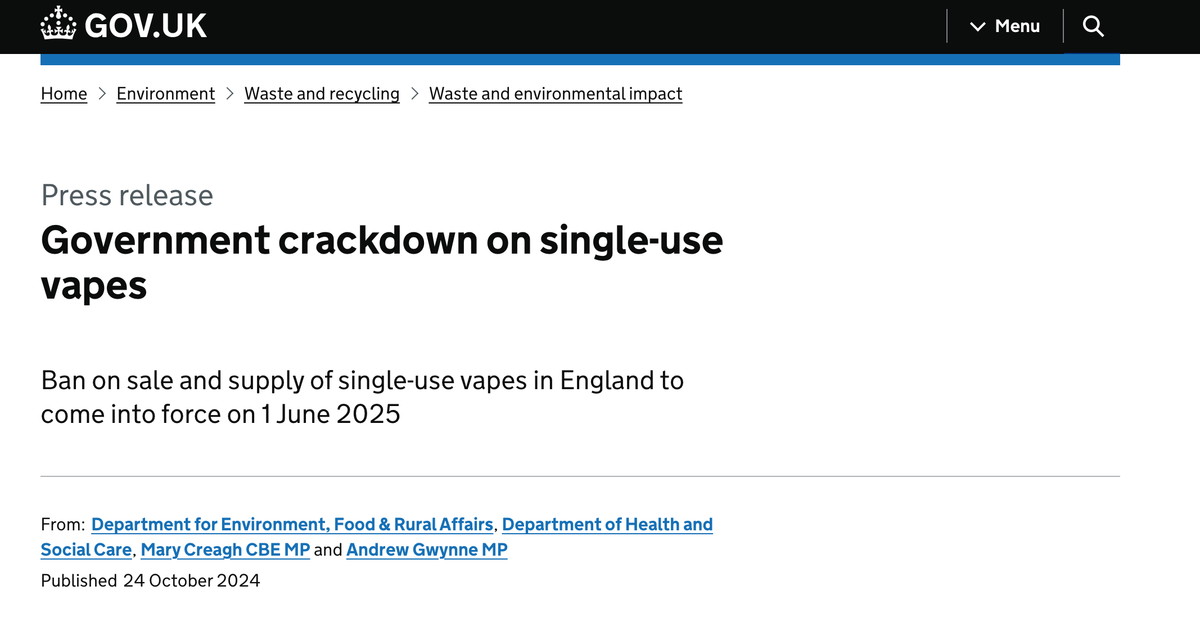
The UK government announced on its official website on 24th October that England will ban the sale of single-use e-cigarettes from 1 June 2025.
Minister for the Circular Economy Mary Creagh confirmed today (24 October) that a new bill has been introduced to Parliament to ban the sale of single-use e-cigarettes from 1 June 2025.
The UK government has introduced legislation to ban the sale of remaining stocks by businesses by 1 June 2025, subject to parliamentary approval. Businesses will need to prepare for the ban to take effect. The UK Cabinet Office and local authorities are working closely together to set a consistent date.
Between 2012 and 2023, the use of e-cigarettes in England is expected to increase by over 400%, with 9.1% of the UK population currently buying and using these products.
Minister for the Circular Economy Mary Creagh said: "Single-use e-cigarettes are extremely wasteful and have caused concern in our towns and cities."
"That's why we need to ban single-use e-cigarettes to end the culture of waste in this country," she said. "This is the first step towards a circular economy, where we will extend the use of resources, reduce waste, accelerate progress towards net zero emissions and create thousands of job opportunities across the country."
Minister for Public Health and Prevention Andrew Gwynne added: "It is worrying that a quarter of 11-15 year olds used e-cigarettes last year, with disposable e-cigarettes being the choice of most children. Banning disposable e-cigarettes will not only help protect the environment, it will also reduce the appeal of e-cigarettes to children and prevent vulnerable young people from being influenced. The Government will also implement the Tobacco and Electronic Cigarettes Act, the most important public health measure for generations, to protect young people from the effects of nicotine and pave the way for a smoke-free Britain."
Green Alliance's Head of Resources, Libby Peake, said: "single-use e-cigarettes are the last thing our children and the planet need, and the unchecked growth of the market for them has gone on for far too long. Each one is a waste of vital resources needed for more sustainable economic development, such as the lithium used in electric vehicle batteries. When littered, the nicotine, plastics and batteries they contain are extremely harmful. Even if thrown away, their batteries can catch fire. Government bans on these harmful devices are a welcome step towards reducing waste in the economy."
"The emergence of single-use e-cigarettes, possibly the first mainstream disposable electronic device, is polluting our streets and reflects the continued evolution of the tobacco industry. The UK government's plan to ban these disposable products by 2025 is a popular and important step. The ban not only aims to reduce the number of discarded e-cigarettes, but also challenges the wider trend of disposable technology, which is contributing to a worrying increase in electronic waste, accompanied by fire hazards and the use of scarce materials. From a health perspective, I also welcome this ban and believe it is essential in breaking the control of e-cigarettes over young people and challenging the throwaway culture that threatens to choke our planet," said climate campaigner and environmental scientist, Less Waste Laura.
We welcome news tips, article submissions, interview requests, or comments on this piece.
Please contact us at info@2firsts.com, or reach out to Alan Zhao, CEO of 2Firsts, on LinkedIn
Notice
1. This article is intended solely for professional research purposes related to industry, technology, and policy. Any references to brands or products are made purely for objective description and do not constitute any form of endorsement, recommendation, or promotion by 2Firsts.
2. The use of nicotine-containing products — including, but not limited to, cigarettes, e-cigarettes, nicotine pouchand heated tobacco products — carries significant health risks. Users are responsible for complying with all applicable laws and regulations in their respective jurisdictions.
3. This article is not intended to serve as the basis for any investment decisions or financial advice. 2Firsts assumes no direct or indirect liability for any inaccuracies or errors in the content.
4. Access to this article is strictly prohibited for individuals below the legal age in their jurisdiction.
Copyright
This article is either an original work created by 2Firsts or a reproduction from third-party sources with proper attribution. All copyrights and usage rights belong to 2Firsts or the original content provider. Unauthorized reproduction, distribution, or any other form of unauthorized use by any individual or organization is strictly prohibited. Violators will be held legally accountable.
For copyright-related inquiries, please contact: info@2firsts.com
AI Assistance Disclaimer
This article may have been enhanced using AI tools to improve translation and editorial efficiency. However, due to technical limitations, inaccuracies may occur. Readers are encouraged to refer to the cited sources for the most accurate information.
We welcome any corrections or feedback. Please contact us at: info@2firsts.com