UKVIA Expresses Disappointment Over UK Tobacco and E-cigarette Act Hearing

Jan.13.2025
UKVIA Expresses Disappointment Over UK Tobacco and E-cigarette Act Hearing
UKVIA expresses disappointment over exclusion from tobacco and e-cigarette bill hearing, warns of potential impact on smoking cessation efforts.

On January 8th, the UK Vaping Industry Association (UKVIA) announced on its official website that it was disappointed that industry representatives and adult advocates for smoking cessation through e-cigarettes were not invited to speak at the January 7th hearing for the Tobacco and E-Cigarette Act. The Act could potentially impact the effectiveness of e-cigarettes as a smoking cessation tool and may prevent smokers from switching to e-cigarettes, or even lead adult e-cigarette users back to traditional cigarettes or the black market.


On January 7th, the UK Parliament's Public Bill Committee held a hearing on the bill, with several government Chief Medical Officers and heads of health organizations giving testimony.


Hazel Cheeseman, CEO of Action on Smoking and Health in the UK, believes that the bill is an important step in reducing smoking among the next generation and helping smokers quit. However, she emphasizes that the government still needs to invest in supporting smokers to quit, highlighting the importance of e-cigarettes as a cessation tool. She supports the bill's restrictions on e-cigarette marketing to protect children, while ensuring that adult smokers have access to e-cigarettes.


The Chief Medical Officer of Wales, Francis Atherton, has emphasized that the tobacco industry has been targeting children in their marketing efforts. He supports legislation aligning e-cigarette regulations with tobacco regulations to reduce youth e-cigarette usage.


The Chief Medical Officer of Scotland, Gregor Ian Smith, emphasized the importance of the bill in reducing the burden of tobacco-related diseases, supporting the bill to unify tobacco and e-cigarette regulations across the four regions to enhance the dissemination of public health information.


Ian Walker, the Policy, Information and Communications Director of Cancer Research UK, believes that the legislation is crucial in reducing the number of cancer cases caused by smoking. He emphasizes the flexibility of the legislation, stating that it can be adjusted according to new evidence and emerging trends in the tobacco industry.


UKVIA stated that the legal e-cigarette industry has always been committed to helping adults quit smoking and shares the goal of a smoke-free future with society. Consumers whose lives have been changed by e-cigarettes should have the opportunity to speak at the meeting on that day.


UKVIA will be holding an event at Parliament on January 8th to present industry perspectives to government officials, with a focus on discussing the Tobacco and e-cigarette Act, including potential implementation of a retail licensing scheme.


Click to view the full transcript of the hearing.


We welcome news tips, article submissions, interview requests, or comments on this piece.

Please contact us at info@2firsts.com, or reach out to Alan Zhao, CEO of 2Firsts, on LinkedIn


Notice

1.  This article is intended solely for professional research purposes related to industry, technology, and policy. Any references to brands or products are made purely for objective description and do not constitute any form of endorsement, recommendation, or promotion by 2Firsts.

2.  The use of nicotine-containing products — including, but not limited to, cigarettes, e-cigarettes, nicotine pouchand heated tobacco products — carries significant health risks. Users are responsible for complying with all applicable laws and regulations in their respective jurisdictions.

3.  This article is not intended to serve as the basis for any investment decisions or financial advice. 2Firsts assumes no direct or indirect liability for any inaccuracies or errors in the content.

4.  Access to this article is strictly prohibited for individuals below the legal age in their jurisdiction.


Copyright


This article is either an original work created by 2Firsts or a reproduction from third-party sources with proper attribution. All copyrights and usage rights belong to 2Firsts or the original content provider. Unauthorized reproduction, distribution, or any other form of unauthorized use by any individual or organization is strictly prohibited. Violators will be held legally accountable.

For copyright-related inquiries, please contact: info@2firsts.com


AI Assistance Disclaimer


This article may have been enhanced using AI tools to improve translation and editorial efficiency. However, due to technical limitations, inaccuracies may occur. Readers are encouraged to refer to the cited sources for the most accurate information.

We welcome any corrections or feedback. Please contact us at: info@2firsts.com

Product | OXVA Introduces XLIM PRO 4 With Liquid-Level Anti-Burn Technology and Dedicated Pods
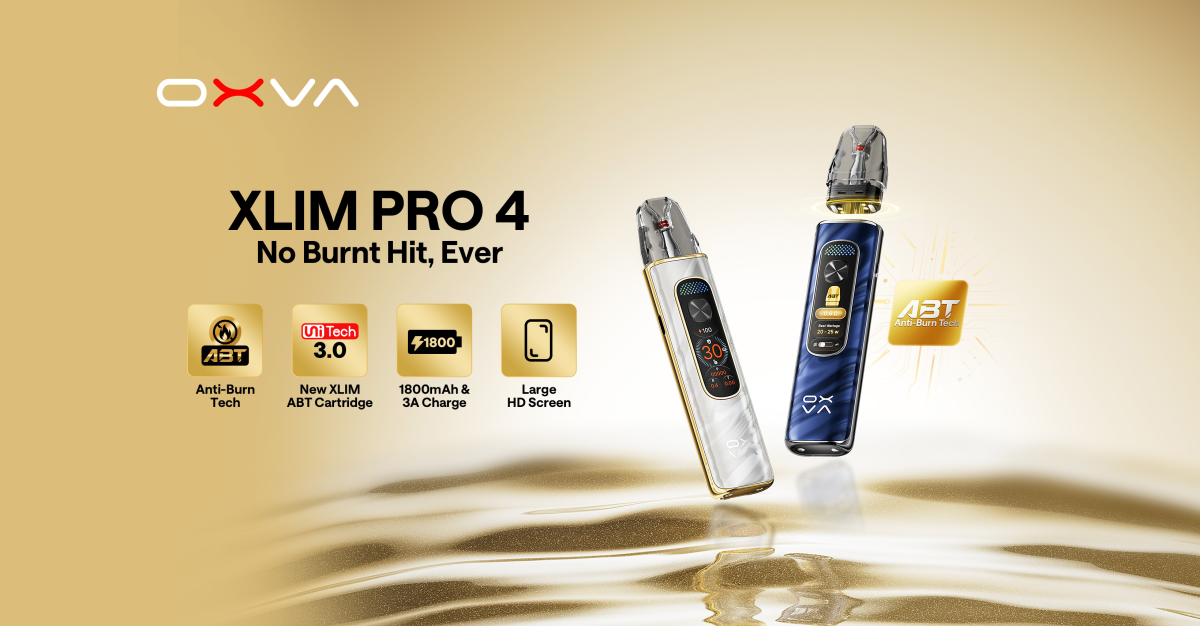
Vaping brand OXVA introduced the XLIM PRO 4 refillable pod system in October 2026, featuring Anti-Burn Tech (ABT) based on smart e-liquid-level detection. The system can issue refill alerts and stop power output when e-liquid levels become too low. ABT requires the XLIM PRO 4 device and a dedicated XLIM ABT cartridge. Standard XLIM pods remain compatible but do not support ABT protection. OXVA previously introduced temperature-based anti-burn technology in the XLIM Pro 2 DNA, developed with Evolv. The new device features a 1,800mAh battery, 5–30W output and a 0.98-inch HD color screen. OXVA's official store lists the device at $37.90 and dedicated ABT replacement cartridges at $12.99. Independent testing confirmed the low-liquid protection response but recorded varying cartridge lifespans.
product
Oct.30
EU Vape, Heated Tobacco and Nicotine Pouch Tax Reform Reaches Ministerial Talks: Sweden Opposes Proposed 2032 Minimum of 50% of Retail Price or €50/kg for Nicotine Pouches
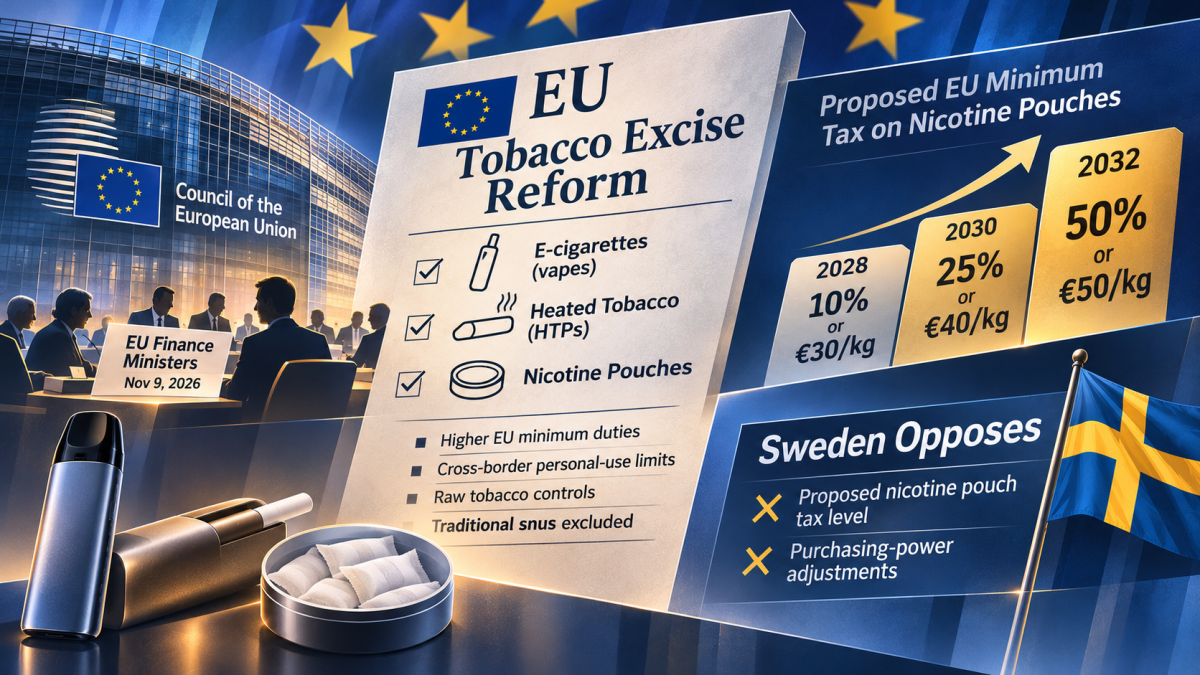
EU finance ministers are scheduled to discuss tobacco excise reform on November 9, 2026, seeking agreement on higher minimum duties for conventional tobacco and a common EU minimum tax framework covering e-cigarettes, heated tobacco and nicotine pouches. A November 5 Council document identifies nicotine pouch taxation as the main outstanding issue. The Irish Council presidency proposes phased increases, reaching 50% of retail selling price or €50 per kilogram in 2032. Sweden has formally said it cannot support the current compromise, objecting to both the proposed nicotine pouch tax burden and the adjustment of minimum rates based on national purchasing power. The package also addresses cross-border personal-use reference quantities, raw tobacco controls and the continued exclusion of traditional tobacco snus.
Regulations
Nov.10
Philippines Mandates Safety Certification for Nicotine Pouches, Gives Industry 12 Months to Comply
The Philippines Department of Trade and Industry has placed nicotine pouches under mandatory product certification through Department Administrative Order No. 26-07, Series of 2026. Nicotine pouches must obtain a Philippine Standard, or PS, license before they can be manufactured, imported, packed, distributed or sold in the country. The regime requires testing for nicotine content, pH and water activity, while packaging must disclose nicotine strength, ingredients, allergens, batch information, the PS certification mark and prescribed health warnings. Existing market participants have a 12-month transition period to comply.
Regulations
Oct.12
South Korea Fully Reviews Nicotine-Analog and Nicotine-Free Vape Liquid Imports, With Over 99% From China and Chinese Supply-Chain Documents Under Scrutiny
Korea Customs Service has tightened import controls on nicotine-analog and nicotine-free e-cigarette liquids, placing the products under 100% document review and subjecting all e-cigarette liquid import declarations to pre-clearance ingredient analysis. As of September 20, 2026, South Korea had imported about 15 metric tons of nicotine-analog liquids, 99.99% from China, and about 316 metric tons of nicotine-free liquids, including roughly 315 metric tons, or 99.7%, from China. The measures follow South Korea's April expansion of its tobacco definition to include synthetic nicotine products and include new checks on Chinese manufacturing, transaction and export documentation.
Sep.24
UK Vape Duty Starts in October as Hayati, DOJO and Others Launch Lower-Capacity Products With Lower Per-Unit Tax
The UK's Vaping Products Duty will take effect on October 1, 2026, at a flat rate of £2.20 per 10ml of vaping liquid. Ahead of implementation, DOJO, PIXL and Hayati have introduced or been reported to be adding lower-capacity tiers alongside larger products. DOJO has added a 6ml BLAST7K Fresh below its 10ml BLAST10K Fresh, PIXL offers both a 12ml 8000 and a 6ml 5K, while retailer Ninja Vapes says Hayati is preparing a 7ml 4K alongside its existing 12ml 6K. The pattern points to a growing lower-capacity tier in the UK market, although the brands have not all explicitly linked the changes to the new duty.
Sep.23
Special Report | Vape bans and tougher rules: the South Caucasus takes different paths
Azerbaijan's sweeping e-cigarette ban has raised concerns over enforcement errors and the emergence of illicit sales, while neighboring Armenia is tightening technical rules and preparing higher excise taxes. Georgia, meanwhile, has resisted calls for broader vape restrictions and introduced preferential taxes for some domestically produced cigarettes. The divergent approaches across the South Caucasus highlight a regional policy dilemma: how to curb nicotine use and protect public health without encouraging black markets or creating unintended economic consequences for businesses and consumers.
Nov.03