Key Points
- Plaintiffs: ECIGRUSA LLC (Worldwide Vape Distribution), Addison Vapor LLC, AF Vapor LLC, Smoke Scene Lubbock LLC.
- Defendant: Texas acting Comptroller Kelly Hancock.
- Challenged law: Provision in SB 2024, signed in July 2025 and effective Sept. 1, 2025.
- Ban scope: E-liquids made wholly or partly in China or in “foreign adversary” countries (including Cuba, Iran, North Korea, Russia).
- Claims: Foreign Commerce Clause preemption, facial discrimination, and First Amendment concerns related to advertising.
- Alleged impact: Insufficient 70-day transition period, stranded inventory, customer losses, and enforcement/prosecution risk.
2Firsts, Feb. 3, 2026
Law360 reports that a group of vape distributors and retailers has filed suit seeking to block Texas from enforcing a new law that makes it a crime to sell or market vape products containing e-liquids made wholly or partly in China or in countries designated as “foreign adversaries” by the U.S. Secretary of Commerce.
The plaintiffs sued Texas acting Comptroller of Public Accounts Kelly Hancock, arguing that the Foreign Commerce Clause reserves regulation of trade with foreign nations to Congress alone.
They contend the state measure risks conflicts and undermines the federal government’s ability to “speak with one voice” in foreign commercial affairs.
The lawsuit targets a provision of Senate Bill 2024, signed into law in July 2025 and effective Sept. 1, 2025. Under the provision, it is a crime to sell or market a vape product containing e-liquid made in whole or in part in China or in a country designated as a foreign adversary, including Cuba, Iran, North Korea and Russia.
Plaintiffs include ECIGRUSA LLC (Worldwide Vape Distribution), Addison Vapor LLC (Artisan Vapor & CBD Addison), AF Vapor LLC (Artisan Vapor & CBD Dallas), and Smoke Scene Lubbock LLC.
They argue that the 70-day window between signing and the effective date was not enough time to overhaul supplier networks, leaving them with hundreds of thousands of dollars in pre-law inventory they can no longer sell. They also claim they have already lost customers and faced enforcement actions.
The complaint further argues that e-liquids contain numerous ingredients, making it difficult—sometimes impossible—to verify the origin of every component; under the statute’s plain language, even one ingredient from a prohibited country could trigger criminal liability.
The plaintiffs also allege the law is facially discriminatory and raises First Amendment concerns by criminalizing advertising based on factual representations, while not banning other foreign-made tobacco products.
The case is ECIGRUSA LLC et al. v. Hancock, No. 3:26-cv-00254, in the U.S. District Court for the Northern District of Texas.
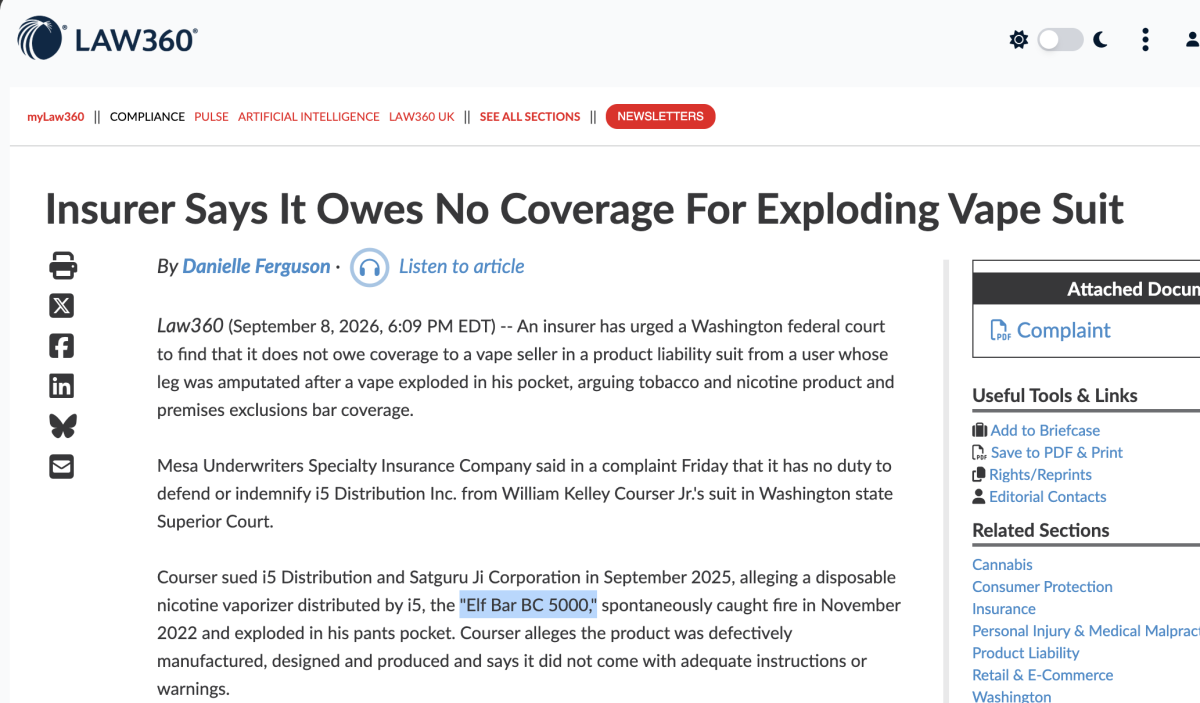
Image source: Law360
We welcome news tips, article submissions, interview requests, or comments on this piece.
Please contact us at info@2firsts.com, or reach out to Alan Zhao, CEO of 2Firsts, on LinkedIn
Notice
1. This article is intended solely for professional research purposes related to industry, technology, and policy. Any references to brands or products are made purely for objective description and do not constitute any form of endorsement, recommendation, or promotion by 2Firsts.
2. The use of nicotine-containing products — including, but not limited to, cigarettes, e-cigarettes, nicotine pouchand heated tobacco products — carries significant health risks. Users are responsible for complying with all applicable laws and regulations in their respective jurisdictions.
3. This article is not intended to serve as the basis for any investment decisions or financial advice. 2Firsts assumes no direct or indirect liability for any inaccuracies or errors in the content.
4. Access to this article is strictly prohibited for individuals below the legal age in their jurisdiction.
Copyright
This article is either an original work created by 2Firsts or a reproduction from third-party sources with proper attribution. All copyrights and usage rights belong to 2Firsts or the original content provider. Unauthorized reproduction, distribution, or any other form of unauthorized use by any individual or organization is strictly prohibited. Violators will be held legally accountable.
For copyright-related inquiries, please contact: info@2firsts.com
AI Assistance Disclaimer
This article may have been enhanced using AI tools to improve translation and editorial efficiency. However, due to technical limitations, inaccuracies may occur. Readers are encouraged to refer to the cited sources for the most accurate information.
We welcome any corrections or feedback. Please contact us at: info@2firsts.com