Key Points
- China has released its first comprehensive, white paper–style overview of e-cigarette regulation, systematically summarizing regulatory development, enforcement outcomes and governance logic since 2018.
- The report confirms e-cigarettes’ full incorporation into China’s tobacco monopoly regulatory framework, supported by legislation, mandatory national standards, licensing systems and multi-agency enforcement.
- Regulators detail a shift from early disorderly expansion to standardized industry operation, citing improved market order, higher industry concentration and rising capacity utilization.
- For the first time, Chinese authorities publicly disclose extensive international engagement, including participation in ISO standard-setting, scientific cooperation and regulatory exchanges with Australia, the EU and Southeast Asian counterparts.
- Export compliance and cross-border enforcement emerge as key priorities, with authorities highlighting export filing requirements, compliance reviews and crackdowns on smuggling and illicit trade.
- The report is released amid intensified regulatory actions in December, signaling that China’s e-cigarette oversight is entering a more consolidated and enforcement-driven phase.
2Firsts, December 29, 2025, Shenzhen — On December 26, 2025, China’s State Tobacco Monopoly Administration (STMA) published the E-Cigarette Supervision and Management Status Report, compiled by the E-Cigarette Supervision and Management Department of the STMA, on its official website.
The document systematically reviews the background, institutional framework, policy measures, enforcement outcomes and international cooperation underpinning China’s e-cigarette regulation, providing a comprehensive account of the regulatory trajectory and key milestones since 2018.
This marks the first time China’s tobacco regulator has released a systematized document publicly summarizing the overall evolution and current state of e-cigarette regulation. The report spans multiple dimensions, including an overview of the e-cigarette industry, the legal and institutional foundations of regulation, major regulatory policy measures, and international cooperation, presenting a relatively complete regulatory framework and implementation logic.
In terms of scope and depth, the document not only reviews industry conditions prior to e-cigarettes being brought under the tobacco monopoly regulatory system, but also systematically outlines institutional developments following their formal inclusion, covering legislation, standards, licensing, enforcement and youth protection. Taken together, the report offers a consolidated view of the current regulatory architecture, operational mechanisms and enforcement outcomes governing China’s e-cigarette sector.
The report also discloses specific practices and data related to enforcement actions against illegal e-cigarette activities, efforts to standardize market order, and initiatives to advance international regulatory engagement, providing a centralized and comprehensive official reference for understanding China’s e-cigarette regulatory system.
1. A Regulatory Timeline Beginning in 2018: The Institutional Evolution of Bringing E-Cigarettes Under Tobacco Monopoly Oversight
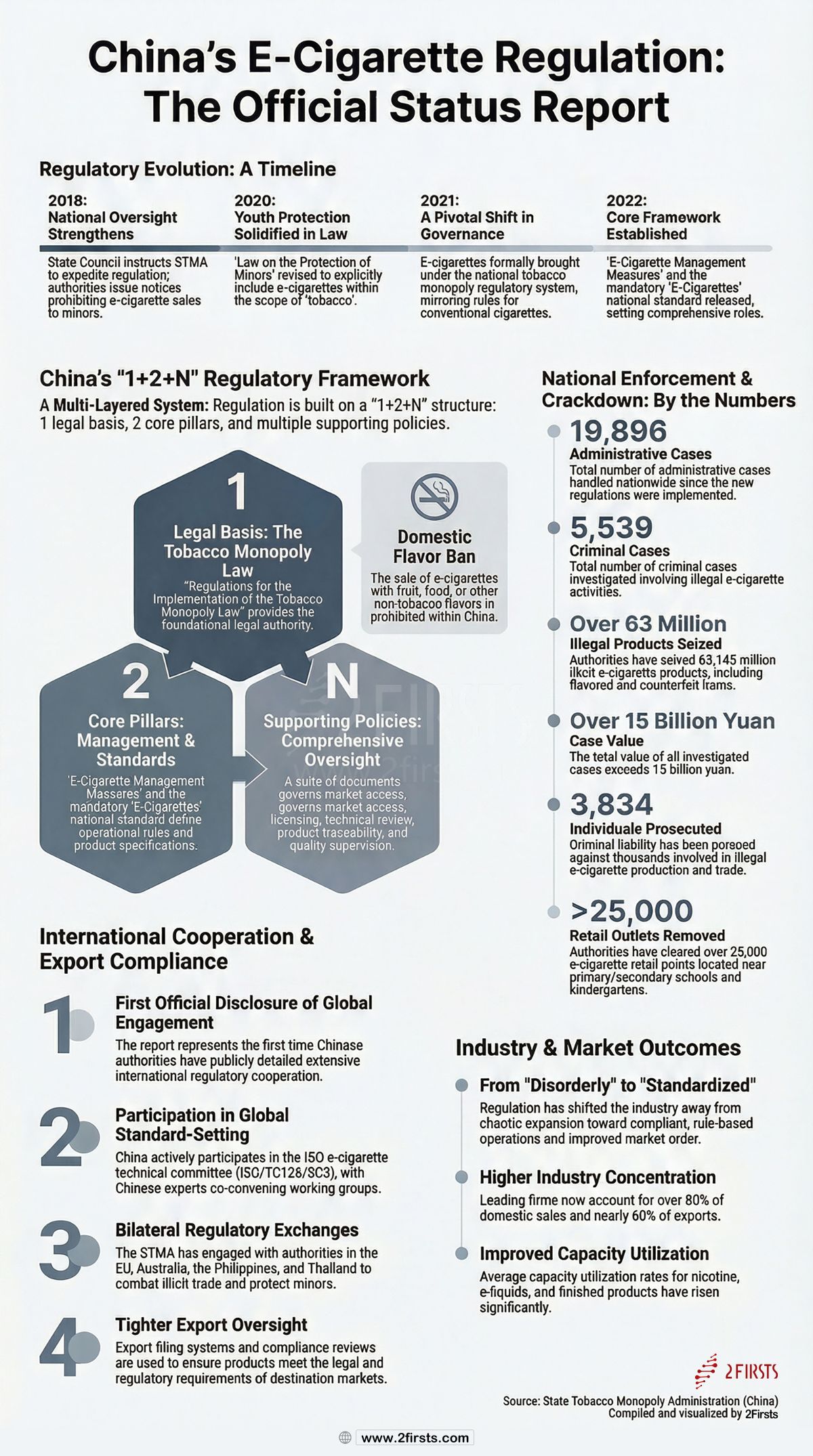
The E-Cigarette Supervision and Management Status Report presents a chronological review of China’s regulatory pathway for e-cigarettes, identifying 2018 as the point at which authorities began to systematically strengthen regulation at the national level.
According to the report, as e-cigarettes expanded rapidly worldwide and domestic market issues gradually emerged, Chinese authorities accelerated legislative efforts and tightened regulatory oversight. In 2018, the State Council instructed the State Tobacco Monopoly Administration to expedite the development of relevant legal frameworks and strengthen regulation of e-cigarettes. In the same year and again in 2019, the STMA and the State Administration for Market Regulation jointly issued notices prohibiting the sale of e-cigarettes to minors and further protecting minors from e-cigarette harm, establishing youth protection as a core regulatory priority.
In 2020, the Standing Committee of the National People’s Congress revised the Law of the People’s Republic of China on the Protection of Minors, explicitly bringing e-cigarettes within the scope of “tobacco,” thereby strengthening legal protections for minors against e-cigarette-related harm.
A pivotal institutional shift occurred in 2021. The report notes that the State Council issued a decision amending the Regulations for the Implementation of the Tobacco Monopoly Law of the People’s Republic of China, adding provisions stipulating that e-cigarettes and other novel tobacco products shall be regulated with reference to the relevant provisions governing conventional cigarettes. This amendment formally brought e-cigarettes under the tobacco monopoly regulatory system, establishing the legal foundation for subsequent institutional development and enforcement.
Building on this framework, the regulatory system entered a phase of concentrated refinement. In March 2022, the STMA issued the E-Cigarette Management Measures, setting out comprehensive rules covering production, sales, transportation, import and export, and regulatory oversight. In April of the same year, the State Administration for Market Regulation (Standardization Administration of China) released the mandatory national standard E-Cigarettes, establishing unified requirements for product design, raw material selection, technical specifications, testing methods, as well as product labeling and instructions.
The report shows that, thereafter, the STMA and relevant authorities successively introduced supporting policy measures across areas including industrial layout, market access, technical review, transaction management, quality supervision, product traceability, logistics management, credit management and regulatory enforcement, gradually forming a more complete e-cigarette regulatory system.
2. From Disorderly Expansion to Standardized Operation: Official Assessment of Industry Governance Outcomes
The E-Cigarette Supervision and Management Status Report provides a systematic assessment of the developmental stages of China’s e-cigarette industry and the outcomes of regulatory governance. According to the report, during the industry’s early phase, gaps in legislation and insufficient regulatory oversight led to a period of disorderly expansion, with a range of problems gradually emerging.
The report identifies three major issues that characterized the early development of the sector. First, product quality and safety risks were prominent, with some products posing hazards such as excessive nicotine levels, e-liquid leakage, heavy metal contamination and the use of unsafe additives. Second, certain operators used flavors, packaging and marketing gimmicks to entice minors to purchase and use e-cigarettes, adversely affecting their physical and mental health. Third, industry order became distorted as a large number of enterprises entered the market in a short period, leading to rapid expansion, intensified cutthroat competition, and frequent instances of trademark counterfeiting, patent infringement and false advertising.
As e-cigarettes were gradually brought under the tobacco monopoly regulatory framework, the report states that authorities adopted a coordinated and comprehensive approach, efficiently establishing a regulatory system covering production, circulation, sales and enforcement. Regulatory actions were advanced in accordance with the law, steering the governance of the e-cigarette industry onto a more rule-based and standardized path.
With regard to market order, the report notes that regulatory requirements have been comprehensively implemented, illegal business activities effectively curbed, and a culture of compliant and law-abiding operations gradually established, resulting in a marked improvement in market conditions.
In terms of industry structure, the report shows that the guiding effect of restrictive industrial policies has continued to take hold, with enterprises and retailers unable to adapt to market competition exiting in an orderly manner and a fairer competitive environment gradually taking shape. At present, leading enterprises account for more than 80% of sales in the domestic market and nearly 60% of exports, while key players in the nicotine and e-liquid segments each hold market shares exceeding 60%.
Regarding capacity utilization, the report notes that, based on statistical survey production data, average capacity utilization rates for nicotine used in e-cigarettes, e-liquids and finished e-cigarette products have risen significantly in recent years, reflecting continued improvements in operational efficiency across the industry.
3. Participation in International Standards and Scientific Cooperation: China Enters the Global Technical Rule-Making Framework for E-Cigarettes
The E-Cigarette Supervision and Management Status Report shows that, alongside strengthening domestic regulation, China’s e-cigarette regulators are simultaneously advancing international cooperation in the e-cigarette sector. The report discloses the State Tobacco Monopoly Administration’s specific involvement in international standard-setting and scientific cooperation, providing insight into China’s participation in the global technical governance of e-cigarettes.
With respect to international standards, the report states that China is actively involved in the development of e-cigarette-related standards under the framework of the International Organization for Standardization (ISO). The ISO Technical Committee on Tobacco and Tobacco Products has established a Subcommittee on Electronic Cigarettes and Vaping Products (ISO/TC126/SC3), which currently operates multiple working groups focusing on areas such as testing methods for emissions from vaping products, as well as requirements and testing methods for e-cigarette devices. According to the report, multiple Chinese experts are registered participants in these working groups, with some serving as co-conveners and contributing to the development of several international e-cigarette standards.
In terms of international scientific cooperation, the report notes that institutions including the Zhengzhou Tobacco Research Institute and the Shanghai New Tobacco Product Research Institute have participated in research activities under the Electronic Vaping Products Subgroup of the Cooperation Centre for Scientific Research Relative to Tobacco (CORESTA).
4. First Disclosure of Cross-Border Enforcement and Export Compliance: China Advances International Regulatory Coordination on E-Cigarettes
In the area of cross-border enforcement and regulatory exchanges, the E-Cigarette Supervision and Management Status Report for the first time provides a consolidated disclosure that the State Tobacco Monopoly Administration has engaged in multiple rounds of exchanges with e-cigarette regulatory authorities in countries and regions including Australia, the Philippines, Thailand and the European Union. These engagements explore the establishment of bilateral and multilateral dialogue mechanisms, focusing on jointly combating illicit e-cigarette trade, strengthening regulatory cooperation and protecting minors from e-cigarette-related harm, with a series of consensuses reached in relevant areas.
The report also states that the STMA is actively promoting international regulatory enforcement cooperation. Since 2024, tobacco monopoly authorities at various levels, working together with public security agencies and customs anti-smuggling departments, have uncovered multiple cases involving the smuggling of e-cigarettes, delivering effective blows to illicit trade networks and continuously improving the order of e-cigarette import and export activities.
In addition, the report notes that the STMA has established and improved mechanisms for publishing international e-cigarette regulatory policy information, and, through measures including export filing requirements and compliance reviews, supervises whether exported e-cigarette products meet the legal and regulatory requirements of destination countries or regions. Where non-compliance is identified, regulators carry out verification and rectification in accordance with the law, strengthening oversight of export compliance risks in the e-cigarette sector.
5. A Fully Formed Regulatory Framework: Legal, Institutional and Technical Systems Advancing in Tandem
The E-Cigarette Supervision and Management Status Report indicates that, following the inclusion of e-cigarettes within the tobacco monopoly regulatory system, China has progressively established a legal and institutional framework for e-cigarette regulation encompassing regulatory scope, institutional rules, enforcement bodies, technical support and mechanisms for social co-governance, providing systematic safeguards for regulatory implementation.
Regarding regulatory scope, the report makes clear that e-cigarettes, e-liquids and nicotine used in e-cigarettes are all subject to tobacco monopoly regulation. E-cigarettes include cartridges, devices, and products sold as combinations of cartridges and devices, while e-liquids refer to mixtures and auxiliary substances that can be wholly or partially aerosolized by electronic devices. The report also reiterates that the sale of e-cigarettes with fruit, food or beverage flavors, as well as e-cigarettes that allow users to add e-liquids themselves, is prohibited within China, and that nicotine-free e-cigarette products are likewise included within the regulatory scope.
In terms of the institutional framework, the report outlines the formation of a “1+2+N” regulatory system, with the Regulations for the Implementation of the Tobacco Monopoly Law of the People’s Republic of China as the legal basis, the E-Cigarette Management Measures and the mandatory national standard E-Cigarettes as core pillars, and multiple supporting policy documents as supplements. This system covers a wide range of areas, including industrial layout, market access, technical review, transaction management, quality supervision, product traceability, logistics management, credit management and regulatory enforcement.
With regard to the regulatory institutional system, e-cigarette oversight involves multiple government departments, including tobacco, market regulation, public security, customs, postal services, development and reform, judicial authorities, finance, taxation, commerce, health and education. The report notes that these departments coordinate according to their respective responsibilities in formulating laws, regulations and policy documents, and strengthen coordination between administrative enforcement and criminal justice through mechanisms such as case notifications, case transfers and joint enforcement actions. As the competent authority for e-cigarette regulation, the State Tobacco Monopoly Administration is responsible for nationwide oversight, with tobacco monopoly authorities at provincial, municipal and county levels assuming corresponding regulatory duties and establishing dedicated e-cigarette supervision departments to strengthen professional regulatory capacity.
In terms of supervision and testing, the report states that the STMA has built a technical review and testing support system covering both pre-market technical evaluation and post-market supervision and inspection. This system relies on the Zhengzhou Tobacco Research Institute and Shanghai New Tobacco Product Research Institute Co., Ltd. as core research institutions, the China National Tobacco Quality Supervision and Inspection Center and Shanghai New Tobacco Testing Technology Co., Ltd. as key testing bodies, and is supported by multiple provincial-level tobacco quality inspection stations, providing technical support and scientific evidence for e-cigarette regulation.
With respect to social co-governance and the protection of minors, the report notes that, alongside strengthening administrative regulation, authorities place emphasis on leveraging social oversight by improving complaint and reporting channels, reinforcing public supervision and guiding enterprises toward self-discipline through credit management and commitment mechanisms. At the same time, laws, mandatory national standards and regulatory measures related to the protection of minors set out systematic requirements across multiple dimensions, including sales channels, product characteristics and places of use.
6. Regulatory Tools Intensify: Industrial Policy, National Standards, Licensing and Market Order Advance in Parallel
The E-Cigarette Supervision and Management Status Report shows that, in pursuit of regulatory objectives centered on standardizing the e-cigarette market and safeguarding public health, the State Tobacco Monopoly Administration, together with relevant authorities, has continued to refine and implement regulatory measures across multiple dimensions, including industrial policy, product standards, market access and circulation management.
With regard to industrial policy, the report notes that, in response to early-stage disorderly development, excess capacity and vicious competition in the e-cigarette sector, regulators have implemented restrictive national industrial policies to impose controls on investment and production capacity. In 2022, the STMA issued the Several Policy Measures (Trial) to Promote the Rule-Based and Standardized Development of the E-Cigarette Industry, explicitly implementing the spirit of relevant legislation and seeking to prevent blind investment and low-level redundant construction. In 2023, the National Development and Reform Commission included e-cigarettes and other novel tobacco products in the “restricted” category of the Industrial Structure Adjustment Guidance Catalogue (2024 Edition), providing regulatory guidance for investment behavior in the sector.
In terms of product standards and quality supervision, the report emphasizes that the formulation and implementation of the mandatory national standard E-Cigarettes has provided a unified technical basis for product quality and safety management. Regulators have established inspection and testing regimes for e-cigarette products, conducting quality supervision and spot checks on licensed enterprises and their products. From 2023 to 2025, authorities organized multiple rounds of supervisory inspections focusing on key areas such as product quality and characteristic flavors, ordering corrective actions for products found to be non-compliant.
Regarding market access, the report shows that e-cigarettes have been lawfully incorporated into China’s national market access system. Regulators apply tobacco monopoly licensing requirements to e-cigarette production, wholesale and retail activities, and implement a technical review system for e-cigarette products sold within China, under which products that fail to pass review are prohibited from entering the market. At the same time, regulators, in coordination with relevant departments, have strengthened oversight of imported e-cigarette products, promoting alignment between import-stage supervision and domestic circulation controls.
In the management of market circulation order, the report states that the STMA has established a unified national e-cigarette transaction management platform, bringing e-cigarette-related business activities under centralized platform oversight. Licensed manufacturers, brand owners, wholesalers and retail entities are required to conduct product transactions through this platform. The report also makes clear that sales of e-cigarette products through online channels outside the platform are prohibited, as are e-cigarette advertising and sales through self-service or automated vending methods.
With respect to logistics and delivery management, the report notes that regulators have imposed quantity limits on the transportation, delivery and cross-regional carrying of e-cigarette products, e-liquids and nicotine used in e-cigarettes, and have established a logistics documentation management system to ensure consistency between product flows, licensing information and transaction records, thereby institutionalizing controls over e-cigarette circulation.
7. Enforcement Continues to Intensify: Multi-Agency Crackdown on E-Cigarette-Related Violations
The E-Cigarette Supervision and Management Status Report indicates that, in efforts to standardize market order and curb illegal business activities, public security, customs, market regulation, postal and tobacco authorities have continued to strengthen inter-agency coordination and joint enforcement. This has led to the gradual formation of a regulatory enforcement framework characterized by “online clearance, offline control, full-chain coverage and joint governance,” while maintaining sustained high-pressure enforcement against e-cigarette-related violations.
In the area of online supervision, the report notes that, in response to the persistent emergence of illegal e-cigarette sales and advertising on internet platforms, tobacco and market regulation authorities have continuously upgraded technical tools and carried out joint enforcement actions. The STMA has established and operates a nationwide tobacco-related information monitoring platform, integrated with the national online transaction supervision system, enabling real-time monitoring of online e-cigarette sales leads and illegal advertisements. Through data analysis, regulators identify enforcement leads and continue to remove illegal e-cigarette-related content from e-commerce, social media, short-video and livestreaming platforms.
With respect to offline enforcement, the report shows that tobacco monopoly authorities at all levels, working together with public security and market regulation departments, have continued to carry out both targeted enforcement campaigns and routine inspections. Since 2021, regulators have launched a series of special actions focusing on protecting minors from e-cigarette harm and cracking down on illegal flavored e-cigarette products, including the “Protecting Growth” campaign,专项行动 targeting sales of e-cigarettes to minors, and dedicated enforcement operations against flavored products such as “milk tea cup” and “cola can” e-cigarettes. In 2024, regulators also carried out targeted actions addressing online sales of modified and variant e-cigarette products.
The report discloses that, across successive enforcement campaigns, authorities nationwide have removed more than 25,000 e-cigarette retail outlets located near primary and secondary schools and kindergartens, and investigated more than 1,200 cases involving the sale of e-cigarettes to minors. At the same time, regulators have intensified full-chain enforcement against illegal production, storage, transportation, retail and import-export activities, with a focus on curbing the resurgence of flavored e-cigarettes, as well as practices such as false customs declarations, re-importation of exported products and illicit trade.
In terms of enforcement outcomes, the report states that since e-cigarettes were brought under regulatory oversight, authorities nationwide have handled a total of 19,896 administrative cases and 5,539 criminal cases involving e-cigarettes, seized 63.145 million illegal e-cigarette products, with the total value of cases exceeding 15 billion yuan, and pursued criminal liability against 3,834 individuals.
8. Regulatory Actions Intensify Since December: A Series of Measures Sets the Context for the Status Report
The release of the E-Cigarette Supervision and Management Status Report comes amid a period of intensified regulatory activity in China’s tobacco and e-cigarette sectors. Since December, regulators have issued a series of signals indicating tighter oversight across enforcement deployment, industrial policy implementation and institutional execution, providing immediate context for the regulatory direction and governance logic summarized in the report.
According to previous reporting by 2Firsts, on December 5 Premier Li Qiang chaired a State Council executive meeting, which called for a full-chain crackdown on tobacco-related illegal activities. The enforcement requirements outlined at the meeting were subsequently implemented across regulatory agencies.
On December 18, the General Office of the State Council released an opinion document strengthening enforcement deployment against tobacco-related violations and explicitly bringing e-cigarettes under a stricter regulatory lens. The document has been widely viewed as a key policy signal of continued tightening oversight over tobacco and novel tobacco products.
Building on these moves, the State Tobacco Monopoly Administration on December 25 issued a new policy framework further tightening controls over e-cigarette production capacity and investment. The document makes clear that new e-cigarette manufacturing projects are prohibited, imposes stricter constraints on capacity expansion, fixed-asset investment and production scale adjustments, and emphasizes accelerating the exit of non-compliant and inefficient capacity.
Previous reporting by 2Firsts noted that the policy framework is intended to implement national restrictive industrial policy requirements, curb what regulators describe as “involution-style” competition, and stabilize approved capacity through institutionalized mechanisms while reinforcing a compliance-oriented operating environment.
Following this series of regulatory actions, the State Tobacco Monopoly Administration released the E-Cigarette Supervision and Management Status Report on December 26, providing a systematic review of China’s e-cigarette regulatory trajectory, institutional framework and enforcement outcomes since 2018. In terms of timing, the report closely aligns with the regulatory measures rolled out throughout December.
9. Alan Zhao: “White Paper”-Style Summary Signals Clear Governance and Cooperation Priorities
Alan Zhao, co-founder and chief executive of 2Firsts, said that the newly released E-Cigarette Supervision and Management Status Report offers a “white paper”-style, centralized and systematic summary of China’s approach to e-cigarette regulation, comprehensively presenting regulators’ governance philosophy, institutional framework, concrete actions and phased outcomes in the sector.
Zhao said the report provides a clear picture of regulators’ overall assessment of the current state of China’s e-cigarette industry and their governance orientation, including an emphasis on market order, compliant operations and risk prevention.
He added that the report for the first time offers a consolidated disclosure of China’s tobacco regulators’ efforts to advance international cooperation in the e-cigarette field, reflecting a strong commitment to continuing bilateral and multilateral cooperation at the international level through regulatory coordination and enforcement collaboration, aimed at jointly combating illicit tobacco trade and cross-border illegal activities.
Zhao said regulators and enforcement agencies in relevant countries and regions, multinational tobacco companies, as well as international clients sourcing e-cigarette products from China, should all pay close attention to the report and, on that basis, actively establish and deepen communication and cooperation with Chinese regulators.
For continued coverage of regulatory and market developments in China’s e-cigarette and nicotine sectors, follow 2Firsts.