FDA Releases Additional Regulatory Science Policy Memoranda on PMTA

Regulations by 2FIRSTS.ai
May.15.2024
FDA Releases Additional Regulatory Science Policy Memoranda on PMTA
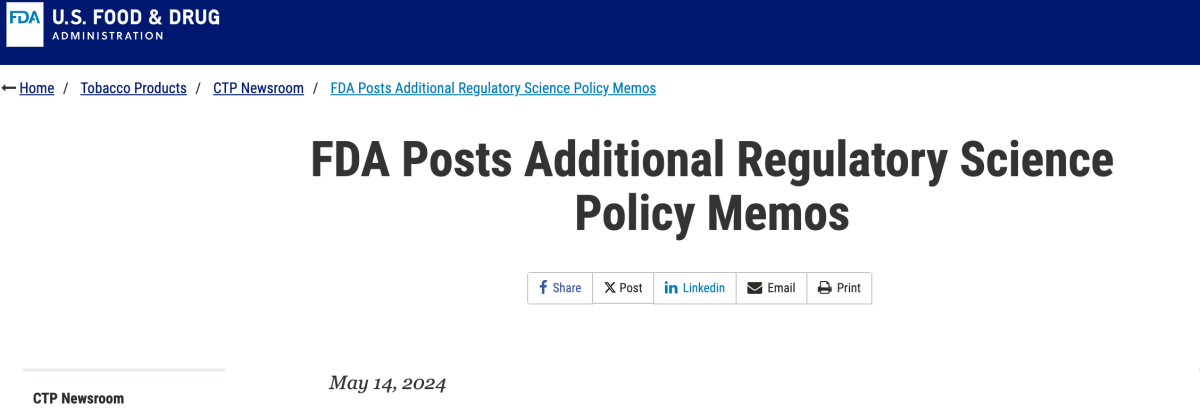
FDA announces new regulatory science policy memoranda focusing on premarket tobacco product application (PMTA) review roles, responsibilities, and processes.

According to the US Food and Drug Administration (FDA), on May 14th, the FDA released an additional regulatory science policy memorandum focusing on internal roles, responsibilities, and processes related to the Pre-Market Tobacco Product Application (PMTA) review.


The five memorandums released this time were completed between 2020 and 2022.


These memoranda describe the internal roles and responsibilities for reviewing scientific disciplines and marketing information. One memorandum also discusses the FDA's approach to acceptance and filing reviews in development, including prioritizing certain non-tobacco nicotine product applications received before November 4, 2021.


These 5 memos include:


August 3, 2020: Guidelines for the review and evaluation of marketing plans for the Office of Health Communication and Education March 4, 2021: Clarification on harmful and potentially harmful constituents (HPHC), aerosol and smoke production, and Biomarkers of Exposure (BOE) data in relation to the Premarket Tobacco Product Application (PMTA) review responsibilities of the Division of Individual Health Science (DIHS), Division of Product Science (DPS), and Division of Non-Clinical Science (DNCS) March 30, 2022: Clarification of PMTA review responsibilities between the Division of Population Health Science and Division of Individual Health Science May 2, 2022: Supplementary explanation of guidelines for the review and evaluation of marketing information for PMTA from the Office of Health Communication and Education June 1, 2022: Implementation of new PMTA acceptance and filing review processes in accordance with the new requirements of 21 CFR 1114.


Furthermore, the memorandum to be released should not be used as a tool, guide, or manual for preparing applications or submissions to the FDA. For applicants seeking to sell new tobacco products, the FDA has already issued final regulations, such as the PMTA Final Rule, which describe the required content, format, and review process for PMTAs, as well as guidance documents.


We welcome news tips, article submissions, interview requests, or comments on this piece.

Please contact us at info@2firsts.com, or reach out to Alan Zhao, CEO of 2Firsts, on LinkedIn


Notice

1.  This article is intended solely for professional research purposes related to industry, technology, and policy. Any references to brands or products are made purely for objective description and do not constitute any form of endorsement, recommendation, or promotion by 2Firsts.

2.  The use of nicotine-containing products — including, but not limited to, cigarettes, e-cigarettes, nicotine pouchand heated tobacco products — carries significant health risks. Users are responsible for complying with all applicable laws and regulations in their respective jurisdictions.

3.  This article is not intended to serve as the basis for any investment decisions or financial advice. 2Firsts assumes no direct or indirect liability for any inaccuracies or errors in the content.

4.  Access to this article is strictly prohibited for individuals below the legal age in their jurisdiction.


Copyright


This article is either an original work created by 2Firsts or a reproduction from third-party sources with proper attribution. All copyrights and usage rights belong to 2Firsts or the original content provider. Unauthorized reproduction, distribution, or any other form of unauthorized use by any individual or organization is strictly prohibited. Violators will be held legally accountable.

For copyright-related inquiries, please contact: info@2firsts.com


AI Assistance Disclaimer


This article may have been enhanced using AI tools to improve translation and editorial efficiency. However, due to technical limitations, inaccuracies may occur. Readers are encouraged to refer to the cited sources for the most accurate information.

We welcome any corrections or feedback. Please contact us at: info@2firsts.com

China Tobacco International HK Warns First-Half Revenue May Fall 25%-30%, Tobacco Leaf and Duty-Free Exposure Highlight Reliance on Traditional Tobacco
CTIHK expects first-half 2026 revenue to fall 25%-30%, mainly due to lower tobacco leaf imports and delayed cigarette shipments to China’s domestic duty-free market. Its 2025 revenue mix—nearly 90% from tobacco leaf-related businesses and less than 1% from new tobacco products—shows continued exposure to traditional supply chains and trade variables.
Jun.18
Australia’s TGA Places Nicotine Pouches Under Therapeutic Goods Rules From July 24, Blocking Imports of Unapproved Products
Australia is strengthening controls on nicotine pouches under its existing therapeutic goods regulatory framework. According to the Therapeutic Goods Administration (TGA), nicotine pouch products must meet regulatory requirements, and unapproved products cannot be legally imported. The move follows Australia’s broader approach of maintaining strict oversight of nicotine products, including nicotine-containing vapes. As nicotine pouches expand globally, Australia’s regulatory approach highlights growing differences in how countries manage emerging smoke-free nicotine products.
Regulations
Jul.27
Japan’s Heated Tobacco Tax Reform Drives Price Increase as JT Raises All Ploom Sticks by ¥40
Japan Tobacco Inc. (JT) has applied to Japan’s finance minister for approval to revise retail prices of its Ploom heated tobacco sticks following planned changes to the heated tobacco tax system from October 1, 2026. If approved, all 31 Ploom stick products will increase by ¥40. After the adjustment, EVO products will cost ¥620 per 20-stick pack, MEVIUS products ¥590 and CAMEL products ¥570. JT said the price revision is intended to respond to tax changes while maintaining product quality and brand value. The tax reform is expected to narrow the tax gap between combustible cigarettes and heated tobacco products, potentially reshaping pricing strategies in Japan’s heated tobacco market.
Jul.22
Altria Smokeable Profit Rises 2.4% as Marlboro Share Falls and U.S. Discounts Gain
Altria’s second-quarter results show a U.S. nicotine market splitting across price, product and regulation. Smokeable profit rose 2.4% as Marlboro pricing offset lower volumes, while discount brand Basic gained share among value-conscious smokers. In oral nicotine, on! PLUS expanded distribution but faced intensifying competition from ZYN and Velo. NJOY remained off the market as patent and regulatory hurdles delayed its return. The broader lesson: U.S. growth increasingly depends on price-tier strategy, retail execution, authorisation and enforcement readiness across the industry.
Special Report
Jul.31
PMI Partners With Italian Tenor Andrea Bocelli to Launch “Believe. Further” Platform
Philip Morris International (PMI) and Italian tenor Andrea Bocelli have launched “Believe. Further,” a multi-year communications platform targeting cultural, institutional and business audiences in Europe, as PMI says smoke-free products accounted for 43% of its net revenues as of the first quarter of 2026.
Jul.01
JT’s Ploom Volumes Rise 43.5% as Cigarettes Anchor Its Transition
JT’s Ploom heated-tobacco volumes rose 43.5% in the first half of 2026, while combustibles still represented about 97% of its tobacco volume and remained the main earnings base. In Japan, reduced-risk products now account for 48.7% of industry shipments, shifting competition from category adoption towards brand share, pricing and consumer retention. JT’s results offer a revealing case of a traditional tobacco company pursuing a prolonged, dual-track transformation.
JTI
Jul.30