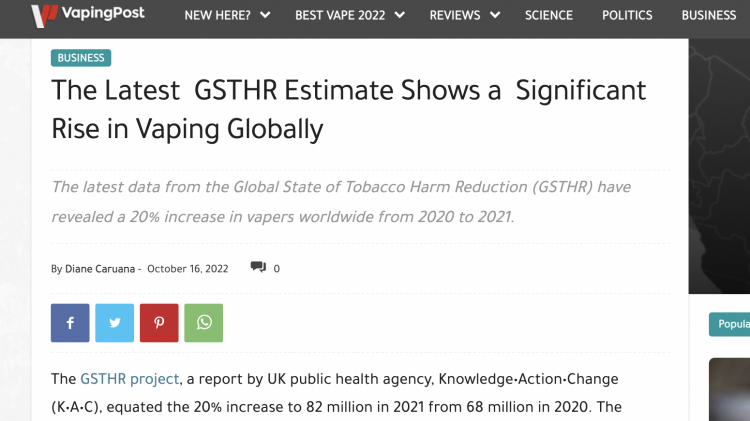
The GSTHR project is a report from the UK public health organization K•A•C, which indicates that the number of e-cigarette users in 2021 increased by 20% from 68 million in 2020 to 82 million. These figures are based on data from 49 countries, obtained by combining information from various sources, including the 2021 Eurobarometer 506 survey. The new GSTHR briefing provides these findings.
During the discussion of the findings, Tomasz Jerzyński, a data scientist at GSTHR, emphasized the increase in e-cigarette usage rates in specific regions. "In addition to the significant global increase in e-cigarette users, our research indicates that the usage rate of nicotine e-cigarette products is also rapidly increasing in some countries in Europe and North America," said Jerzyński. "This growth is particularly noteworthy because these products have only been on the market for a decade in most markets.
A report has revealed that the largest market for electronic cigarettes is the United States, valued at $10.3 billion, followed by Western Europe ($6.6 billion), the Asia-Pacific region ($4.4 billion), and Eastern Europe ($1.6 billion). Speaking about the significance of this study, Professor Gerry Stimson, Director of Knowledge-Action-Change and Honorary Professor at Imperial College London, stated that these numbers are particularly encouraging given the widespread opposition and efforts to condemn e-cigarettes.
According to the latest data from "Global Tobacco Harm Reduction Status," consumers are finding nicotine e-cigarette products attractive and are using them more and more around the world. Despite bans in many countries, these countries have taken a stance against reducing tobacco harm due to Michael Bloomberg's billions of dollars and his personal passion for fighting nicotine.
In order to reduce the destructive harm of smoking, which results in 8 million deaths per year, governments must be pragmatic. Nicotine electronic cigarette products and other safer nicotine products should be accessible and affordable for those around the world seeking to quit deadly combustible cigarettes as a harm reduction tool.
Statement:
This article is compiled from third-party information and is intended only for industry exchange and learning purposes.
This article does not represent the views of 2FIRSTS, and 2FIRSTS cannot confirm the authenticity or accuracy of the article's content. The translation of this article is for industry exchange and research purposes only.
Due to limitations in the level of translation, the compiled article may not fully reflect the original text. Please refer to the original article for accuracy.
2FIRSTS maintains complete alignment with the Chinese government regarding any statements and positions related to domestic issues, Hong Kong, Macau, Taiwan, and foreign affairs.
Copyright of the compiled information belongs to the original media and authors. If there is any infringement, please contact us for deletion.
Disclaimer
This article is provided solely for professional research, industry discussion, and informational purposes. Any references to brands, companies, products, technologies, or policies are made for factual reporting and analytical purposes only, and do not constitute endorsement, recommendation, promotion, or advertising by 2Firsts.
Nicotine-containing products, including but not limited to cigarettes, e-cigarettes, heated tobacco products, and nicotine pouches, carry significant health risks. Readers are responsible for complying with all applicable laws and regulations in their respective jurisdictions, including age restrictions and access limitations.
The information contained in this article should not be regarded as investment, legal, medical, regulatory, or commercial advice. While 2Firsts strives to ensure the accuracy and reliability of its content, it does not assume liability for any direct or indirect loss arising from errors, omissions, inaccuracies, or reliance on the information contained herein.
This article is not intended for individuals below the legal age for accessing tobacco or nicotine-related information in their jurisdiction.
Copyright Notice
This article is either original content produced by 2Firsts or content reproduced, translated, summarized, or adapted from third-party sources with attribution where applicable. The intellectual property rights of the original content remain with 2Firsts or the respective original rights holders.
No individual or organization may copy, reproduce, distribute, republish, modify, translate, or otherwise use this content without prior authorization. Any unauthorized use may result in legal action.
For copyright-related inquiries, corrections, or removal requests, please contact: info@2firsts.com.
AI-Assisted Translation and Editing Notice
Portions of this article may have been translated, edited, or reviewed with the assistance of artificial intelligence tools to improve efficiency and readability. Due to the limitations of AI-assisted translation and editing, discrepancies, omissions, or inaccuracies may exist when compared with the original source.
Where applicable, readers are advised to refer to the original source for the most complete and accurate information. If you identify any errors or believe that any content infringes upon your rights, please contact us at info@2firsts.com, and we will review and address the matter promptly.