Indonesia's West Java BJBC Destroys Illegal Tobacco and Alcohol

Regulations by 2FIRSTS.ai
Dec.07.2023
Indonesia's West Java BJBC Destroys Illegal Tobacco and Alcohol
Indonesia's West Java customs office to destroy illegal cigarettes and alcohol valued at 8.2 billion rupiah.

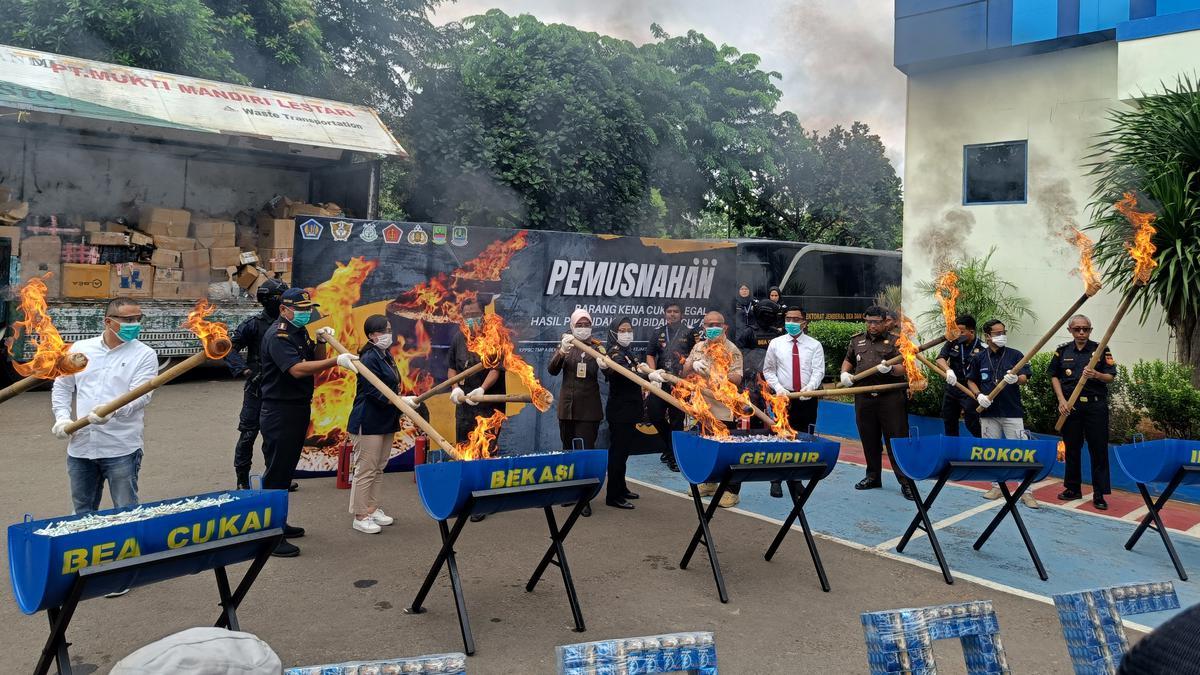
According to a report by Liputan6 on December 6, Yanti Sarmuhidayantie, the head of BikaSi, also known as the West Java Office of Customs and Excise, announced that the office will be destroying illegal tobacco and alcohol, which are considered national assets.


Yanti Sarmuhidayantie, at the Bacasi Tax Office, has provided a detailed account of the destruction of 4.16 million illicit cigarette packs and 466.22 liters of illegal alcoholic beverages, with a total value of 8.2 billion rupees.


We welcome news tips, article submissions, interview requests, or comments on this piece.

Please contact us at info@2firsts.com, or reach out to Alan Zhao, CEO of 2Firsts, on LinkedIn


Notice

1.  This article is intended solely for professional research purposes related to industry, technology, and policy. Any references to brands or products are made purely for objective description and do not constitute any form of endorsement, recommendation, or promotion by 2Firsts.

2.  The use of nicotine-containing products — including, but not limited to, cigarettes, e-cigarettes, nicotine pouchand heated tobacco products — carries significant health risks. Users are responsible for complying with all applicable laws and regulations in their respective jurisdictions.

3.  This article is not intended to serve as the basis for any investment decisions or financial advice. 2Firsts assumes no direct or indirect liability for any inaccuracies or errors in the content.

4.  Access to this article is strictly prohibited for individuals below the legal age in their jurisdiction.


Copyright


This article is either an original work created by 2Firsts or a reproduction from third-party sources with proper attribution. All copyrights and usage rights belong to 2Firsts or the original content provider. Unauthorized reproduction, distribution, or any other form of unauthorized use by any individual or organization is strictly prohibited. Violators will be held legally accountable.

For copyright-related inquiries, please contact: info@2firsts.com


AI Assistance Disclaimer


This article may have been enhanced using AI tools to improve translation and editorial efficiency. However, due to technical limitations, inaccuracies may occur. Readers are encouraged to refer to the cited sources for the most accurate information.

We welcome any corrections or feedback. Please contact us at: info@2firsts.com

South Korea’s New Vape Rules Raise Bar for E-Liquid Makers and China-Linked Supply Chains, Expert Says
South Korea’s new vape regulations are reshaping the e-liquid market, raising compliance requirements for manufacturers, retailers and overseas suppliers. In an interview with 2Firsts, Korean nicotine products specialist Sam Kim discusses licensing barriers, inventory impacts, China-linked supply chains, and emerging regulatory challenges around nicotine analogues, nicotine-free products and DIY mixing. The Korean case may offer broader insights as governments worldwide adapt to rapidly evolving nicotine products.
Jul.16
PMI Q2 Call: ZYN Growth, IQOS Pricing and a Diverging Global Tobacco Market
Philip Morris International’s second-quarter earnings call offered new detail on its smoke-free strategy. Management said it would increase U.S. investment behind nicotine pouch brand ZYN, keep IQOS focused on volume before stronger pricing, and use SENTIA, DELIA, LEVIA, VEEV and ZYN to manage tax and regulatory pressure across Japan and Europe. Analysts from Goldman Sachs, Morgan Stanley, UBS and other firms also pressed PMI on profitability, market share, cigarette resilience and the durability of its global transformation over coming quarters.
Jul.24
Product | BAT Japan Launches virto Bright Peach Click in Japan, Expanding glo Hilo’s Capsule-Based Flavor Portfolio
British American Tobacco Japan (BAT Japan) has introduced virto Bright Peach Click, a new heated tobacco stick designed for the glo Hilo system. The product expands the existing virto consumable lineup with a combination of tobacco, menthol and ripe peach flavors, featuring a capsule mechanism that releases additional fruit flavor when activated. The product launched in Japan on July 27, 2026, through glo official online channels, convenience stores and tobacco retailers.
Aug.03
Japan Health Ministry Cites Limited Evidence in Decision Not to Tighten Heated Tobacco Rules
Japan’s health ministry has proposed not tightening regulations on heated tobacco products to the same level as cigarettes as part of a review of passive smoking measures, with an expert panel broadly agreeing with the proposal, Jiji Press reported.
Jul.10
Philip Morris Romania Expands IQOS Boutique Network to 120 Locations With Retail 2.0 Store
Philip Morris Romania has opened IQOS Boutique Victoriei in Bucharest, expanding the country’s IQOS retail network to 120 points of sale and advancing a Retail 2.0 concept that combines design, technology, interactive art and urban culture.
PMI
Jul.13
Canadian Court Allows Juul and Altria Vape Class Action to Move Forward Over Youth Marketing Claims
A Quebec Superior Court has allowed a class action lawsuit against Juul Labs and Altria Group related to vaping products to proceed, involving allegations concerning marketing practices, youth exposure and corporate responsibility. The ruling only allows the case to move forward and does not represent a finding that Juul or Altria are legally liable. The case highlights continued legal risks facing vape companies regarding product marketing, youth protection and corporate accountability.
Jul.28