KT&G Launches Limited Edition "Raison Ionia 3 in 1" at Airports

Business by 2FIRSTS.ai
Sep.12.2024
KT&G Launches Limited Edition "Raison Ionia 3 in 1" at Airports
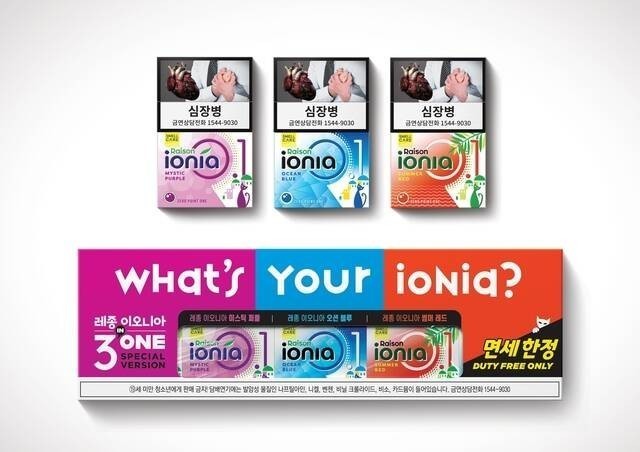
KT&G launches limited edition "Raison Ionia 3 in 1" cigarettes at Korean airports, catering to duty-free shoppers with new flavors.

According to N. News on September 12th, South Korean tobacco company KT&G announced that they will be offering limited quantities of the "Raison Ionia 3 in 1" product at airport duty-free shops.


This limited edition product is exclusively designed for airport duty-free shops, including three new varieties of cigarettes called "Raison Ionia". Each carton contains 10 packs, with 4 packs of Ocean Blue, 3 packs of Mystical Purple, and 3 packs of Summer Red. The price is $31 per carton, and the product is available at duty-free shops in five airports: Incheon, Gimpo, Gimhae, Daegu, and Jeju.


The "Raison Ionia" cigarette contains 4% tobacco, with each cigarette having tar and nicotine levels of 0.1 milligrams and 0.01 milligrams, respectively.


The head of KT&G Raison team, Gong Jeong-ho, stated,


In order to meet the needs of airport consumers, we have launched a limited edition "Raison Ionia" containing three new products. In the future, we will continue to introduce products that meet the needs and trends of consumers to enhance brand satisfaction.


We welcome news tips, article submissions, interview requests, or comments on this piece.

Please contact us at info@2firsts.com, or reach out to Alan Zhao, CEO of 2Firsts, on LinkedIn


Notice

1.  This article is intended solely for professional research purposes related to industry, technology, and policy. Any references to brands or products are made purely for objective description and do not constitute any form of endorsement, recommendation, or promotion by 2Firsts.

2.  The use of nicotine-containing products — including, but not limited to, cigarettes, e-cigarettes, nicotine pouchand heated tobacco products — carries significant health risks. Users are responsible for complying with all applicable laws and regulations in their respective jurisdictions.

3.  This article is not intended to serve as the basis for any investment decisions or financial advice. 2Firsts assumes no direct or indirect liability for any inaccuracies or errors in the content.

4.  Access to this article is strictly prohibited for individuals below the legal age in their jurisdiction.


Copyright


This article is either an original work created by 2Firsts or a reproduction from third-party sources with proper attribution. All copyrights and usage rights belong to 2Firsts or the original content provider. Unauthorized reproduction, distribution, or any other form of unauthorized use by any individual or organization is strictly prohibited. Violators will be held legally accountable.

For copyright-related inquiries, please contact: info@2firsts.com


AI Assistance Disclaimer


This article may have been enhanced using AI tools to improve translation and editorial efficiency. However, due to technical limitations, inaccuracies may occur. Readers are encouraged to refer to the cited sources for the most accurate information.

We welcome any corrections or feedback. Please contact us at: info@2firsts.com

China’s HTP Exports Fell 14.3% in H1 2026 as Russia and Belarus Accounted for 76% Lead
In H1 2026, China’s HS 24041100 exports stood at $1.32 million, down 14.3% YoY, with volume falling 17.2% to 55.33 tons. Market distribution shifted drastically amid overall export drops. Exports to Russia and Belarus totaled $1 million, taking 76.0% of all shipments versus 29.5% in H1 2025. Belarus became the top destination with export value jumping 177.5%, while the Philippines, Singapore and Indonesia’s combined share slumped from 49.3% to 11.2%.Domestically, Yunnan led exporter registrations; Jiangsu and Shanghai were key suppliers, yet Anhui and Sichuan had no exports. Heavy concentration means order or declaration changes for Russia/Belarus greatly affect national aggregate data. The data shows customs entry points (not end markets), covering tobacco consumables only, excluding heating equipment and the complete HTP supply chain.
Aug.11
Yinghe-Controlled Vape Maker SKE Ordered to Post £569,039 Security as It Pursues Crystal Bar Design Infringement Case in UK
The UK High Court has ordered Chinese vape manufacturer Shenzhen SKE Technology to provide £569,039 ($776,000) in security for costs in its design infringement proceedings against Vapepen London and other defendants over its Crystal Bar vape product. The court did not accept the defendants’ main argument that recovering costs from a China-based company would face significant enforcement obstacles, but found that SKE had not sufficiently disclosed its own financial position. The order is procedural and does not determine the underlying infringement claims.
News
Aug.21
2Firsts Data | China’s U.S. Vape Exports Have Yet to Regain Previous Growth Momentum in H1 2026, but Hardware Grew 15.2% and 6-Methyl Nicotine-Related Products Rose 234.7%
China’s vape exports to the U.S. reached approximately $1.58 billion in the first half of 2026, remaining broadly stable from a year earlier but still below previous growth momentum. 2Firsts’ analysis of China Customs data shows that the U.S. market has not simply returned to its previous trajectory after the enforcement shock and inventory-driven swings of 2025. Instead, export momentum is shifting across product categories. Vaping devices and atomization hardware increased 15.2% year over year, while 6-methyl nicotine-related and other nicotine substitute products surged 234.7%. Meanwhile, traditional nicotine-containing vaping products continued to face pressure.
Jul.22
U.S. Appeals Court Says BAT Must Face Class Action Over Cigarette Labels
A U.S. appeals court ruled that British American Tobacco (BAT) must continue facing a consumer class action lawsuit over cigarette labels. The ruling allows the case to proceed but does not determine that BAT violated the law or is liable for damages. The case highlights ongoing legal risks facing major tobacco companies related to product labeling, consumer disclosures and product liability claims.
Jul.31
 $20 Million, a Permanent Injunction and Distributor Controls: Posh Deal Tightens Illinois Vape Compliance
$20 Million, a Permanent Injunction and Distributor Controls: Posh Deal Tightens Illinois Vape Compliance
An Illinois court ordered three companies tied to Posh vapes to pay $20 million and permanently restricted the sale, marketing and distribution in Illinois of products lacking required FDA authorization. The consent order also imposes downstream distributor controls, age-verification measures and social-media marketing limits, creating a new state-level compliance benchmark for disposable vape businesses.
Regulations
Aug.05
South Korea Vape Strategies Diverge as BAT Reconsiders Exit and PMI Takes VEEV to About 14,000 Stores
BAT Rothmans says it previously considered exiting South Korea's vaping market because of competitive pressure from unregulated products, but is now reassessing conditions following changes to the country's nicotine regulatory framework. Vuse and other BAT vaping products remain available through existing distribution channels. The statement followed a South Korean media report that interpreted BAT's broader withdrawal from selected Vapour markets as a full exit from South Korea. Meanwhile, Philip Morris International launched VEEV inPRIME in the country in June and began expanding distribution to around 14,000 convenience stores and other retail channels in July. The contrasting moves highlight differing investment strategies as South Korea's regulated vaping market evolves.
Aug.14