Native American Youth E-Cigarette Quitting Program Launched

Events by 2FIRSTS.ai
Aug.07.2024
Native American Youth E-Cigarette Quitting Program Launched
Michigan tribe launches free e-cigarette cessation program for young people in partnership with Truth Initiative, aiding over 750,000 participants.

According to a report by 9and10news on August 6th, the Tribal Council of Michigan has launched a free e-cigarette cessation program specifically designed for young people in the tribe.


According to reports, the Michigan Tribal Council has partnered with the Truth Initiative to launch the "This is Quitting" program, providing a first-of-its-kind anonymous text messaging service for young people. The project was launched in January 2019 and has since had over 750,000 participants, specifically designed for young people looking to quit e-cigarettes.


This project provides tailored advice, cognitive and behavioral coping strategies, and social support to participants based on their age, enrollment date, or quit date (set and reset via text message) and the amount of e-cigarette products they use, in order to help them successfully quit smoking. These text messages include information on nicotine replacement therapy, encouragement and support, skills training, and self-efficacy building exercises.


According to Dr. Amanda Graham, the Director of Innovation at the Truth Initiative, the use of e-cigarettes by teenagers remains a serious public health issue. According to the 2023 National Youth Tobacco Survey, over 2 million teenagers have reported using nicotine.


According to a study published in the journal JAMA Internal Medicine, the quit smoking success rate of young people aged 18-24 who used the "This is Quitting" program was nearly 40% higher than the control group.


We welcome news tips, article submissions, interview requests, or comments on this piece.

Please contact us at info@2firsts.com, or reach out to Alan Zhao, CEO of 2Firsts, on LinkedIn


Notice

1.  This article is intended solely for professional research purposes related to industry, technology, and policy. Any references to brands or products are made purely for objective description and do not constitute any form of endorsement, recommendation, or promotion by 2Firsts.

2.  The use of nicotine-containing products — including, but not limited to, cigarettes, e-cigarettes, nicotine pouchand heated tobacco products — carries significant health risks. Users are responsible for complying with all applicable laws and regulations in their respective jurisdictions.

3.  This article is not intended to serve as the basis for any investment decisions or financial advice. 2Firsts assumes no direct or indirect liability for any inaccuracies or errors in the content.

4.  Access to this article is strictly prohibited for individuals below the legal age in their jurisdiction.


Copyright


This article is either an original work created by 2Firsts or a reproduction from third-party sources with proper attribution. All copyrights and usage rights belong to 2Firsts or the original content provider. Unauthorized reproduction, distribution, or any other form of unauthorized use by any individual or organization is strictly prohibited. Violators will be held legally accountable.

For copyright-related inquiries, please contact: info@2firsts.com


AI Assistance Disclaimer


This article may have been enhanced using AI tools to improve translation and editorial efficiency. However, due to technical limitations, inaccuracies may occur. Readers are encouraged to refer to the cited sources for the most accurate information.

We welcome any corrections or feedback. Please contact us at: info@2firsts.com

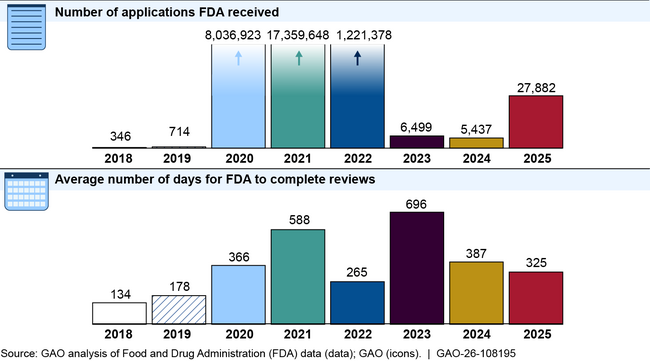
Six Years of Data Show FDA Clearing PMTA Backlog
FDA data from FY2020 to FY2025 show how the PMTA system for e-cigarette products evolved after an early surge of submissions created prolonged front-end delays. Millions of applications accumulated at the Acceptance stage before entering substantive review. Since 2023, the number of applications pending acceptance has declined sharply, and industry participants report shorter initial decision timelines in late 2025.
Feb.06
ACT Health Minister Vows Continued Crackdown on E-Cigarettes and Illicit Tobacco
ACT Health Minister Rachel Stephen-Smith said the government would not ease its action against e-cigarettes and illicit tobacco and would continue strengthening regulation, legislation, and enforcement. Speaking at the launch of a new program to help young people quit vaping, she said reducing tobacco excise would not materially reduce profits in the illicit tobacco market.
Mar.10 by 2FIRSTS.ai
Indiana SB 185 Advances: Foreign-Made Vapes Would Be Barred, With Focus on China
Indiana State Sen. Ron Alting is backing Senate Bill 185, which would ban vape shops in Indiana from selling any foreign-made vaping products and restrict retail shelves to U.S.-made items. Alting has framed the proposal as a consumer-safety measure and has singled out China, citing industry reporting that China produces more than 90% of the world’s vape hardware.
Jan.27 by 2FIRSTS.ai
PMI Faces Setback in India: Global Regulatory Fragmentation Complicates Its Smoke-Free Transition
India has reaffirmed its 2019 ban on e-cigarettes and heated tobacco devices, effectively blocking Philip Morris International (PMI) from launching IQOS in the country despite years of lobbying. Together with Taiwan, China’s conditional opening of heated tobacco products, and Japan’s planned 2026 excise tax hikes, these moves highlight increasingly divergent national regulatory pathways—an external uncertainty shaping PMI’s smoke-free growth trajectory.
Feb.12
The Volume Illusion: Measuring the Future of Nicotine with the Tools of the Past
As next-generation nicotine products become economically central rather than marginal, traditional volume-based metrics are increasingly unable to explain consumption, risk, and value. Units designed for a cigarette-based economy struggle to describe systems defined by delivery speed, pharmacokinetics, and adaptive user behavior. Drawing on financial reporting, regulation, and nicotine science, a fundamental question: can the future of nicotine still be measured using the tools of its past?
Feb.09 by Alan Zhao | 2Firsts Perspectives
FDA Issues Draft PMTA Guidance for Flavored E-Cigarettes, Maintaining Higher Evidence Bar for Fruit and Sweet Flavors
The U.S. Food and Drug Administration (FDA) on March 9 released a draft guidance outlining its current thinking on premarket tobacco product applications (PMTAs) for flavored electronic nicotine delivery systems (ENDS). The document reiterates that fruit, candy, dessert, and other sweet-flavored e-cigarettes present a “significant public health risk” to youth and therefore face a higher evidentiary burden if manufacturers seek marketing authorization.
Mar.10 by 2FIRSTS.ai