Philippine Bureau of Internal Revenue Raises Tobacco Prices Mandate

Sep.18.2024
Philippine Bureau of Internal Revenue Raises Tobacco Prices Mandate
Philippine BIR prohibits selling e-cigarettes, cigarettes and heated tobacco below set minimum price, violators to face criminal charges.

According to a report by GMA Integrated News on September 18, the Philippines' Bureau of Internal Revenue (BIR) has now prohibited the sale of e-cigarettes, cigarettes, and heated tobacco products at prices lower than those set by the tax authorities, which include a combination of consumption tax and value-added tax.
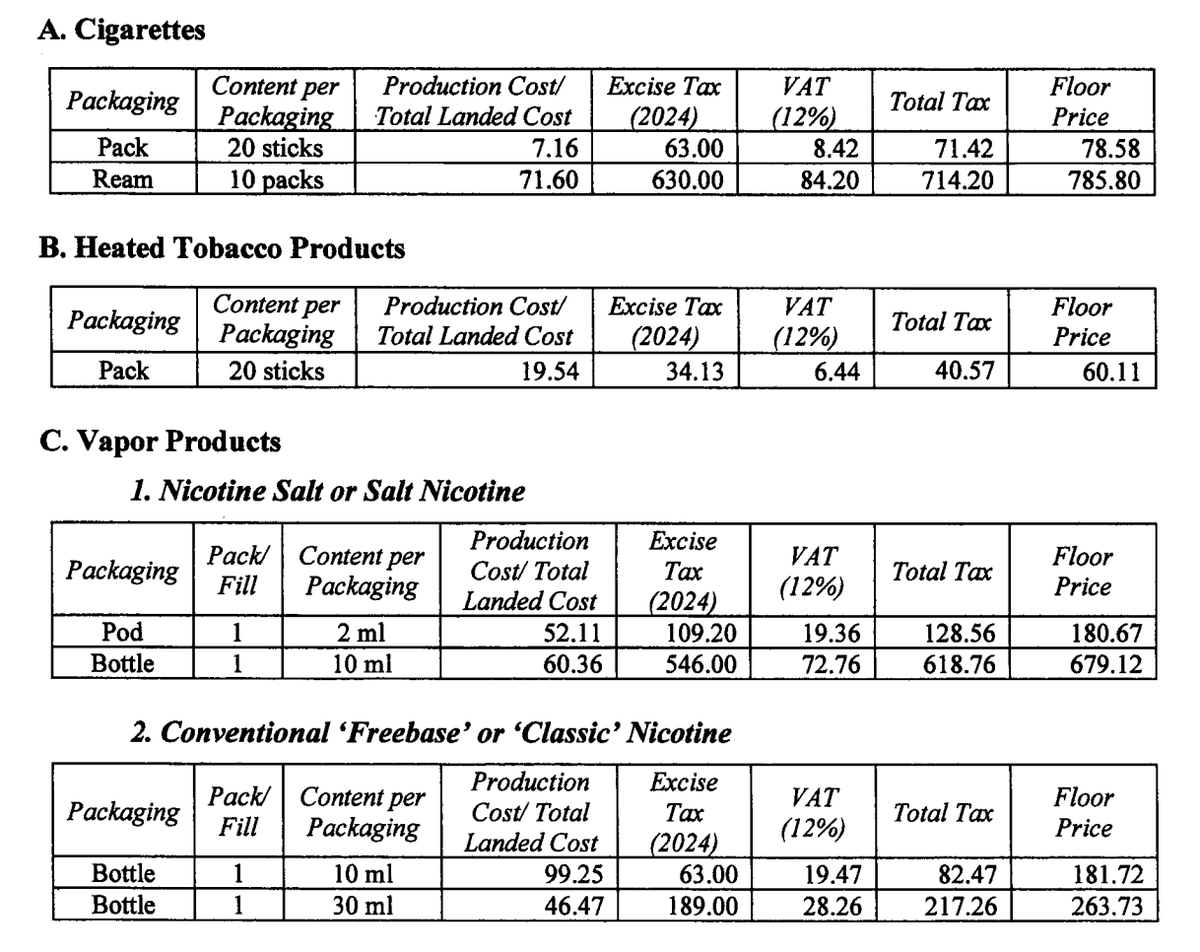
Philippine Bureau of Internal Revenue Raises Tobacco Prices Mandate
Revenue Regulation No. 16-2024" (RR No. 16-2024) specifies the latest floor prices for cigarettes, heated tobacco, and e-cigarette products in 2024. | Image source: BIR official website


On September 16, Bureau of Internal Revenue (BIR) Commissioner Romeo Lumagui Jr. issued Revenue Regulation No. 16-2024, updating the latest floor prices for cigarettes, e-cigarettes, and heated tobacco products.


Ma Guo reminded online sellers, retailers, and distributors of tobacco products that they will face criminal liability if they sell these products below the prescribed minimum price. He emphasized that selling these products below the minimum price is a criminal offense, and sellers will be sentenced to prison.


We are closely monitoring online platforms and physical stores. Do not sell products below the minimum price and immediately remove all posts and products priced below the minimum.


The latest rates for Revenue Regulation No. 16-2024 (RR No. 16-2024) are as follows:


The Bureau of Internal Revenue (BIR) stated that selling tobacco products at a price lower than the legally required comprehensive consumption and value-added tax is prohibited under Section 145 (C) of the amended National Internal Revenue Code (NIRC).


The agency also added that sellers who sell tobacco products below the specified base price "will be subjected to a fine of no less than 10 times the total amount of excise tax and value-added tax payable, but not less than 200,000 pesos (approximately $3,600) and not exceeding 500,000 pesos (approximately $9,000), and will be sentenced to imprisonment for no less than four years but not exceeding six years.


According to Article 263(A) of the revised National Internal Revenue Code, anyone selling heated tobacco products and vaping products at a price lower than the comprehensive consumption tax and value-added tax will be fined an amount equal to ten times the total amount of the consumption tax owed but not less than 200,000 pesos (approximately $3,600), and will also be sentenced to a minimum of four years but not more than six years in prison.


We welcome news tips, article submissions, interview requests, or comments on this piece.

Please contact us at info@2firsts.com, or reach out to Alan Zhao, CEO of 2Firsts, on LinkedIn


Notice

1.  This article is intended solely for professional research purposes related to industry, technology, and policy. Any references to brands or products are made purely for objective description and do not constitute any form of endorsement, recommendation, or promotion by 2Firsts.

2.  The use of nicotine-containing products — including, but not limited to, cigarettes, e-cigarettes, nicotine pouchand heated tobacco products — carries significant health risks. Users are responsible for complying with all applicable laws and regulations in their respective jurisdictions.

3.  This article is not intended to serve as the basis for any investment decisions or financial advice. 2Firsts assumes no direct or indirect liability for any inaccuracies or errors in the content.

4.  Access to this article is strictly prohibited for individuals below the legal age in their jurisdiction.


Copyright


This article is either an original work created by 2Firsts or a reproduction from third-party sources with proper attribution. All copyrights and usage rights belong to 2Firsts or the original content provider. Unauthorized reproduction, distribution, or any other form of unauthorized use by any individual or organization is strictly prohibited. Violators will be held legally accountable.

For copyright-related inquiries, please contact: info@2firsts.com


AI Assistance Disclaimer


This article may have been enhanced using AI tools to improve translation and editorial efficiency. However, due to technical limitations, inaccuracies may occur. Readers are encouraged to refer to the cited sources for the most accurate information.

We welcome any corrections or feedback. Please contact us at: info@2firsts.com

UK Local Council Proposes £5 Refundable Deposit on Vape Devices
Norwich City Council is set to debate a proposed vape deposit scheme that would require consumers to pay an extra refundable £5 per device at purchase, with the money returned when the device is handed back, as recent recycling-facility fires, including a major Widnes blaze reportedly very likely caused by a vape, draw greater attention to the risks of improperly discarded lithium-battery devices.
Jul.01
Seita’s Julia Neumaier Says France Should Target Vape Access, Not Plain Packaging
Julia Neumaier, general manager of Seita, Imperial Brands’ French subsidiary, said France should focus vaping regulation on access control, age verification, online sales and distribution channels, rather than applying tobacco-style plain packaging to vaping products.
Jul.15
JT Plans ¥800 Billion Investment in Heated Tobacco Over Three Years, Betting on Ploom as Second Growth Engine
Japan Tobacco Inc. (JT) CEO Takehiko Tsutsui said the company plans to invest about ¥800 billion (approximately US$5.4 billion) in heated tobacco products over three years through 2028, aiming to establish Ploom as a second growth engine after combustible cigarettes. Tsutsui said Ploom AURA helped JT increase its share of Japan’s heated tobacco market to 15.8% in the first quarter of 2026. Ploom products are now available in 29 markets, with Ploom AURA sold in 25 markets including Japan. JT also plans to continue its cigarette business while positioning its food operations, particularly frozen noodle products in North America, as another growth opportunity.
Jul.23
AP Questions FDA Rationale as Glas Fruit-Flavored Vapes Won Authorization Without Added Cessation Benefit
The U.S. Food and Drug Administration (FDA) recently authorized two fruit-flavored vaping products from Glas, but a newly released agency memo shows the products did not demonstrate greater smoking-cessation benefits than tobacco-flavored e-cigarettes. The Associated Press said the findings are likely to raise further questions about the FDA’s regulatory rationale and standards for flavored vaping products.
Jun.12
FDA Proposes Foreign Tobacco Factory Registration Rule to Tighten Import Oversight
The FDA has proposed a rule requiring foreign tobacco manufacturers to register facilities and list products before exporting to the U.S. If finalized, the rule could affect overseas OEM/ODM factories, contract manufacturers, specification developers, bulk product makers, and repackaging or relabeling firms. FDA says the proposal would help identify unauthorized imported tobacco products, including e-cigarettes.
Special Report
Jun.26
China’s Jiangsu Tobacco Monopoly Bureau and Drug Regulator Target Illegal Vape Sales Disguised as Medical Devices, Define Six Violations
China’s Jiangsu Tobacco Monopoly Bureau and Jiangsu Provincial Medical Products Administration have issued a joint notice targeting illegal production and sales of vape products disguised as medical devices. The notice identifies six categories of violations, including obtaining medical licenses through false materials, misusing medical device credentials, expanding production beyond approved scopes, and using medical device-related online platforms to promote or sell vape products. The action is based on China’s tobacco and medical device regulations and aims to strengthen vape oversight and consumer protection.
Aug.04