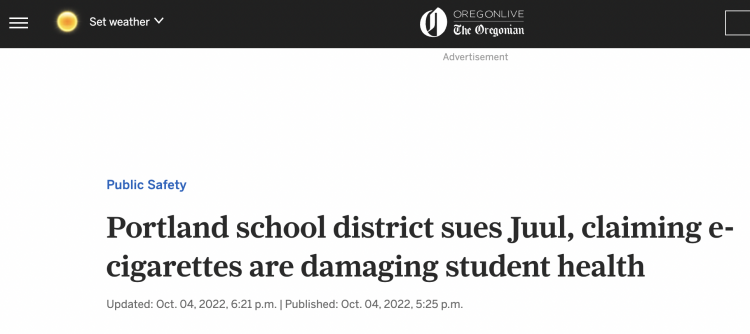
The Portland Public Schools district has become the latest district to sue e-cigarette company Juul Labs, accusing the company of marketing its products to teenagers and contributing to the illegal drug use in the city's schools.
According to a lawsuit filed in the US District Court in Portland, approximately half of the disciplinary actions related to drug abuse in the 2021-22 school year were due to vaping and e-cigarette use.
As a result, the school district has added information on electronic cigarettes and nicotine addiction to its "Insight" curriculum, which is a 14-week student and parent education program aimed at students who violate the district's drug and tobacco policies.
A lawsuit alleges that, similar to the nationwide rise in electronic cigarette usage, there is a high rate of teenagers in Portland public schools using e-cigarettes. The lawsuit states that from 2017 to 2019, the usage of e-cigarettes among 11th-grade students in Multnomah County rose from approximately 10% to 21%. Juul's founders, Adam Bowen and James Monsees, are accused of developing a highly addictive product to expand their loyal user base and using tactics similar to the tobacco industry to market it to young people.
It accuses the company of using child-friendly flavors to appeal to young people without ensuring that the flavorings can be safely inhaled.
A recently filed lawsuit alleges that an electronic cigarette manufacturer has been engaging in both environmental pollution and extortion. The school district is requesting that a judge order the company to cease enabling teenage addiction and award damages to help cover costs for prevention education, addiction treatment, and on-campus monitoring. They are also seeking punitive damages.
Statement:
This article is compiled from third-party information and is solely for the purpose of industry exchange and learning.
This article does not represent the views of 2FIRSTS, and 2FIRSTS cannot confirm the truthfulness and accuracy of the article's contents. The compilation of this article is only for industry exchange and research purposes.
Due to limitations in translation ability, the translated article may not accurately reflect the original text. Please refer to the original text for accuracy.
2FIRSTS is entirely aligned with the Chinese government on any domestic, Hong Kong, Macau, Taiwan, and international views and positions.
The copyright of the compiled information belongs to the original media outlet and author. If there is any copyright infringement, please contact us for removal.
Disclaimer
This article is provided solely for professional research, industry discussion, and informational purposes. Any references to brands, companies, products, technologies, or policies are made for factual reporting and analytical purposes only, and do not constitute endorsement, recommendation, promotion, or advertising by 2Firsts.
Nicotine-containing products, including but not limited to cigarettes, e-cigarettes, heated tobacco products, and nicotine pouches, carry significant health risks. Readers are responsible for complying with all applicable laws and regulations in their respective jurisdictions, including age restrictions and access limitations.
The information contained in this article should not be regarded as investment, legal, medical, regulatory, or commercial advice. While 2Firsts strives to ensure the accuracy and reliability of its content, it does not assume liability for any direct or indirect loss arising from errors, omissions, inaccuracies, or reliance on the information contained herein.
This article is not intended for individuals below the legal age for accessing tobacco or nicotine-related information in their jurisdiction.
Copyright Notice
This article is either original content produced by 2Firsts or content reproduced, translated, summarized, or adapted from third-party sources with attribution where applicable. The intellectual property rights of the original content remain with 2Firsts or the respective original rights holders.
No individual or organization may copy, reproduce, distribute, republish, modify, translate, or otherwise use this content without prior authorization. Any unauthorized use may result in legal action.
For copyright-related inquiries, corrections, or removal requests, please contact: info@2firsts.com.
AI-Assisted Translation and Editing Notice
Portions of this article may have been translated, edited, or reviewed with the assistance of artificial intelligence tools to improve efficiency and readability. Due to the limitations of AI-assisted translation and editing, discrepancies, omissions, or inaccuracies may exist when compared with the original source.
Where applicable, readers are advised to refer to the original source for the most complete and accurate information. If you identify any errors or believe that any content infringes upon your rights, please contact us at info@2firsts.com, and we will review and address the matter promptly.