Tax Measures Proposed in Tennessee to Regulate E-Cigarette Market

Apr.22.2025
Tax Measures Proposed in Tennessee to Regulate E-Cigarette Market
Tennessee proposes taxes on e-cigarette products, creates FDA-approved product registry to prevent unauthorized sales, concerns over market monopoly.

Key Points:

Tax measures introduced: Tennessee proposes to tax disposable e-cigarettes at 0.07 USD per milliliter, and to impose a 10% tax on refillable e-cigarette products, expected to generate over 16 million USD in revenue annually.

Establishing a registration directory: A directory for e-cigarettes will be established, limited to only FDA-authorized products. It will be open to the public starting in 2026, and products not listed in the directory will be prohibited from being sold.

Control of Unauthorized Products: Products that have not been approved by the FDA or are not under review cannot be sold. Manufacturers must submit a certification annually.

Store owners are concerned about market monopolies: e-cigarette merchants worry that the legislation may indirectly protect the interests of large tobacco companies, potentially leading to the closure of small and medium-sized businesses.


According to a report by Localmemphis on April 16, the Tennessee House of Representatives debated a bill on Wednesday (16th) that plans to tax e-cigarette products and create a registry of e-cigarette products approved by the FDA.


House Bill 0968 proposes a tax of $0.07 per milliliter on disposable e-cigarettes and a 10% tax on refillable e-cigarette products. Additionally, the bill calls for the creation of a state-wide directory of e-cigarette products for sale to the public, which will be open to the public starting January 1, 2026, and prohibits the sale of products not listed in the directory.


The bill also stipulates that any product not authorized by the FDA or in the process of applying for authorization will be prohibited from being sold. Starting on August 1, 2025, and each year thereafter, e-cigarette manufacturers will be required to present proof of FDA approval or pending review to the revenue department.


Tennessee state lawmakers Ken Yager (R-Kingston) and David Hawk (R-Greeneville) have introduced companion bills aimed at preventing youth access to e-cigarettes and keeping unapproved e-cigarette devices out of the market, in order to make a contribution towards preventing young people from accessing e-cigarettes and to prevent unapproved e-cigarette devices from entering the market.


E-cigarette store owner Phil Harrell stated that the majority of e-cigarette shops in the area have taken measures to ensure they do not stock unauthorized brands.


These products are only available at gas stations and are all tobacco company products. The FDA's approval has effectively created a monopoly in the e-cigarette market, with lawmakers now protecting this monopoly.


Harrell is worried that the new law will cause both of his e-cigarette stores to go out of business.


The bill also requires employees to check the license of individuals purchasing e-cigarette products and impose a 10% tax on open system products. According to the fiscal note of the bill, the new tax is expected to generate over $16 million in revenue. The Senate has passed the bill version with a vote of 24-4.


We welcome news tips, article submissions, interview requests, or comments on this piece.

Please contact us at info@2firsts.com, or reach out to Alan Zhao, CEO of 2Firsts, on LinkedIn


Notice

1.  This article is intended solely for professional research purposes related to industry, technology, and policy. Any references to brands or products are made purely for objective description and do not constitute any form of endorsement, recommendation, or promotion by 2Firsts.

2.  The use of nicotine-containing products — including, but not limited to, cigarettes, e-cigarettes, nicotine pouchand heated tobacco products — carries significant health risks. Users are responsible for complying with all applicable laws and regulations in their respective jurisdictions.

3.  This article is not intended to serve as the basis for any investment decisions or financial advice. 2Firsts assumes no direct or indirect liability for any inaccuracies or errors in the content.

4.  Access to this article is strictly prohibited for individuals below the legal age in their jurisdiction.


Copyright


This article is either an original work created by 2Firsts or a reproduction from third-party sources with proper attribution. All copyrights and usage rights belong to 2Firsts or the original content provider. Unauthorized reproduction, distribution, or any other form of unauthorized use by any individual or organization is strictly prohibited. Violators will be held legally accountable.

For copyright-related inquiries, please contact: info@2firsts.com


AI Assistance Disclaimer


This article may have been enhanced using AI tools to improve translation and editorial efficiency. However, due to technical limitations, inaccuracies may occur. Readers are encouraged to refer to the cited sources for the most accurate information.

We welcome any corrections or feedback. Please contact us at: info@2firsts.com

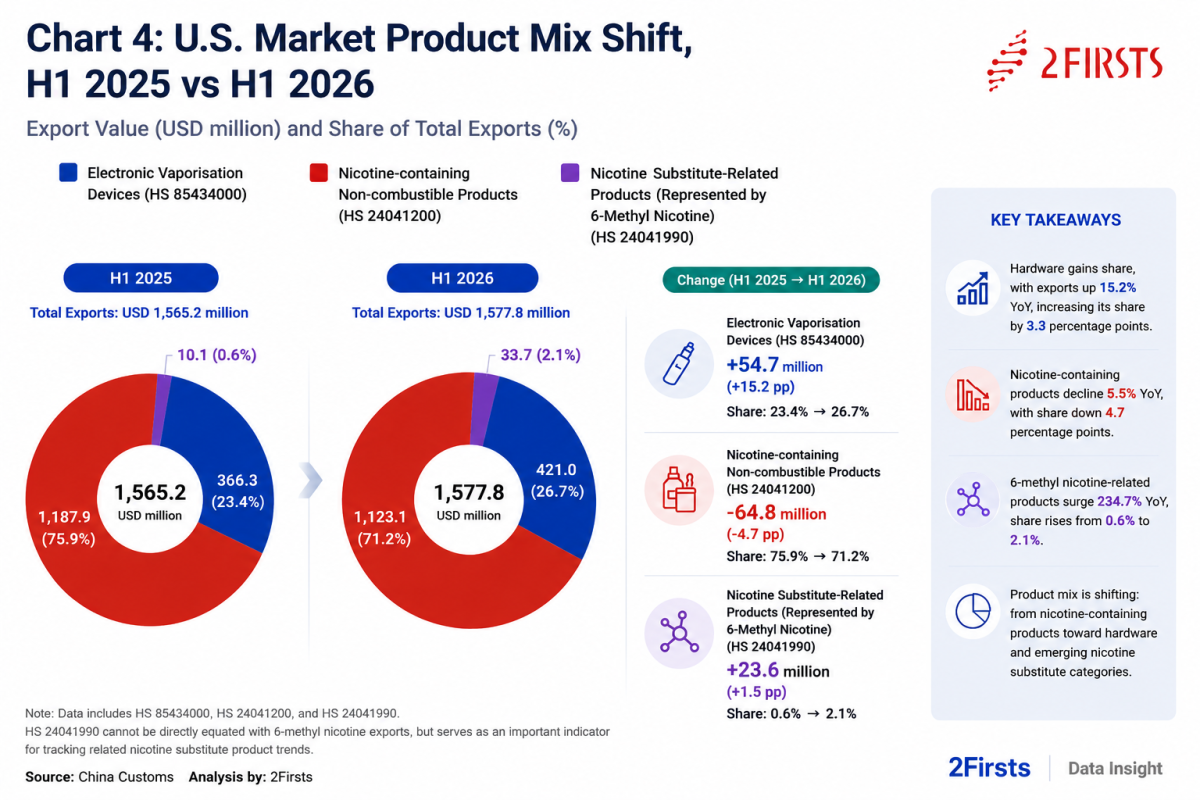
2Firsts Data | China’s U.S. Vape Exports Have Yet to Regain Previous Growth Momentum in H1 2026, but Hardware Grew 15.2% and 6-Methyl Nicotine-Related Products Rose 234.7%
China’s vape exports to the U.S. reached approximately $1.58 billion in the first half of 2026, remaining broadly stable from a year earlier but still below previous growth momentum. 2Firsts’ analysis of China Customs data shows that the U.S. market has not simply returned to its previous trajectory after the enforcement shock and inventory-driven swings of 2025. Instead, export momentum is shifting across product categories. Vaping devices and atomization hardware increased 15.2% year over year, while 6-methyl nicotine-related and other nicotine substitute products surged 234.7%. Meanwhile, traditional nicotine-containing vaping products continued to face pressure.
Jul.22
BAT Expands ITC Infotech Partnership Across Poland, Romania and India to Advance AI
ITC Infotech has expanded its multi-year strategic technology partnership with British American Tobacco (BAT), providing technology services across Poland, Romania and India while continuing to support BAT's newly launched Future Capabilities Centre in India and existing technology hubs in Malaysia and Mexico. The companies said the agreement will focus on AI-enabled innovation, technology capability building and greater operational efficiency. The partnership also aligns with BAT's broader Fit2Win transformation programme, under which the group is expanding the use of external technology and business-services partners to simplify its global operating model.
Aug.13
China’s Jiangsu Tobacco Monopoly Bureau and Drug Regulator Target Illegal Vape Sales Disguised as Medical Devices, Define Six Violations
China’s Jiangsu Tobacco Monopoly Bureau and Jiangsu Provincial Medical Products Administration have issued a joint notice targeting illegal production and sales of vape products disguised as medical devices. The notice identifies six categories of violations, including obtaining medical licenses through false materials, misusing medical device credentials, expanding production beyond approved scopes, and using medical device-related online platforms to promote or sell vape products. The action is based on China’s tobacco and medical device regulations and aims to strengthen vape oversight and consumer protection.
Aug.04
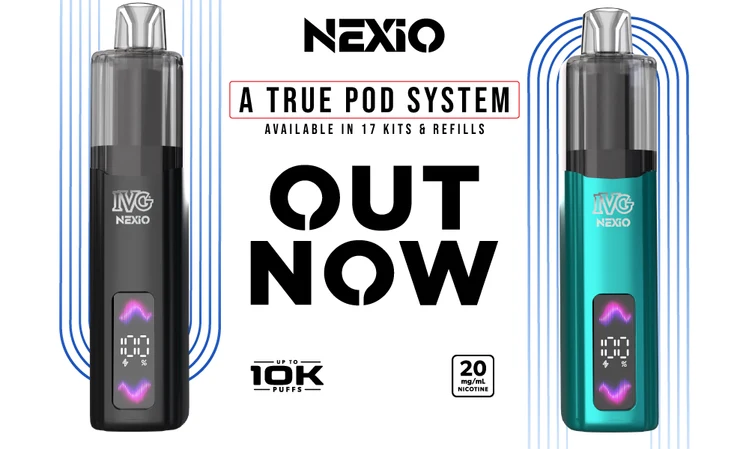
Product | IVG Launches NEXiO Prefilled Pod System, Expanding Beyond Disposable Vapes
UK vape brand IVG has launched the NEXiO reusable prefilled pod system, expanding its product portfolio beyond disposable vape products. The device features a 1,000mAh rechargeable battery, prefilled pods with a refill reservoir structure and a claimed capacity of up to 10,000 puffs. Officially launched in the UK on July 9, 2026, NEXiO debuted with 17 flavor options, reflecting IVG’s move into reusable pod formats.
Aug.19
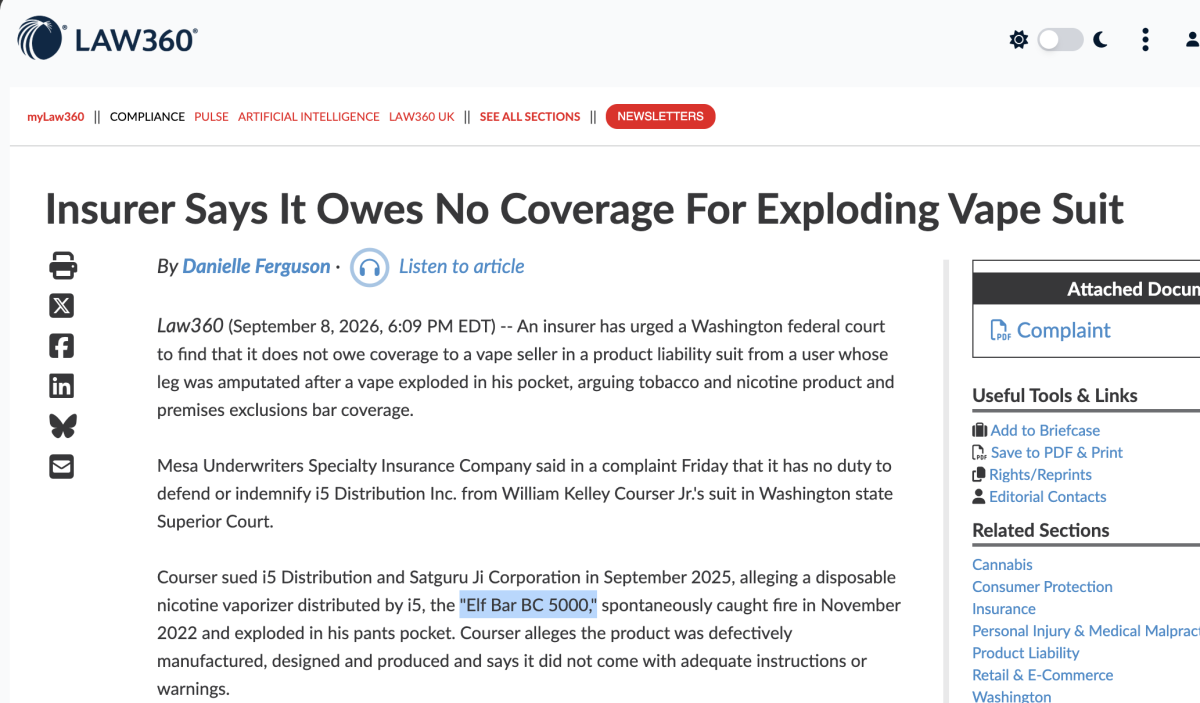
Elf Bar Vape Explosion and Amputation Claim Spurs Coverage Suit, U.S. Insurer MUSIC Seeks Ruling It Owes No Duty to Defend or Indemnify Distributor i5
Mesa Underwriters Specialty Insurance Company has asked a federal court in Washington to declare that it has no duty to defend or indemnify vape distributor i5 Distribution in a product liability case involving an Elf Bar BC5000. The plaintiff alleges that the disposable vape caught fire and exploded in his pocket, causing severe burns and ultimately requiring an above-the-knee amputation of his left leg. MUSIC is relying on a tobacco, nicotine or nicotine replacement products exclusion and a premises limitation endorsement. The court has not ruled on the coverage dispute.
News
Sep.10
Malaysia Police Seize RM12.7 Million in Illegal Vapes and Cigarettes as Probe Points to Sea Shipments From China
Police in Malaysia’s Selangor state seized illegal vape products and contraband cigarettes worth about RM12.7 million (approximately $3 million) in two enforcement operations. According to New Straits Times and The Star, the vape-related operation uncovered 131,036 boxes of vape products, 4,900 bottles of e-liquid and 25,510 vape devices, valued at about RM9.4 million. Police said preliminary investigations indicated that some illegal vape products entered Malaysia through sea shipments from China before moving through storage and distribution networks.
Aug.10