Venezuela President Evaluating Plans to Ban E-Cigarettes

Regulations by Jacky Yin
Jul.14.2023
Venezuela President Evaluating Plans to Ban E-Cigarettes
Venezuelan President Nicolás Maduro's call to evaluate the possibility of banning the sale of e-cigarettes has raised concerns among sellers, who are supportive of regulating the market but is defensive about the proposal.

Venezuelan President Nicolás Maduro's requested to evaluate the possibility of banning the sale of e-cigarettes has raised concerns among sellers, who are supportive of regulating the market but is defensive about the proposal, reported the Spanish news, Agencia EFE.


Venezuela President Evaluating Plans to Ban E-Cigarettes
Venezuelan President Nicolás Maduro | Getty Images


Recently, Venezuela developed a regulatory program for the manufacture, importation, exportation, distribution, sale, use and promotion of electronic cigarettes.


President Maduro said on a television program:


"I want to tell our medical and scientific teams to look into the possibility of banning the sale of these devices that are harmful to health and cause serious problems."


It added that the regulations are a first step and that there is still a long way to go. He asked Health Minister Magaly Gutiérrez to work on this request.


Presidet Maduro's statement has sent shockwaves through different sectors in the country, with Lérida Padrón, president of the Venezuelan Society of Respiratory and Thoracic Surgery (Sovetorax), expressing their firm support for these regulatory measures put in place by the government.


Padrón noted:


"People think that nicotine-free e-cigarettes don't harm their health, which is completely wrong."


However, businesses selling e-cigarettes say they have been living with "uncertainty".


Miguel Brown, manager of an e-cigarette store, argues that e-cigarettes are addictive devices, but are "less harmful" than cigarettes, and that many people use them as a "substitute" for cigarettes or because of the popularity of the product.


He said:


"The audience for e-cigarettes has grown over time. It's not just because people want to replace cigarettes with e-cigarettes, but because it's a fad."


He explained that the industry agreed to ban sales to minors and pregnant women, a measure that many stores implement to avoid legal problems. However, he argued that a complete ban on sales would only hurt business and reduce employment opportunities.


Venezuela President Evaluating Plans to Ban E-Cigarettes
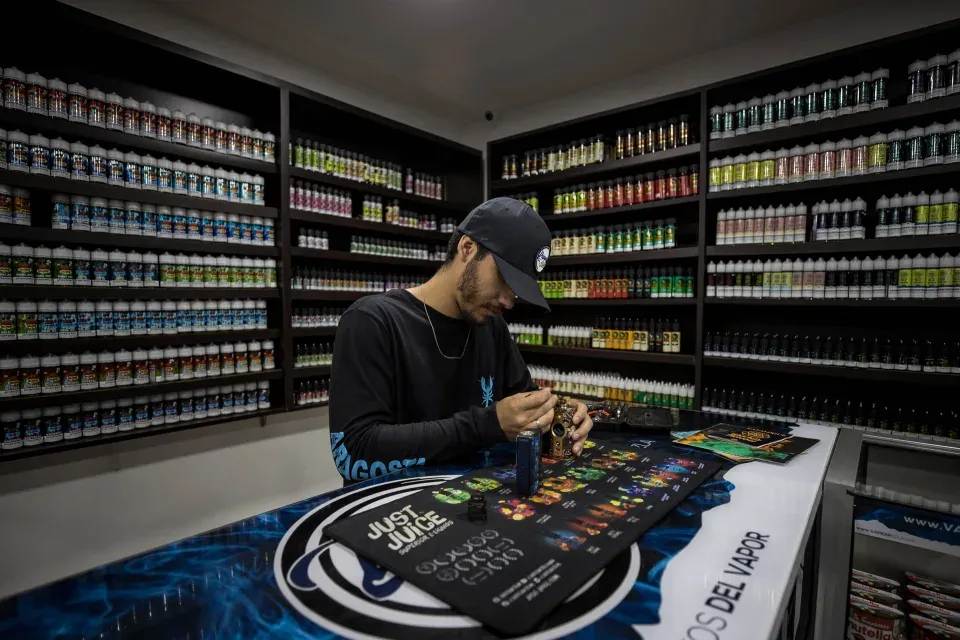
Store manager filling an e-cigarette with e-liquid |Agencia EFE


Venezuela's Official Gazette No. 42.641 published regulations on the production, sale and use of e-cigarettes, which prohibit the sale of e-cigarettes to minors and the use of e-cigarettes in the workplace and in indoor public places, including transportation.


Reference:


【1】Cigarrillos electrónicos en Venezuela, entre la regulación y la prohibición total


*The content excerpted or reproduced in this article comes from a third-party, and the copyright belongs to the original media and author. If any infringement is found, please contact us to delete it. Any entity or individual wishing to forward the information, please contact the original author and refrain from forwarding directly from here.


FDA Expands ENDS Market Access With First Authorization of Non-Tobacco and Non-Menthol Products
The U.S. Food and Drug Administration (FDA) announced on May 5, 2026 that it authorized the marketing of four Glas electronic nicotine delivery system (ENDS) products through the premarket tobacco product application (PMTA) pathway. The authorized products are Classic Menthol, Fresh Menthol, Gold and Sapphire pods, each containing 50mg/ml, or 5%, tobacco-derived nicotine.
May.06 by 2FIRSTS.ai
One Year After UK Disposable Vape Ban: Youth Use Falls to 13%, Adult Use to 8%
among both youth and adults. However, industry groups and regulators warn that the illicit vape market remains a growing concern.
Jun.09
CBP and FDA Seize 18 Million Illegal Vapes Worth $175 Million in Maritime Cargo Operation
U.S. Customs and Border Protection (CBP) announced that more than 18 million illegal e-cigarettes valued at over $175 million were seized during “Operation Red Mist,” a joint enforcement initiative involving the U.S. Coast Guard and the FDA. The operation primarily targeted maritime vape shipments originating from China and focused on combating illicit importation, transportation, and distribution activities.
Regulations
May.14
Imperial Tobacco Canada Responds to Anti-Smoking Groups on Youth Vaping
Imperial Tobacco Canada responded to the April 17 press conference by anti-smoking groups by calling for a more focused, fact-based discussion on youth vaping that targets the illicit market. The company said youth should not be using nicotine products and that it supports strong measures to prevent youth access, but argued that the discussion failed to clearly distinguish between the regulated market and the illicit market that is driving youth access.
Apr.22 by 2FIRSTS.ai
Tobacco Farming in the New Nicotine Era: Why Indian Farmers Struggle to Transition — Contributed by Samrat Chowdhery
In this contributed article to 2Firsts, Mumbai-based journalist and harm reduction advocate Samrat Chowdhery examines India’s tobacco transition from the perspective of agriculture, supply chains and regulation. As noted by 2Firsts, India offers a relevant case for understanding how new nicotine technologies may affect not only consumption, trade and policy, but also tobacco farming.
Special Report
May.29
Glas Says FDA Scientific Review Backed Several Flavored Products Before Senior Leaders Blocked Them
Glas says newly released internal FDA records show agency scientific reviewers supported authorization for several flavored G2 products before senior leadership halted them. According to documents obtained through a Freedom of Information Act request, FDA’s Office of Science first recommended marketing authorization for all eight products in December 2025 and later supported six of them in February 2026. FDA ultimately authorized only the G2 device and one tobacco-flavored pod in March.
Apr.23 by 2FIRSTS.ai