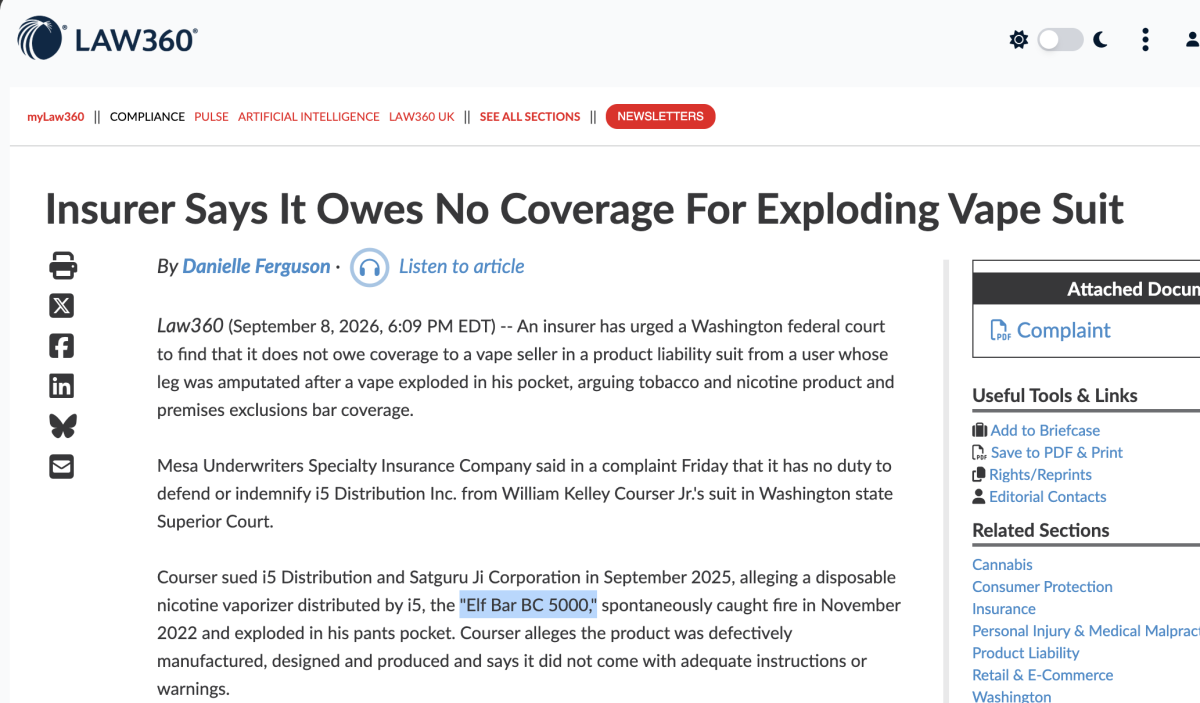
According to LAW360's report on June 1st, VPR Brands LP, a US e-cigarette company, is seeking to maintain the ban on the sale of ELFBAR and has requested the Federal Circuit Court to uphold the injunction, stating that their product is not intended for nicotine consumption and is not regulated by the FDA.
Chinese e-cigarette manufacturer, iMiracle, has filed an application with the United States Circuit Court to overturn the ban on selling products under the name "ELFBAR." They claim that this ban has resulted in losses of millions of dollars.
2FIRST interviewed ELFBAR regarding the issue. The spokesperson for ELFBAR stated that they are currently in the process of appealing, and there is no definitive ruling yet. The spokesperson further mentioned that VPR has a history of malicious litigation for profit using trademark loopholes, which they consider as a "rogue behavior." The spokesperson also pointed out that VPR's blatant imitation of ELFBAR products further exposes the suspicious motives behind their trademark litigation.
It is understood that VPR filed an appeal in October last year, claiming that ELFBAR infringed upon their "ELF" trademark. The court issued a preliminary injunction against ELFBAR in February of this year, prohibiting the use of the "ELFBAR" trademark in the United States. In May, ELFBAR discovered that VPR was engaging in commercial activities using counterfeit "ELFBAR" products in the US, leading them to bring the matter before the court.
ELFBAR has previously asserted that VPR's ELF e-cigarettes have been "illegally" sold from the beginning since the Florida-based company never obtained FDA approval for market sales.
However, in their appeal, VPR stated that ELFBAR cannot prove that VPR's ELF products are clearly illegal because only the FDA can make such determinations.
VPR claims that their ELF brand products have never been subject to FDA regulation or legal action. Furthermore, VPR states that the ELF devices are neither sold nor intended for nicotine consumption, unlike ELFBAR products that come pre-filled with "nicotine e-liquids with candy and fruit flavors."
After losing the trademark case, the "ELFBAR" brand name and appearance were counterfeited in the US. ELFBAR responded that they would take legal measures.
Based on the information obtained at the e-cigarette exhibition in the US by 2FIRST, VPR's ELF devices contain nicotine e-liquids and are disposable e-cigarettes with a striking resemblance to ELFBAR. Additionally, ELF also uses the name "ELFBAR."
VPR believes that ELFBAR relies on expert opinions to claim that VPR's products violate FDA regulations, which they consider an incorrect legal conclusion, which the court cannot accept. VPR argues that the district court correctly mistrusted the legal conclusion of the expert.
The case is awaiting a decision from the Federal Circuit Court, but there are still some pending motions from both parties.
Disclaimer
This article is provided solely for professional research, industry discussion, and informational purposes. Any references to brands, companies, products, technologies, or policies are made for factual reporting and analytical purposes only, and do not constitute endorsement, recommendation, promotion, or advertising by 2Firsts.
Nicotine-containing products, including but not limited to cigarettes, e-cigarettes, heated tobacco products, and nicotine pouches, carry significant health risks. Readers are responsible for complying with all applicable laws and regulations in their respective jurisdictions, including age restrictions and access limitations.
The information contained in this article should not be regarded as investment, legal, medical, regulatory, or commercial advice. While 2Firsts strives to ensure the accuracy and reliability of its content, it does not assume liability for any direct or indirect loss arising from errors, omissions, inaccuracies, or reliance on the information contained herein.
This article is not intended for individuals below the legal age for accessing tobacco or nicotine-related information in their jurisdiction.
Copyright Notice
This article is either original content produced by 2Firsts or content reproduced, translated, summarized, or adapted from third-party sources with attribution where applicable. The intellectual property rights of the original content remain with 2Firsts or the respective original rights holders.
No individual or organization may copy, reproduce, distribute, republish, modify, translate, or otherwise use this content without prior authorization. Any unauthorized use may result in legal action.
For copyright-related inquiries, corrections, or removal requests, please contact: info@2firsts.com.
AI-Assisted Translation and Editing Notice
Portions of this article may have been translated, edited, or reviewed with the assistance of artificial intelligence tools to improve efficiency and readability. Due to the limitations of AI-assisted translation and editing, discrepancies, omissions, or inaccuracies may exist when compared with the original source.
Where applicable, readers are advised to refer to the original source for the most complete and accurate information. If you identify any errors or believe that any content infringes upon your rights, please contact us at info@2firsts.com, and we will review and address the matter promptly.