Expansion of Smoke-Free Zones Around Schools in South Korea

Regulations by 2FIRSTS.ai
Aug.16.2024
Expansion of Smoke-Free Zones Around Schools in South Korea
South Korea's Ministry of Health and Welfare announces expansion of no-smoking zones around kindergartens, daycares, and schools to 30 meters.

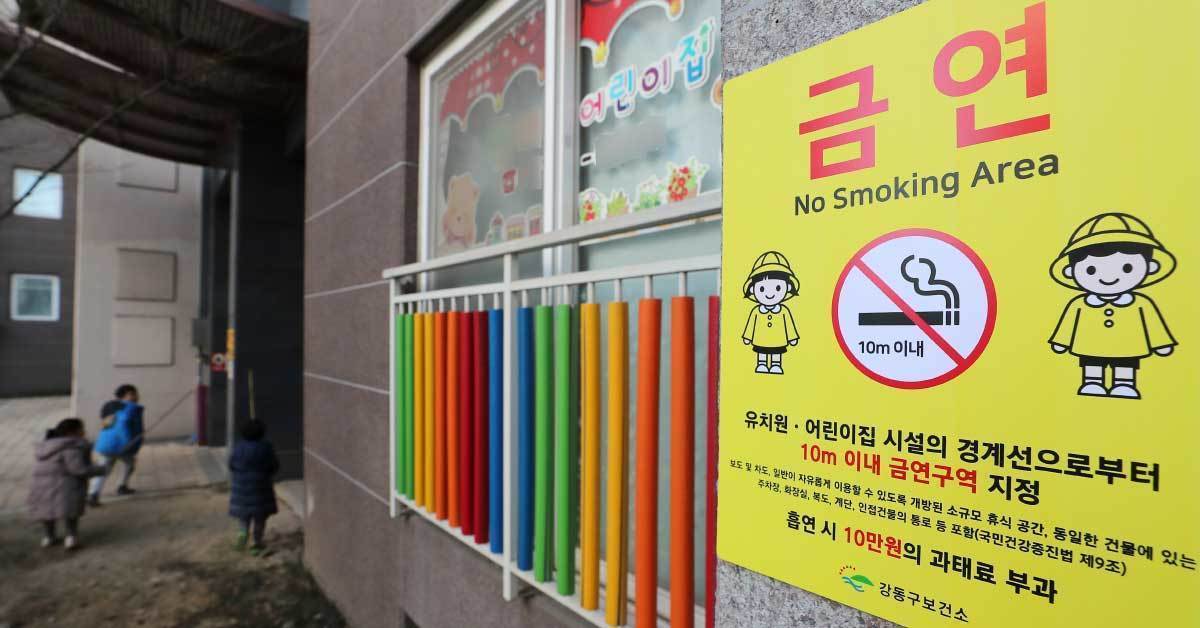
According to a report from Wikitree on August 15th, the South Korean Ministry of Health and Welfare announced that starting on the 17th, a 30-meter radius around all kindergartens, daycares, and primary and secondary schools will be designated as no-smoking zones.


The recent revision, based on the National Health Promotion Act and the Basic Act on Education, has expanded the no-smoking areas from 10 meters to 30 meters. The revised no-smoking areas now also include the areas surrounding schools, and violators will be fined 10,000 Korean won (73.63 US dollars).


Each city, county, and district government will be responsible for setting up no-smoking signs within 30 meters of the boundaries of kindergartens, daycare centers, and primary and secondary schools. The signs will be installed on building fences, walls, and sidewalks.


The expansion of smoke-free zones near educational facilities will be implemented after a one-year grace period. Starting this month, smoking at gas stations will incur fines of up to 5 million Korean won (3681.6 US dollars).


The department stated that the measure is aimed at protecting children and adolescents from the harm of secondhand smoke.


We welcome news tips, article submissions, interview requests, or comments on this piece.

Please contact us at info@2firsts.com, or reach out to Alan Zhao, CEO of 2Firsts, on LinkedIn


Notice

1.  This article is intended solely for professional research purposes related to industry, technology, and policy. Any references to brands or products are made purely for objective description and do not constitute any form of endorsement, recommendation, or promotion by 2Firsts.

2.  The use of nicotine-containing products — including, but not limited to, cigarettes, e-cigarettes, nicotine pouchand heated tobacco products — carries significant health risks. Users are responsible for complying with all applicable laws and regulations in their respective jurisdictions.

3.  This article is not intended to serve as the basis for any investment decisions or financial advice. 2Firsts assumes no direct or indirect liability for any inaccuracies or errors in the content.

4.  Access to this article is strictly prohibited for individuals below the legal age in their jurisdiction.


Copyright


This article is either an original work created by 2Firsts or a reproduction from third-party sources with proper attribution. All copyrights and usage rights belong to 2Firsts or the original content provider. Unauthorized reproduction, distribution, or any other form of unauthorized use by any individual or organization is strictly prohibited. Violators will be held legally accountable.

For copyright-related inquiries, please contact: info@2firsts.com


AI Assistance Disclaimer


This article may have been enhanced using AI tools to improve translation and editorial efficiency. However, due to technical limitations, inaccuracies may occur. Readers are encouraged to refer to the cited sources for the most accurate information.

We welcome any corrections or feedback. Please contact us at: info@2firsts.com

Product | IVG Pro 15K Enters European Retail Channels, Expanding High-Capacity Pod System Segment
UK vape brand IVG has introduced the IVG Pro 15K, a high-capacity pod system combining a 2ml prefilled pod with a 10ml refill container to deliver up to 15,000 puffs. Unlike conventional high-puff disposable vapes, the IVG Pro 15K adopts a reusable device structure, reflecting a broader shift in the European vape market toward longer-use-cycle products and reusable hardware ecosystems.
Jul.14
One Nation Proposes 50% Tobacco Excise Cut as Australia’s Illicit Market Expands
Australian One Nation leader Pauline Hanson has proposed cutting tobacco excise by 50% and freezing indexation until June 30, 2028, in a bid to lower legal cigarette prices and reduce the price advantage of the illicit tobacco market.
Jun.18
 Philip Morris Lowers Profit Outlook as Zyn Faces Competition and FDA Delays
Philip Morris Lowers Profit Outlook as Zyn Faces Competition and FDA Delays
According to Reuters, Philip Morris International (PMI) lowered its 2026 adjusted earnings-per-share forecast amid regulatory uncertainty around Zyn nicotine pouches, rising competition and shipment pressure in the U.S. market.
PMI
Jun.02
Maine Approves Vape Stewardship Bill Requiring Producers to Manage End-of-Life Devices
The Maine Legislature has passed LD 1519, a bill that would establish a producer-funded stewardship program for electronic smoking devices, requiring manufacturers and importers to manage the collection, transportation, recycling and disposal of end-of-life products, particularly disposable vapes containing lithium-ion batteries.
Jun.12
BREAKING | China’s Tobacco Regulator Summons iMiracle Over Suspected Compliance Breaches
Based on public records reviewed by 2Firsts, this is the first time China’s State Tobacco Monopoly Administration has publicly announced regulatory talks with an e-cigarette company.
Jul.29
Special Report|South Korean Lawmaker Queries China Tobacco Regulator Over Synthetic Nicotine as Export-Rule Gaps Emerge
A South Korean lawmaker has asked China’s tobacco regulator to clarify rules for e-cigarettes containing synthetic nicotine amid questions over product declarations and possible tax losses. The dispute exposes gaps between Chinese export requirements and destination-market rules, while underscoring the global impact of China’s licensing and traceability policies.
Jul.10