Just Fog Launches Ultra-Compact E-Cigarette "Copop Mini" in Korea

JTI by 2FIRSTS.ai
Apr.09.2024
Just Fog Launches Ultra-Compact E-Cigarette "Copop Mini" in Korea
JFT Corporation launches ultra-compact e-cigarette "Copop Mini" in South Korea, following success of "Copop" in the market.

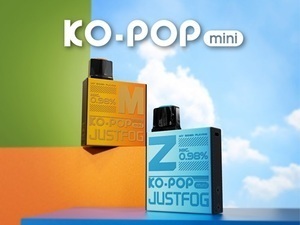
According to a report by Business Korea on April 9th, JFT Co., Ltd., the parent company of the e-cigarette brand "Just Fog," announced the launch of the ultra-compact e-cigarette "Copop Mini" in South Korea. This new product is a smaller version of the popular high-capacity disposable e-cigarette "Copop" that is currently getting the best response in the South Korean market.


The dimensions of the Copop Mini are 4.2 centimeters in length and 4.3 centimeters in width, with each e-cigarette holding a capacity of 1.95 milliliters of e-liquid, allowing users to take up to 800 puffs. The product comes in two flavors, "Weapon of Love" (strawberry and banana) and "Z Nation" (blueberry and raspberry), each containing 0.98% of natural nicotine.


On the 9th, the "Copop Mini" was officially launched for sale at the GS25 chain of convenience stores in South Korea, priced at 10,000 Korean won (7.38 US dollars).


We welcome news tips, article submissions, interview requests, or comments on this piece.

Please contact us at info@2firsts.com, or reach out to Alan Zhao, CEO of 2Firsts, on LinkedIn


Notice

1.  This article is intended solely for professional research purposes related to industry, technology, and policy. Any references to brands or products are made purely for objective description and do not constitute any form of endorsement, recommendation, or promotion by 2Firsts.

2.  The use of nicotine-containing products — including, but not limited to, cigarettes, e-cigarettes, nicotine pouchand heated tobacco products — carries significant health risks. Users are responsible for complying with all applicable laws and regulations in their respective jurisdictions.

3.  This article is not intended to serve as the basis for any investment decisions or financial advice. 2Firsts assumes no direct or indirect liability for any inaccuracies or errors in the content.

4.  Access to this article is strictly prohibited for individuals below the legal age in their jurisdiction.


Copyright


This article is either an original work created by 2Firsts or a reproduction from third-party sources with proper attribution. All copyrights and usage rights belong to 2Firsts or the original content provider. Unauthorized reproduction, distribution, or any other form of unauthorized use by any individual or organization is strictly prohibited. Violators will be held legally accountable.

For copyright-related inquiries, please contact: info@2firsts.com


AI Assistance Disclaimer


This article may have been enhanced using AI tools to improve translation and editorial efficiency. However, due to technical limitations, inaccuracies may occur. Readers are encouraged to refer to the cited sources for the most accurate information.

We welcome any corrections or feedback. Please contact us at: info@2firsts.com

The Volume Illusion: Measuring the Future of Nicotine with the Tools of the Past
As next-generation nicotine products become economically central rather than marginal, traditional volume-based metrics are increasingly unable to explain consumption, risk, and value. Units designed for a cigarette-based economy struggle to describe systems defined by delivery speed, pharmacokinetics, and adaptive user behavior. Drawing on financial reporting, regulation, and nicotine science, a fundamental question: can the future of nicotine still be measured using the tools of its past?
Feb.09 by Alan Zhao | 2Firsts Perspectives
Study: Links between internalizing mental health symptoms and nicotine/tobacco use vary by gender identity among U.S. adolescents
A study using 2020–2023 U.S. data from the ITC Youth Tobacco and Vaping Survey (ages 16–19) reports that both nicotine/tobacco use and internalizing mental health (IMH) symptoms vary across disaggregated gender identities, and that gender identity moderates the relationship between IMH symptoms and product use.
Feb.27 by 2FIRSTS.ai
New Zealand Vape Company Alt Becomes Government Partner After Suing Over Nicotine Limits
Health NZ signed a NZD 500,000 contract with New Zealand-owned vape company Alt NZ Limited in December 2025 for its free vape kit programme for smokers, with more than 7,000 kits distributed so far.
Mar.23 by 2FIRSTS.ai
STG UK refreshes XQS nicotine pouch packaging: new flavour indicators, hitting retail from March
Scandinavian Tobacco Group UK (STG UK) has announced a rebrand across its XQS nicotine pouch range. The updated packaging will be visible at retail from March, with the recommended retail price remaining £5.50. The new packs feature a bolder logo and glossy textures, retain nicotine strength indicators, and add a side flavour profile indicator to show the flavour type.
Feb.28 by 2FIRSTS.ai
Thailand’s DDC Files Complaint Over Online Sales of Nicotine Pouches
Thailand’s Department of Disease Control has lodged a complaint over the alleged online sale of nicotine pouches. The department said its monitoring found the products were being advertised and sold through electronic media, and a further inquiry later identified a physical shop linked to a store in Pathum Thani province.
Mar.23 by 2FIRSTS.ai
FDA Commissioner Stresses “Predictability” as Science Chief Addresses Industry Uncertainty
FDA Commissioner Marty Makary briefly appeared at the February 10 PMTA roundtable, underscoring the importance of regulatory predictability. At the close of the session, Office of Science Director Matthew Farrelly responded to industry concerns over review uncertainty, stating the agency will issue a written summary of feedback, while reiterating that no fixed quantitative risk benchmark governs authorization decisions.
Feb.11