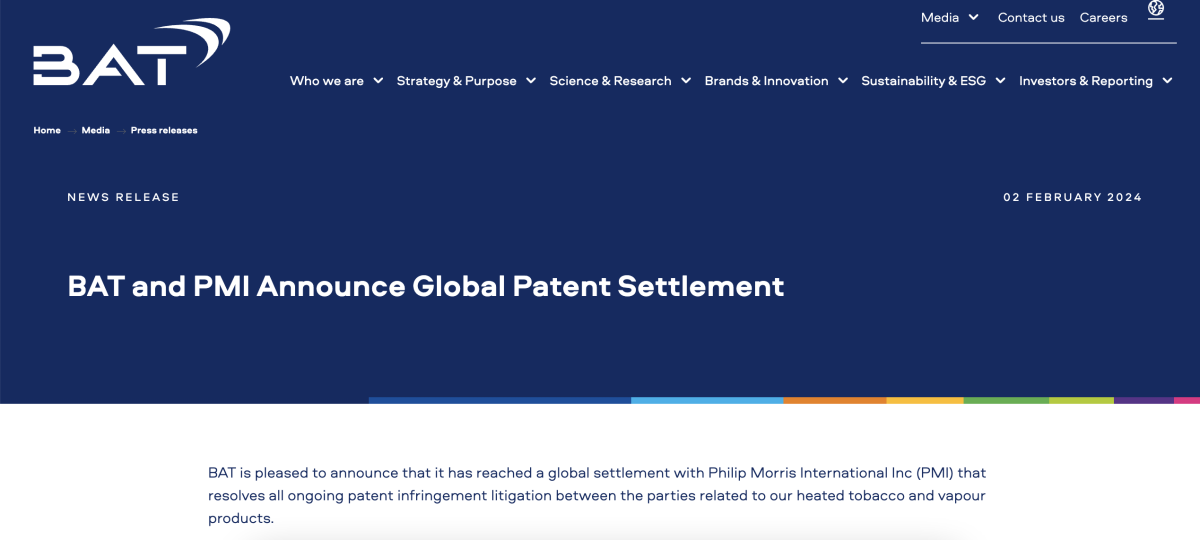
On February 2nd, in the Eastern Time Zone of the United States, both Philip Morris International (PMI) and British American Tobacco (BAT) announced on their respective official websites that they have resolved their intellectual property dispute regarding heated tobacco and e-cigarette products.
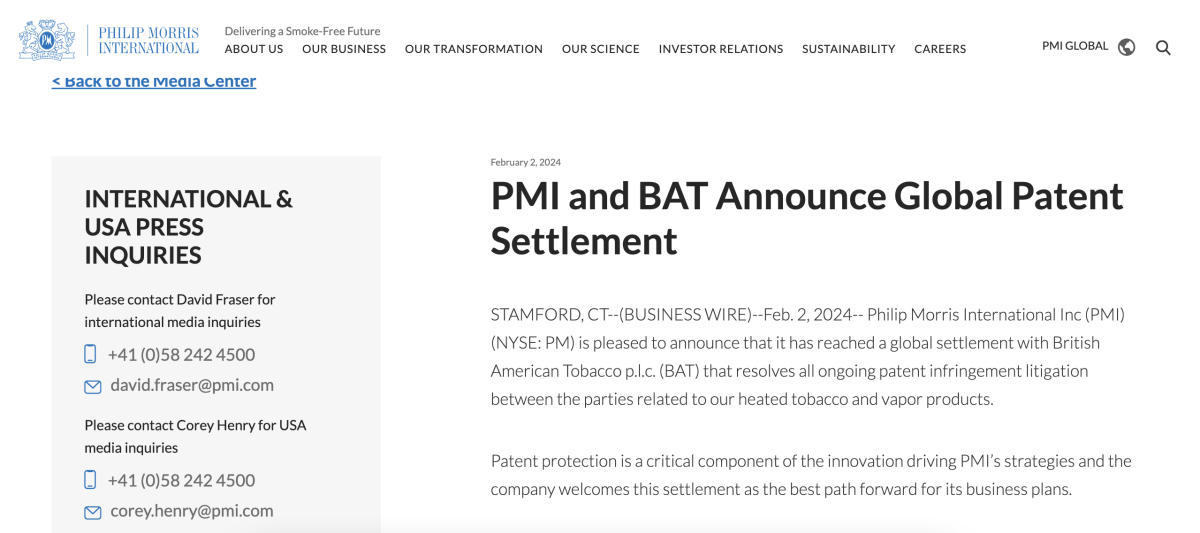
British American Tobacco (BAT) and Philip Morris International (PMI) have announced a settlement agreement that includes non-monetary terms between the two companies. This agreement resolves all ongoing global patent infringement lawsuits, including any related injunctions and exclusions, and prevents future claims against current heated tobacco and vaping products. The settlement also allows both parties to continue innovating and launching improved versions of their products. Both companies are committed to ongoing innovation in the reduced-risk product space, furthering efforts to reduce the harm caused by tobacco.
These two international tobacco companies have been embroiled in a multifaceted patent war. BAT's e-cigarette brand VUSE and heat-not-burn tobacco device brand GLO suffered a defeat in one case, being ordered to pay millions of dollars; while PMI was prohibited from introducing its flagship heat-not-burn tobacco device IQOS into the United States due to another lawsuit.
PMI CEO, Jacek Olczak, expressed satisfaction with the resolution, stating, "We are pleased that both parties are content with the outcome. Adult smokers worldwide consistently display a desire for a range of smoke-free products, and we believe that continued innovation in reduced-risk alternatives can expedite the reduction of smoking-related harms, benefiting consumers and public health as a whole. Meanwhile, we will remain committed to phasing out the sale of traditional cigarettes as part of PMI's journey.
BAT CEO Tadeu Marroco has expressed his satisfaction with the recent agreement, stating, "This agreement is a significant step forward for BAT and all our stakeholders. With the successful development of our billion-pound brands VUSE and GLO, the potential for reducing tobacco harm is evident. I am pleased that this settlement will allow BAT to focus on developing innovative solutions to provide adult consumers with reduced-risk products and contribute to our 'A Better Tomorrow' mission. By doing so, we will help build a smoke-free world for consumers, investors, and society as a whole."
2FIRSTS has invited Chinese e-cigarette legal expert Counsellor Tang Shunliang to provide a professional analysis of the background and potential impact of the patent settlement between PMI and BAT. An article providing this analysis will be published later. Stay tuned.
We welcome news tips, article submissions, interview requests, or comments on this piece.
Please contact us at info@2firsts.com, or reach out to Alan Zhao, CEO of 2Firsts, on LinkedIn
Notice
1. This article is intended solely for professional research purposes related to industry, technology, and policy. Any references to brands or products are made purely for objective description and do not constitute any form of endorsement, recommendation, or promotion by 2Firsts.
2. The use of nicotine-containing products — including, but not limited to, cigarettes, e-cigarettes, nicotine pouchand heated tobacco products — carries significant health risks. Users are responsible for complying with all applicable laws and regulations in their respective jurisdictions.
3. This article is not intended to serve as the basis for any investment decisions or financial advice. 2Firsts assumes no direct or indirect liability for any inaccuracies or errors in the content.
4. Access to this article is strictly prohibited for individuals below the legal age in their jurisdiction.
Copyright
This article is either an original work created by 2Firsts or a reproduction from third-party sources with proper attribution. All copyrights and usage rights belong to 2Firsts or the original content provider. Unauthorized reproduction, distribution, or any other form of unauthorized use by any individual or organization is strictly prohibited. Violators will be held legally accountable.
For copyright-related inquiries, please contact: info@2firsts.com
AI Assistance Disclaimer
This article may have been enhanced using AI tools to improve translation and editorial efficiency. However, due to technical limitations, inaccuracies may occur. Readers are encouraged to refer to the cited sources for the most accurate information.
We welcome any corrections or feedback. Please contact us at: info@2firsts.com